
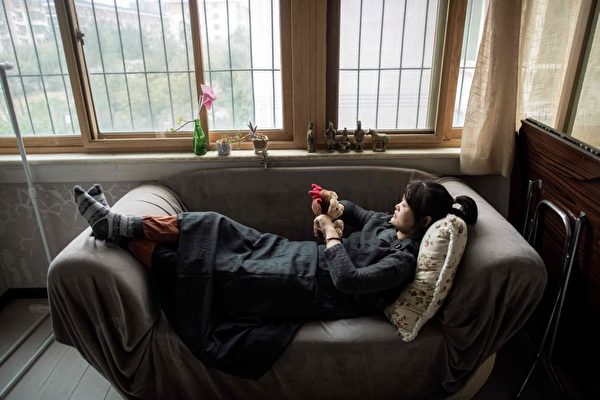
The youth unemployment rate in China continues to rise, leading to an increasing number of young people facing the prospect of unemployment upon graduation, resorting to living with their parents or settling for low-paying jobs, resulting in what is now being termed as “failed generation”. In contrast to the traditional “leeching off parents” where individuals rely explicitly on their parents’ support without working, a new form of dependency known as “new leeching off parents” is gaining popularity among those who are employed and even have a decent income, sparking controversy.
Recently, a viral account of a young unemployed woman from Yunnan province has sparked heated discussions online. Her annual expenditure amounted to only 2858 yuan (Chinese Renminbi), less than 8 yuan per day, as she lived with her parents without asking them for money.
Critics argue that while her parents cover expenses such as housing, utilities, and meals, every penny she saves is essentially shifting the burden of living costs onto her parents. This is deemed as a form of “new leeching off parents”. However, some netizens argue that this does not qualify as leeching off parents since the woman does not ask her parents for money, at most she’s just using the resources available at home.
Supporters of the woman argue that true leeching off parents involves emptying parents’ lifelong savings to pay for down payments, needing parental support even after getting married and having children, while this unemployed young woman spends only 2858 yuan a year without asking her family for any money.
Several Chinese media outlets have reproduced related videos highlighting this issue.
There has been a significant amount of discussion on social media platforms in China regarding the topic of “new leeching off parents”.
Netizens express various opinions such as, “If parents feel anxious and worn out, they should adjust their own mindset,” “As long as one is not stealing, mooching off taxpayer resources, how one chooses to live should be respected,” “Why do some people have money to spend without working, while others aspire for such a lifestyle?”, “Our social security system is failing us, please save us,” “In other words, parents need care in old age, and the country needs people to contribute economically.”
However, some netizens argue that with the current job market scenario and low-income opportunities, it is natural for many young people to feel inclined towards dependency on their parents. The issue of dependence on parents is considered a mutual concern.
A self-media blogger suggests that the situation of young people choosing to depend on their parents temporarily does not necessarily equate to laziness or avoidance. It could be due to difficulties in finding job opportunities, repeated failure in interviews, sudden job layoffs, or constant obstacles in seeking stable employment positions.
One netizen on Weibo summarized the key differences between the new form of leeching off parents and the traditional one: Traditional leeching off parents involves not working, living off parents at home and blatantly relying on parental support, while the new leeching off parents do not lie around at home or ask for money directly, maintaining a respectable appearance while silently consuming their parents’ money, time, and energy. The newer dependency group typically holds jobs and may even have a decent income, with several common manifestations:
1. Parenting neglectors: Young couples work, leaving child-rearing responsibilities such as daily care, medical visits, and pickups entirely to their parents, essentially free-loading off their parents and exhausting their physical and mental strength.
2. Property buyers/support-seekers: Having parents utilize their retirement savings to pay down payments and subsidize mortgage payments, depleting the older generation’s retirement funds.
3. Long-term exam takers/support: Using exam preparation as an excuse for prolonged unemployment, relying on parents for food and shelter, lacking planning for years on end without setting deadlines for exam results.
4. Full-time children: Some young people return home to care for their parents in exchange for family financial support; viewed by some as a paid form of filial piety, while others categorize it as a new form of leeching off parents, resulting in significant debate.
One blogger highlighted that the entire society is currently in a state of dependency on parents. The age at which young people achieve true economic independence after graduation is progressively getting later. Economic independence implies being able to afford one’s basic needs, occasionally socialize with friends, and pursue hobbies, and young people achieving this are considered accomplished. A decade ago, fresh graduates could generally achieve this by the age of 22 or 23, but presently, it has become extremely arduous for recent graduates in their early twenties.
According to data released by the Chinese Ministry of Education, the expected number of graduates from ordinary higher education institutions in 2026 is projected to reach 12.7 million, an increase of approximately 480,000 from the previous year, setting a new record high. When considering those from previous years who remain unemployed and returning overseas students, the overall number of job seekers is even more substantial.
In August, China’s youth unemployment rate climbed to 18.9%, hitting a new high in a year.
Chinese capital market expert Xu Zhen previously stated to Daijiworld that “Due to adjustments made in the statistical approach by the Chinese government, the youth unemployment rate only covers urban actively job-seeking labor force. Insufficient employment, low wages, and unsecured jobs are still counted as employment, and a large number of youth who choose to lie low, rely on parents, or continue their education are not considered unemployed. Hidden unemployment among rural labor force is also not within the statistical scope. Therefore, the official youth unemployment rate is somewhat embellished.”
University graduates in China face the daunting task of seeking job opportunities in a competitive job market, leading to a growing sense of pessimism among young Chinese individuals regarding their future. They are confronted with difficult dilemmas: settling for low-paying jobs, relying on their parents to survive as “failed generations”, or simply opting to do nothing.
“Failed generation” is a term that has gained traction on Chinese online platforms in recent years, drawing a parallel to “unfinished buildings” in real estate, symbolizing young people who have invested years of study and resources from their parents but end up facing unemployment upon graduation, being forced to rely on their parents or accept low-paying jobs, thus stagnating in life much like incomplete structures.
On October 5th, an article titled “In Shanghai, there are increasingly more failed young people” published on a public platform resonated with urban Chinese youth. The article mentioned the story of Nannan, born in 1992, who used to work at ByteDance, calculating every day how much money she could save to meet the down payment for a house, with a goal of getting married and having children before turning 30. However, she was quoted as saying: “My life is a failure. The down payment was lost due to investment, I quit my job almost six months ago, and now I spend every day at home gardening.”
Recent years have seen young people sharing their “retired” life in rural areas, claiming to have been laid off, resigned, or simply not having a job. These self-proclaimed “retirees” among young people have either taken extended breaks or are unemployed.
Chinese issue expert Li Linyi stated that currently, Chinese youth often exhibit feelings of helplessness rather than anger when faced with challenges. Many parents still financially support their children, helping to alleviate some of the financial burden. However, the increasing sense of disappointment and disillusionment among the youth could potentially pose greater social risks. If such emotions aggregate and transform into collective discontent, it could evolve into a more challenging social upheaval against the Chinese authorities.