
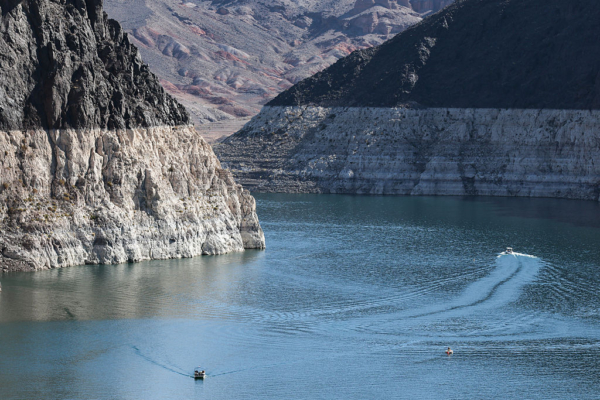
As the drought continues in western states, the water level of Lake Mead, which is the largest reservoir in the United States based on storage capacity, has dropped to its lowest recorded level.
According to data from the Bureau of Reclamation, on August 6, the water level of Lake Mead dropped to 1,040.50 feet (about 317.15 meters) above sea level, which is lower than the previous record low of 1,040.58 feet (about 317.17 meters) set in July 2022. At that time, Lake Mead reached this low point for the first time after years of drought.
Hoover Dam, located at the border of Nevada and Arizona on the Colorado River, forms Lake Mead, providing water for around 40 million people in seven western states and parts of Mexico. Additionally, Lake Mead also generates hydroelectric power for users in California, Arizona, and Nevada. However, as the water level continues to decline, the power generation capacity is also under threat.
The Colorado River basin has been experiencing a “megadrought” for over twenty years. In 1999, Lake Mead was near full capacity, but by 2022, following the driest period in history in many western areas, the reservoir had dropped by nearly 176 feet (about 53.6 meters).
In 2021, when the water level of Lake Mead first fell below 1,075 feet (327.7 meters), federal officials declared a Tier 1 water shortage. As the water level further decreased, authorities implemented more significant water reduction measures.
Furthermore, Hoover Dam also produces several gigawatt-hours of electricity every year.
On August 6, the water level at Glen Canyon Dam, which forms Lake Powell, located at Lake Mead’s sister reservoir, was 3,521 feet (1,073.2 meters), a drop of nearly 33 feet (10.06 meters) from a year ago. When the water level falls below 3,490 feet (1,063.75 meters), hydroelectric power generation becomes impractical. Currently, despite the water levels being far below the levels required for reliable power generation and water storage, both reservoirs are still operating for power generation.
Lake Mead National Recreation Area attracts millions of visitors each year engaging in various activities such as boating, fishing, and hiking. Due to the declining water levels, some submerged landscapes have resurfaced, such as the ruins of St. Thomas. Additionally, there is a World War II-era B-29 bomber submerged in the lake, which crashed and sank into the lake almost seventy years ago.