
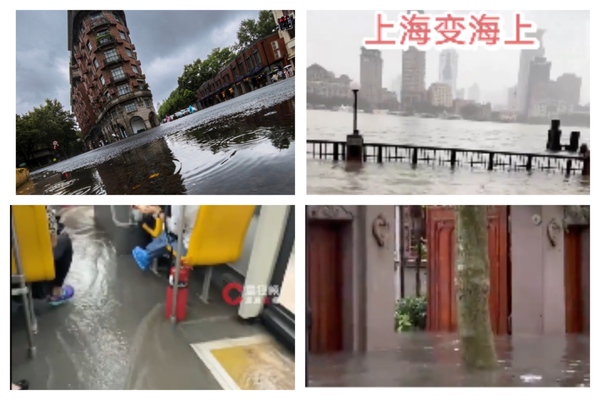
The thirteenth typhoon of the year, “White Dolphin,” swept across eastern China, hitting Zhejiang, Jiangsu, Shanghai, and other areas with heavy rain. Multiple regions issued red alerts for heavy rain. Shanghai witnessed rare heavy rainfall, breaking a 154-year observation record with precipitation levels unseen since records began in 1873. On August 10th, many areas in the city experienced severe flooding, giving rise to scenes reminiscent of “Shanghai turned into a sea.”
Affected by Typhoon “White Dolphin,” Shanghai experienced continuous heavy rainfall from August 9th to 10th. At 10:30 am on August 9th, the Shanghai Central Meteorological Observatory upgraded the heavy rain warning in the central urban area from orange to red. This marked the first issuance of a red alert for heavy rain in the central urban area of Shanghai in 13 years since Typhoon “Fitow” in 2013. As of the 10th, Jinshan District remained under a red alert for heavy rain, while the central urban area was under an orange alert.
From 8:00 on the 9th to 8:00 on the 10th, the Xujiahui National Meteorological Station in Shanghai recorded a 24-hour rainfall of 316.1 millimeters, setting a new record for the highest daily rainfall since the station was established in 1873. This extreme precipitation led to severe urban waterlogging.
By 5:00 pm on the 9th, a total of 215,600 people had been relocated to safe areas across Shanghai.
Due to the impact, on August 9th, Shanghai’s two major airports canceled a total of 1,384 flights, with Pudong Airport canceling 871 flights and Hongqiao Airport canceling 513 flights, resulting in nearly 60% of flights being reduced or canceled. On the 10th, the two airports canceled 943 flights, with Pudong Airport canceling 642 flights and Hongqiao Airport canceling 301 flights.
In Wuxi, a woman who was scheduled to fly to Urumqi from Shanghai at 7:50 pm on the night of the 10th told reporters, “I didn’t make it to Shanghai Pudong Airport because I was trapped at home. The area around our community was flooded, and we couldn’t get out. I waited from noon until 5 pm before they finally sent the flight cancellation message. The airline didn’t release the cancellation information earlier, which made me anxious. I ended up canceling my ticket.”
She further explained that Wuxi was severely flooded, stating, “It’s very serious. Wuxi had the highest rainfall in the country today. Many places were flooded, with water levels above knee-high. My home is on a higher floor, so it’s safe, but many households were flooded. I stayed indoors, and the weather was stormy all day.”
According to data from the China Weather Network, as of 9:00 am on the 10th, Wuxi ranked first in the country with a recorded rainfall of 53.3 millimeters among 2,569 national meteorological observation stations.
Another woman, who was returning from Singapore to Lanzhou and was scheduled to transfer through Shanghai on the 9th, revealed, “I landed in Lanzhou after 10 pm. Most flights from yesterday (9th) to today (10th) were canceled. I was supposed to fly to Lanzhou on the 9th, but the flight was canceled half an hour before takeoff. They said they couldn’t inform us earlier due to weather delays, and accommodation had already been arranged for those affected.”
The woman mentioned that the departure time was rescheduled to 11:40 am on the 10th, but there were multiple time changes before finally boarding around 4 pm. “We thought we were finally going to take off, but after waiting for over an hour on the plane, they said they couldn’t identify the aircraft issue and needed to change planes. The boarding gate was changed again, we switched planes, and eventually took off after 6 pm, landing around 9:30 pm. It was a very tumultuous day, encountering various challenges.”
The impact of Typhoon “White Dolphin” in the city center of Shanghai caused significant flooding in multiple areas. On August 10th, the Shanghai Flood Control Command and Meteorological Bureau issued a warning for the risk of urban flooding.
Continuous rainfall has led to water accumulation on some roads in Shanghai, prompting speed limits on several highways, including G15 Shenhai Expressway Songjiang section, G1503 Ring Expressway Qingpu section, and Songjiang section. Several subway lines were suspended, shortened, or had reduced speeds, all water passenger transportation was halted, and residents were encouraged to work from home.
The heavy rain also resulted in unusual sights at Shanghai’s famous landmarks. The popular Wukang Road area was heavily flooded, with the renowned Wukang Building surrounded by water, resembling a giant cruise ship floating on the surface. Not only Wukang Road but other areas of Shanghai also reported severe flooding, with some city roads turning into temporary rivers.
According to reports by the online short video news and media outlet “Giant Flow Video,” a shop owner in Shanghai lamented that her second-hand luxury goods store was flooded, incurring losses totaling at least 1 million Chinese yuan. She revealed that some high-end jewelry was swept away by the floodwaters directly, while luxury handbags that couldn’t be moved in time were waterlogged, damaged, and could only be sold at a discount or might not sell at all. The shop, which had undergone renovations just last year, now had all cabinets and floors damaged by the water.
On August 10th, the topic labeled “Shanghai turned into a sea” trended on Weibo.
Netizens commented, “Shanghai really became a seaside. I didn’t expect Shanghai to be the hardest hit by ‘White Dolphin.'” “Shanghai has turned into a sea; it’s the first time I’ve seen Wukang Road like this.” “Typhoon ‘White Dolphin’ hitting Shanghai turned the city into an ocean; going to work feels like going to sea.” “Shanghai has been completely flooded in many areas. Even worse news, ‘White Dolphin’ seems to be ‘stalling’… we might have this weather for the next week.”
According to the China Weather Network, from 8:00 on the 9th to 8:00 on the 10th, in terms of rainfall rankings among national stations, Wenling, Zhejiang, topped with 425 millimeters, followed by Sanmen, Zhejiang (367.8 millimeters), and Xujiahui, Shanghai (316.1 millimeters), all exceeding 300 millimeters, indicating intense rainfall. Looking at regional stations, 17 stations in Zhejiang recorded rainfall over 500 millimeters, with the highest precipitation in Zantou Village, Zhejiang, reaching 648.3 millimeters within 24 hours.
Among national meteorological stations, Xujiahui, Shanghai, recorded 316.1 millimeters; Wenling, Zhejiang, recorded 425 millimeters; Sanmen, Zhejiang, recorded 367.8 millimeters; Taizhou, Zhejiang, recorded 299 millimeters; Linhai, Zhejiang, recorded 283.9 millimeters; Yongjia, Zhejiang, recorded 268.6 millimeters; Ninghai, Zhejiang, recorded 259 millimeters, with a total of 7 stations experiencing extremely heavy rainfall.
In Wenzhou, Zhejiang, and Jinxiang, Zhejiang, as well as Xujiahui, Shanghai, Pudong, Shanghai, and Qingpu, Shanghai, these six stations broke records for the strongest single-day precipitation since 1951. Additionally, 15 locations in Shanghai and Zhejiang surpassed the record for the largest single-day rainfall for the same period in August.
As reported by Lizhi News, on the night of August 9th, in Sanmen County, Taizhou, Zhejiang, a supermarket was flooded due to the heavy rain brought by Typhoon “White Dolphin,” leading to the loss of goods washed away in the floodwaters.
The 58-year-old shop owner, Mr. Xu, described it as the largest-scale flood he had ever experienced, with over 200 square meters of the supermarket interior submerged up to sixty to seventy centimeters deep. The combination of torrential rain and flooding from passing large vehicles caused two roller shutter doors to break and significant water ingress. Due to the rapid rise in water levels, goods and items on the lower shelves and refrigerators were inundated and unsellable, requiring disposal, while both entrance doors were destroyed. Initial estimates put the losses at tens of thousands of yuan, with the exact amount still being calculated. Mr. Xu was cleaning up until three-thirty in the morning, resting for just one to two hours, and the supermarket was unable to operate normally at present.
On August 10th, influenced by Typhoon “White Dolphin,” meteorological departments in Fengtai District, Beijing, Jinshan District, Shanghai, Kunshan City, Jiangsu, Linhai City, Zhejiang, and other areas issued red alerts for heavy rain.
On that day, Chief Forecaster Zhang Fanghua from the National Meteorological Center predicted that from the night of August 10th to the 12th, there would be relatively strong rainfall in northern Zhejiang, Jiangsu, Anhui, Hubei, Henan, Shandong, Shanxi, southern Hebei, southern Beijing, and other areas.