
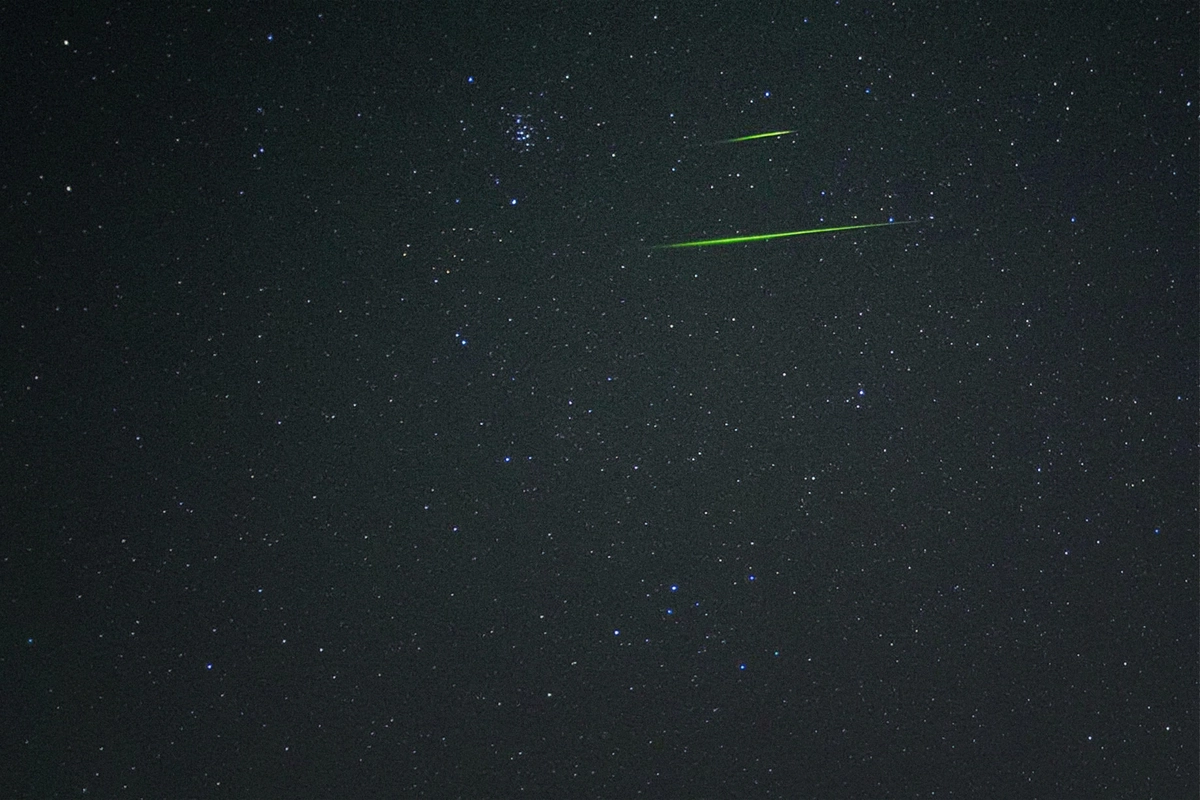
On the morning predicted by experts for the arrival of a meteor shower, Eliot Herman made sure that his backyard in Tucson, Arizona, was perfectly prepared. Although he himself wasn’t waiting outdoors in the chilly autumn air, a row of automated wide-angle cameras was diligently capturing the clear desert night sky. He was on the lookout for the Leonids – a meteor shower that occurs every November and can sometimes unleash stunning meteor storms every few decades.
“The Leonid meteor shower always appears in the early morning before dawn,” he mentioned in an interview. He also pointed out that among the many meteors he has seen, the Leonids are the “greenest.” A testament to his experience, as he has observed quite a number of meteors over the years.
This year, astronomers anticipate that from November 6 to 30, the Leonids will enter the Earth’s atmosphere, peaking around the early hours of November 17 to 18. While current predictions do not indicate a massive meteor storm for 2026, scientists have been caught by surprise before by the performance of the Leonids.
The Leonid meteor shower is considered one of the most exciting meteor showers of the year. Typically, around 10 to 15 meteors are visible per hour, which is not an overwhelming number. However, these meteors travel at incredibly high speeds and often display vibrant colors. The shower is also renowned for its periodic outbursts of meteors approximately every 33 years, during which observers have witnessed thousands of fireballs cascading down like rain from the sky.
A few years ago during a meteor shower season, Herman set up his camera equipment in his backyard in anticipation. However, that night did not yield a meteor storm, yet he still managed to capture several meteors. The last significant Leonid meteor storm occurred in 2001, but it paled in comparison to the mesmerizing displays documented in the past few decades. One remarkable night in mid-November 1966, stargazers in the United States witnessed thousands of meteors falling from the sky at a rate of several per minute within just 15 minutes. This stunning scene mirrored the astronomical phenomenon of the “Night of the Falling Stars” in 1833, during which more than 100,000 meteors per hour lit up the sky. Such magnificent displays evoke a profound sense of our planet traversing through the vast cosmos.
The bright streaks that whip across the sky are produced by dust and debris from comets or asteroids colliding with the Earth’s atmosphere. These cosmic particles travel in a broad stream along the orbit of their parent body, producing meteor showers when our planet periodically passes through these streams. As these particles enter the atmosphere at speeds reaching up to 45 miles per second (approximately 72 km/s), they burn up and emit a glow that resembles bright beams of light.
Interestingly, all these meteors travel along parallel paths, advancing along the trajectory left behind by their parent comet long ago. Yet, when we look in the direction from which they seem to arise, they appear to radiate outward from a single point in space. Astronomers refer to this point as the “radiant.” The Leonid meteor shower appears to emanate from a point within the constellation Leo, thus acquiring its name.
However, there is no actual connection between the meteors and the constellation of Leo, as this constellation lies hundreds of light-years away from Earth. The Leonids merely seem to converge at that distant point while their actual origin is a comet that completes an orbit around the Sun every 33 years. The meteoric debris is released from comet 55P/Tempel-Tuttle, a relatively small comet with a nucleus measuring approximately 2.24 miles in diameter. As it approaches the Sun, the frozen material on its surface gradually sheds, releasing a significant amount of particles and leaving behind an extensive and complex trail of debris stretching millions of miles in space.
Traditionally, whenever the Tempel-Tuttle comet returns, the Leonid meteor shower tends to exhibit significant outbursts, but this does not always happen, and the public has been disappointed more than once. The comet is expected to return again in 2031.
The geometric relationship in space determines how we observe the Leonid meteor shower from Earth. The best practice is to view as much of the sky as possible rather than merely fixating on the radiant point. As meteors streak across the sky from the radiant, they will exhibit longer trails; however, near Leo, they might only appear as brief flashes or not at all. This phenomenon is caused by a visual effect known as “perspective shortening.” Thus, it is advisable to set up a comfortable reclining chair with a blanket to relax and enjoy the show. For those wanting to capture the meteor shower like Herman, using a wide-angle lens can help encompass more of the night sky, as meteors can appear anywhere in the sky.
One of the largest hindrances to observing meteors is the moon. Whether it is a full moon, a waxing gibbous, a waning crescent, or a new moon, moonlight can drown out the brilliance of meteors crossing the night sky, thereby reducing the number visible to the naked eye. Fortuitously, as the radiant of the Leonid shower rises, it coincides with the setting of the first quarter moon. The constellation Leo will reach its highest position in the sky around 4 to 6 a.m. local time, allowing observers to search for meteors in the larger expanse of the sky surrounding the constellation. Nonetheless, any time after midnight is worth watching.
Finding a location that is open to the sky and dimly lit is essential. The ideal scenario would be to reside far from city lights. Alternatively, seek out a spot with minimal light pollution. Naturally, one unpredictable factor is the weather, as cloudy skies can hinder visibility.
For those unable to escape the moonlight while observing the Leonid meteor shower, astrophotographer Herman suggests embracing the situation. Including the moon in your frame might not detract from the beauty of your composition; on the contrary, it could still capture a few meteors in your photograph.
As anticipation builds for this year’s Leonid meteor shower, enthusiasts should prepare to witness a captivating display in the night sky, filled with the wonder of astral phenomena.