
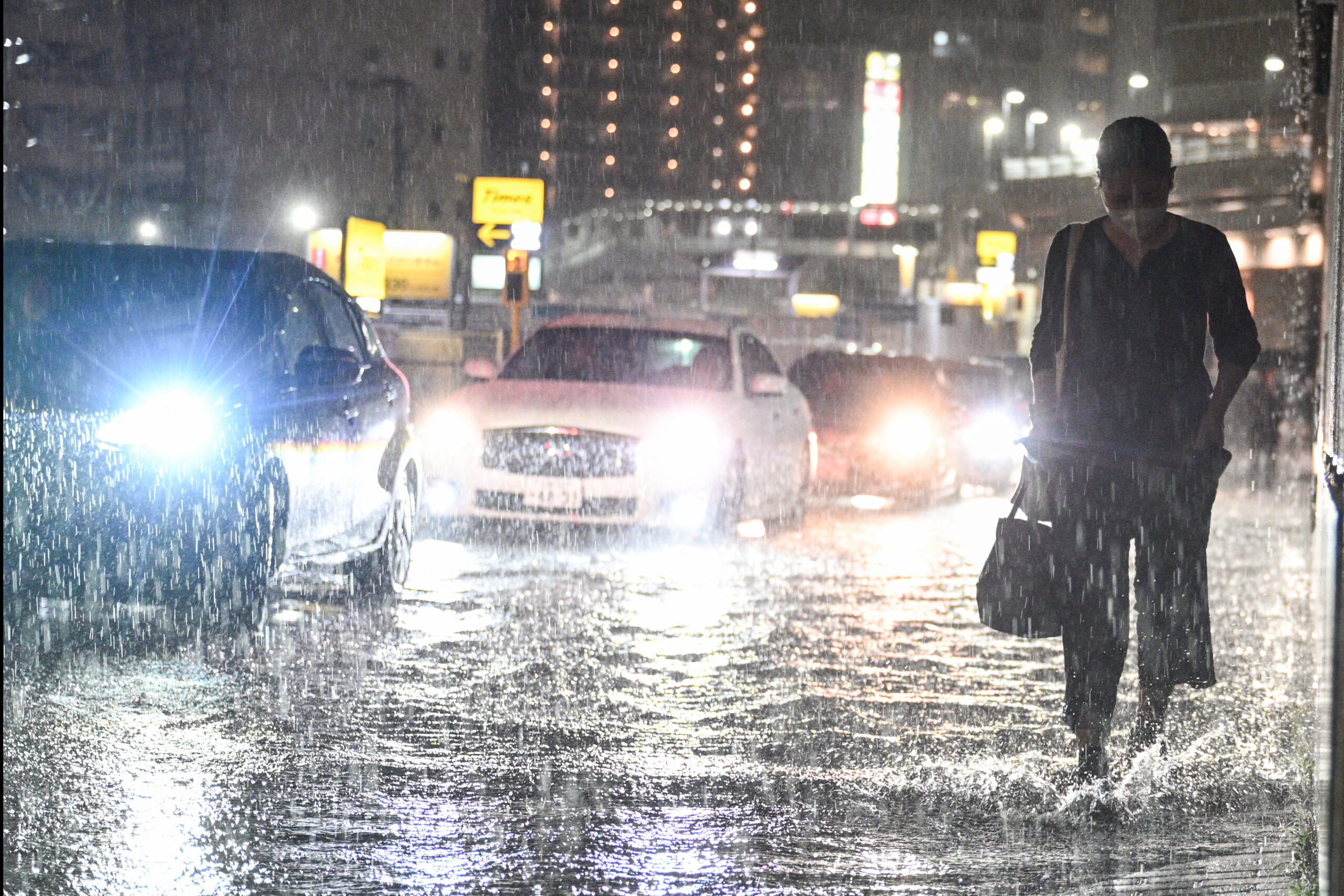
Japan’s Chiba Prefecture was hit by record-breaking heavy rain on Thursday, August 13, with the Japan Meteorological Agency issuing the highest-level “Level 5 Heavy Rain Special Warning” for multiple areas in Chiba. The torrential rain severely disrupted transportation networks, causing rail and bus services connecting Narita Airport to central Tokyo to come to a complete halt. Large numbers of passengers were stranded at the terminals, prompting the airport to urgently prepare food, drinking water, and sleeping bags in response.
According to reports from the Yomiuri Shimbun and the Asahi Shimbun, the heavy rain began affecting transportation in Chiba Prefecture rapidly from Thursday afternoon. Rail services linking Narita Airport and central Tokyo were gradually suspended, leading to a gathering of numerous passengers unable to board trains in front of the airport ticket gates.
Narita International Airport Corporation stated that as of 8:30 p.m. (7:30 a.m. Eastern Time), both buses and trains from the airport to central Tokyo had completely ceased operations, leaving arriving passengers stranded with a large crowd stuck inside the terminals.
To avoid further chaos, the airport continued to broadcast announcements requesting passengers not to proceed to the underground 1st floor stations of Terminals 1 and 2. Considering the possibility of continued transportation disruptions, the airport authorities began preparations to provide food, drinking water, and sleeping bags to stranded passengers.
Many “airport refugees” were reported on social media, with numerous tourists visiting Japan sharing their experiences of being trapped at the airport and having to make do for the night, awaiting the gradual resumption of transportation.
As of 9:20 p.m., JR East announced that sections of the Sobu Line, Keiyo Line, Kururi Line, Uchibo Line, Sotobo Line, and Narita Line were temporarily suspended. On the Keisei Electric Railway side, the Keisei Main Line, Narita Sky Access Line, Chiba Line, and Chiharadai Line were also not in service.
Urban transportation was similarly severely impacted. In Chiba’s Chuo Ward, near the Chiba Chuo Station on the Keisei Line, flooding was reported under a viaduct, with a sedan becoming trapped in the water. The city of Kashiwa also received numerous reports of flooded roads, making some sections impassable.
In Kashiwa, a car got trapped due to flooded roads, with a woman trapped inside the vehicle, already in a state of cardiac arrest when being taken to the hospital. In Ichikawa City, a man was found unconscious on a road and was confirmed dead after being taken to the hospital.
The heavy rain also caused widespread power outages. Tokyo Electric Power Company reported that as of 9:30 p.m., approximately 46,550 households in Chiba Prefecture were without electricity, with the situation being most severe in Chiba’s Chuo Ward, where over 34,000 households were affected.
The Japan Meteorological Agency indicated that by late evening, the hourly rainfall in Chuo Ward of Chiba City reached 115 millimeters, while Sakura City recorded 97 millimeters, Funabashi City 62 millimeters, and Abiko City 61 millimeters, all setting new local observation records. Since the introduction of the new disaster prevention meteorological information in May this year, the Meteorological Agency issued the “Level 5 Heavy Rain Special Warning” for Chiba Prefecture for the first time, covering 18 cities including Chiba City and Ichihara City by 10:15 p.m.
In addition to flooding, some areas also experienced landslides. Chiba City and Ichihara City were issued a “Level 5 Landslide Special Warning,” while reports of landslides were received in Ichikawa City, Sakura City, and Abiko City.
The Japan Meteorological Agency warned that the unstable atmospheric conditions in the Kanto region are expected to continue until the 14th, with the possibility of further heavy rain reaching warning levels. Railways, highways, and other modes of transportation may continue to be affected in the aftermath.
(Translated from 中央社)