
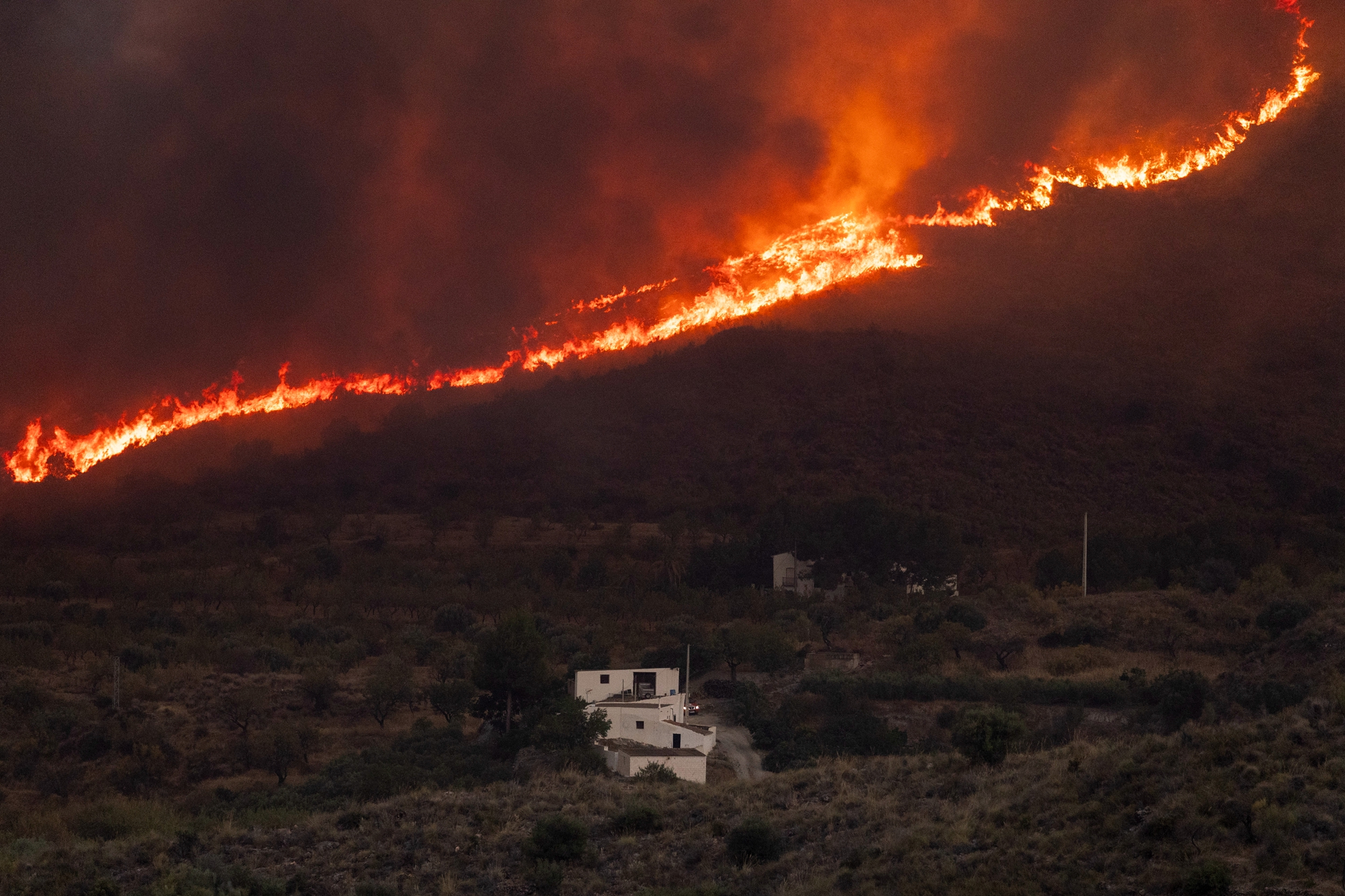
On the afternoon of July 17, in the vicinity of Orés in Aragón, Spain, a wildfire threatened the town of Luesia. The wildfire has already burned over 14,000 hectares, forcing more than a thousand people to evacuate. Spanish authorities had initially vowed to “spare no effort” in controlling the fire on the northern front. However, subsequent updates indicate that the strong winds have made it difficult to contain the blaze, with officials admitting they are facing one of the most complex forest fires in the region in recent years.
Alfonso González, the person in charge of the firefighting operation in Orés, reported on July 17 that the rescue teams deployed in Luesia were working tirelessly to protect the town center and avoid damage to houses, as the fire was rapidly approaching the small town. Residents of Luesia had already been evacuated as a precaution.
González is responsible for managing the wildfire in Orés. On July 17, Spanish authorities deployed 300 emergency response personnel from the military to combat the fire, with helicopters continuously dropping water on the affected areas, at times involving up to 5 helicopters simultaneously in water-scooping operations.
By early afternoon, reports indicated that the wildfire had spread to 12,600 hectares of land, leading to evacuations of residents from five towns in the area. Furthermore, the fire was encroaching on a region deemed “crucial from a forestry perspective,” where the high stakes necessitated full-fledged efforts to control the fire at all costs. As a result, the greatest challenge and main focus of firefighting activities were concentrated on the northern front of the fire.
In comparison, the situation in the southern and left wing areas of the fire site had been relatively better controlled. Nevertheless, González expressed that, “Of course, it is not completely extinguished yet, there is still a long way to go.”
However, later updates in the afternoon revealed that the increasing wind strength had heightened the difficulty of controlling the forest fire in Orés, resulting in the fire becoming harder to contain, with the affected area expanding to around 14,000 hectares, encompassing a radius of 60 kilometers.
Roberto Bermúdez de Castro, the regional official in charge of finance, interior, and public administration affairs, acknowledged, “We are facing one of the most complex forest fires in the region in recent years.”
Spain has been witnessing widespread wildfires in several regions. The fire situation in La Mierla, in the province of Guadalajara, forced more residents to evacuate. On Friday afternoon, residents of four other villages in the area also received evacuation notices. Currently, residents from a total of ten towns have been evacuated, with the wildfire affecting an area exceeding 2,000 hectares.
Additionally, a forest fire in Árchez, Málaga province, prompted the town of Cómpeta, with a population of 4,000, to implement lockdown measures.
Previous reports indicated that the fire in La Mierla led to residents from seven towns being evacuated, with some individuals being accommodated at the Humanes sports center.
The wildfires in the region are still not under control. The Spanish State Meteorological Agency (AEMET) has issued a new heatwave warning, predicting a rise in temperatures starting from Saturday, with temperatures possibly reaching 42 to 44 degrees Celsius in parts of Andalusia and La Mancha next week.
Meteorological experts have also warned that hot and dry air flows from North Africa will sweep across most of Spain, elevating the forest fire risk to an extremely high level.
Since June, most parts of Europe have been experiencing prolonged high temperatures, leading to dry vegetation and making wildfires difficult to contain. According to reports from Reuters, on Friday, July 17, the average maximum temperature in Western Europe was estimated at 27.5°C (81.5°F), which is 4.2°C higher than the normal average temperature for July 17 between 1961 and 1990.