
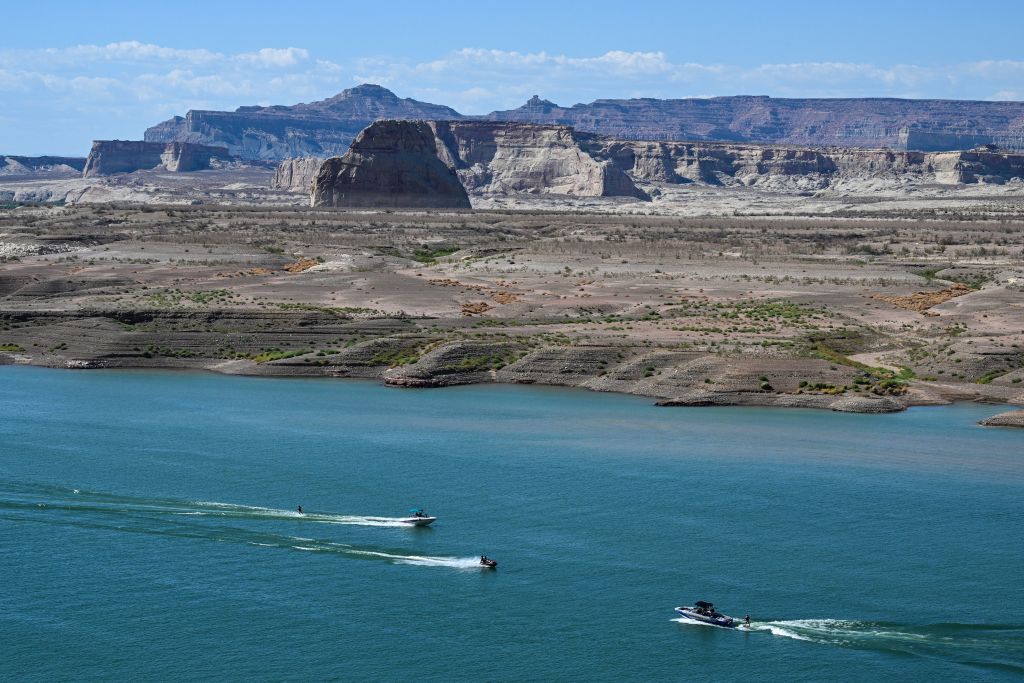
The important reservoir on the Colorado River in the United States is facing an increasingly serious water shortage crisis, leading some cities in the Southwest to work hard to conserve water and increase protection efforts to ensure that this reservoir, spanning the border of Utah and Arizona, can have sufficient water storage.
Although experts say that the fluctuation of the Colorado River’s water level is unlikely to affect drinking water supply, some cities in Arizona, California, and New Mexico in the American Southwest are not taking any chances. They are actively taking measures to conserve water, including recycling and using wastewater, restricting residents from watering lawns, and desalinating seawater.
These efforts stem from the water shortage facing Lake Powell. This artificial reservoir provides electricity to millions of households in the American West, but this summer’s water storage is at the lowest level on record.
On July 19, the water storage in Lake Powell was only 23.4%, with the reservoir last being full in 1983. If the water level of the reservoir continues to drop, the Colorado River may no longer flow through the Grand Canyon, triggering an ecological disaster known as the “dead pool.”
This crisis could trigger a chain reaction nationwide. According to data from the California Department of Food and Agriculture, nearly half of the vegetables and over three-quarters of the fruits and nuts in the United States are produced in California, much of which is irrigated with water from the Colorado River.
Utah is particularly hard hit, with farmers and rural towns facing an unprecedented water shortage. Most of the water diverted from the Colorado River is used for agricultural production, with only 20% used for residential water supply.
USA TODAY interviewed government officials and water policy experts in Phoenix, Tucson, San Diego, and Albuquerque to understand how these cities are addressing the Colorado River water shortage problem, as they are heavily reliant on this river for water supply.
Phoenix, Arizona has invested in building three water purification facilities, installed leak sensors in city-owned residences, and uses technology to control irrigation plans based on weather data. The city serves 1.7 million users and extracts about 47.9 million gallons of water from the Colorado River annually.
In the late 20th century, Tucson, Arizona replaced many lawns with Sonoran desert landscapes, using natural rocks and water-efficient native plants for landscaping.
John Kmiec, director of the Tucson Water Department, introduced that over the past 25 years, these measures have allowed Tucson to fill a reservoir with water from the Colorado River. Despite significant population growth, the city’s water consumption remains at the level of the late 1980s.
San Diego, California has the largest seawater desalination plant in the United States. With the tight water supply from the Colorado River, the city is scaling up its seawater desalination efforts.
Nevertheless, water conservation has become a way of life in San Diego.
On July 14, the federal government reached an agreement with the Metropolitan Water District of Southern California, paying up to $65 million to stop the agency from withdrawing water from the Colorado River.
The agency’s jurisdiction includes San Diego. It also provides compensation to the city’s farmers, encouraging them to conserve water and letting some farmland fallow.
In Albuquerque, New Mexico, the local water authority encourages people to limit watering plants to three days a week and prohibits watering lawns between 11 a.m. and 7 p.m. These measures have reduced the city’s per capita daily water consumption to about 125 gallons, compared to 250 gallons in the mid-1990s.
The city has developed a century-long water resource planning initiative called “Water 2120.” Additionally, city officials hope to invest more in underground water storage.
(Reference: USA TODAY)