
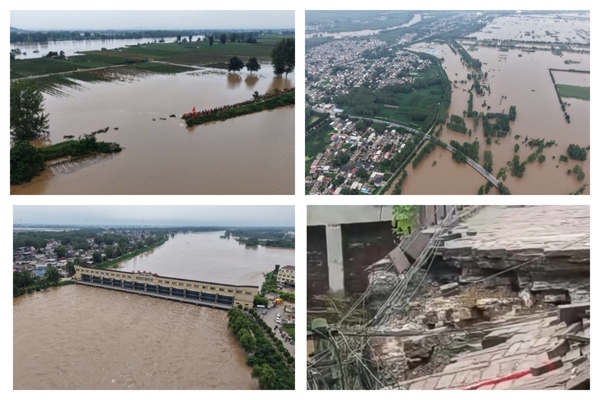
As a result of the impact of Typhoon “White Dolphin”, heavy rainfall has been persisting in multiple areas of Henan province. In the late night of August 12th, due to extreme heavy rainfall and the simultaneous discharge of large volumes of water from upstream reservoirs, a 40-meter breach occurred in the embankment of the North Ru River section in Changqiao Town, Jia County, Pingdingshan City, leading to the evacuation of 2182 people overnight. Simultaneously, part of the Seven-Hole Bridge spanning the Lan River in Zhongtou Town, Jia County, was washed away, with the bridge originally built in the thirteenth year of the Jiajing reign of the Ming Dynasty.
According to a report by the official Chinese state media Xinhua News Agency on August 13th, a breach occurred in the embankment of the North Ru River section in Changqiao Town, Jia County, Pingdingshan City on the night of the 12th, with the breach width exceeding 40 meters. By early morning on the 13th, before 3 a.m., 2182 people were evacuated overnight to safety. By 8 a.m. on the 13th, the flood flow in the Jia County section of the North Ru River had decreased from 2880 cubic meters per second to 2370 cubic meters per second, and the water level in the river had dropped from 87 meters to 86.4 meters.
Around 4 p.m. on August 13th, an on-duty staff member of the Pingdingshan City Emergency Management Bureau told The Paper that the sealing and rescue operations of the breach had been basically completed, all surrounding residents had been evacuated, and the breach had not caused any casualties.
In addition, on August 13th, the Jia County Urban Management Bureau announced that around 7 a.m. on the 13th, the Baofeng to Jia County 168 high-pressure gas pipeline of the Ping’an Jia County Gas Co., Ltd. ruptured due to flooding at the Ru River section. Following the incident, the gas supply valve downstream of Jia County was closed, and synchronous valve closure operations were carried out in the upstream Baofeng transmission section.
Public records show that the North Ru River, commonly known as the Ru River, is a tributary of the Sha Ying River, which is a tributary of the Huai River. It originates from Luoshan Township, Checun Town, Song County, Luoyang City, Henan Province, flowing through six counties and cities including Ruyang County, Ruzhou City, Jia County, Baofeng County, Xiangcheng County, and Ye County, before merging into the Sha River in Dingying Township, Xiangcheng County, with a total length of 250 kilometers.
The extreme heavy rain also struck Zhongtou Town, which is connected to Changqiao Town. At around 11:40 p.m. on August 12th, the Seven-Hole Bridge, with a history of nearly 500 years, spanning the Lan River, was washed away. Residents near the bridge told Jiupai News on the morning of the 13th that around 11 a.m. on the 12th, it was raining heavily, causing the water level to rise, but it did not flood the bridge deck, although the water flow was very fast. Around 11 p.m., the Seven-Hole Bridge collapsed, with three holes collapsed and the foundation of one hole unstable. Today, businesses around the area have stopped, and there are no guardrails around the bridge yet, posing some danger.
In the afternoon of the 13th, a staff member of the Zhongtou Town government told The Beijing News that affected by Typhoon “White Dolphin”, continuous rainfall and the surge of upstream river water kept eroding the bridge deck. At around 11:40 p.m. on the 12th, the two middle bridge holes of the Seven-Hole Bridge cracked and collapsed, without causing any casualties.
According to public records, the Seven-Hole Bridge was built in the thirteenth year of the Jiajing reign of the Ming Dynasty (1534 AD) by the magistrate at the time, Chen Wangshou.