
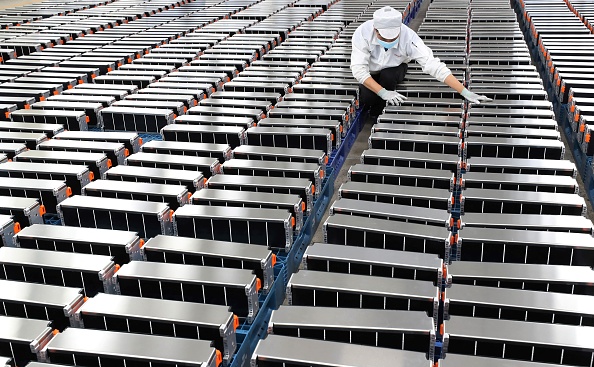
According to the news from Epoch Times on September 6, 2026, the amount of scrapped electric vehicle (new energy vehicle) batteries in China is expected to exceed 1 million tons by 2030. However, there is currently no sound and safe method for dealing with these scrapped power batteries in China, and improper handling may cause serious environmental pollution and other hidden dangers. This news has become a hot topic on September 6.
Under the promotion of the Chinese Communist Party, the development of electric vehicles in China has been rapid, leading to a substantial increase in the demand for electric vehicle batteries. When the battery capacity diminishes to below 80% of the rated capacity, its performance no longer meets the requirements for vehicle operation, making it unusable and in need of scrapping. This wave of large-scale battery scrapping is coming for these discarded power batteries.
According to China Central Television (CCTV) News, it is estimated that by 2030, the annual amount of scrap power batteries in China is projected to exceed 1 million tons.
In China, many electric vehicle owners are unaware of battery recycling channels, and with the current lack of recycling points, discarded batteries can easily flow into grey dismantling channels. These scrapped power batteries contain heavy metals and hazardous substances such as nickel, cobalt, and manganese, posing chemical pollution risks. Improper disposal not only pollutes the soil and water sources but also increases the likelihood of fires and explosions.
In response, Professor Wu Mengqiang from the School of Materials and Energy at the University of Electronic Science and Technology of China stated that the construction of recycling service points is lagging behind, leading to inefficient channels at present. Approximately 45% of consumers do not know where to recycle their discarded batteries. Moreover, a large number of batteries flow into informal channels, with over 60% of retired batteries circulating through “small workshops.” In addition, violent dismantling brings severe pollution issues, as these workshops without environmental qualifications dismantle batteries by hand, emitting residue and waste gases that contribute to environmental pollution.
Industry experts generally believe that scrapped power batteries generally pose risks of fire and explosion: internal short circuits, overheating, damages, or rough dismantling can easily lead to thermal runaway, resulting in combustion or explosions. The risk is even higher when residual battery capacity is not fully discharged. Improper dismantling or reassembly in underground workshops is more prone to issues.
Furthermore, there are risks from chemical and toxic substances: leakage of electrolytes containing fluorinated solvents can generate volatile toxic gases; if nickel, cobalt, lithium, manganese, and other heavy metal ions from the positive and negative electrode materials enter the soil or water bodies, they can cause long-term ecological toxicity and pollution. Non-standard dismantling often involves strong acid soaking or open-air treatment, exacerbating leaks and pollution.
Moreover, scrapped batteries may enter the electric bicycle sector, where a large volume of retired cores are dismantled, repackaged, and used for two-wheel/three-wheel electric vehicles. Investigative reports from CCTV and others show that around one-third of electric bicycle fires are related to modified batteries, with about 80% of the cores coming from discarded power batteries of new energy vehicles. These batteries have diminished performance, poor consistency, and are prone to overheating, short circuits, or fires.
These risks are especially pronounced in underground workshops and black market circulation channels.
According to the “Global and Chinese Power Battery Recycling Industry Report (2026 GEPT4U5)” shows that in 2026, the total amount of recyclable scrap power batteries worldwide is expected to reach 3.8 million tons, and it is projected to exceed tens of millions of tons by 2030. From a market structure perspective, the Asia-Pacific region accounts for over 70% of global power battery recycling processing, with China being the absolute core. In 2025, the retirement volume of power batteries in China was approximately 1.2 million tons, and issues with “small workshops” in handling these scrapped batteries have led to safety and environmental hazards from dismantling. Additionally, lithium iron phosphate batteries, lacking high-value nickel and cobalt metals, have lower economic benefits in the recycling process due to lithium’s low price phase, affecting the enthusiasm of legitimate enterprises for recycling.
Internet user “Helenbirdy” expressed, “Strongly demanding car manufacturers or battery manufacturers to invest more in replacing vehicle batteries, providing consumers with more practical options.”