
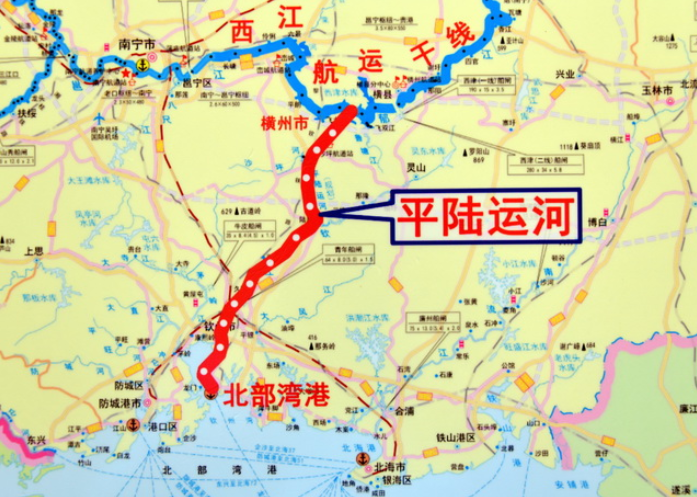
On September 16th, the Pinglu Canal in Guangxi, China officially opened for navigation, touted as the “world’s best” by officials. However, this massive project has faced scrutiny since its inception, especially after the major casualties caused by the Guangxi floods in July this year. Some experts claim that the construction of the Pinglu Canal has disrupted the watershed between the Qin River basin and the West River basin, exacerbating flood disasters brought by typhoons.
The opening ceremony of the Pinglu Canal took place in Guangxi on the morning of September 16th. According to reports from CCTV, the construction of the Pinglu Canal began on August 28, 2022, with a total length of 134.2 kilometers. Built to Class I river navigation standards, it can accommodate vessels of up to 5000 tons, making it the highest-grade canal for navigation in China.
Starting from the Pingtang River mouth in Xijin District, Hengzhou City, Nanning in the north, and passing through Lingshan County and Luwu Town in Qinzhou in the south, the Pinglu Canal connects directly to the North Bay along the Qin River with the completion of the Ma Dao, Qishi, and Qingnian three major transit points.
Official propaganda touts that the project has achieved four “world’s best” titles: the strongest canal navigation capacity in the world, the fastest navigation speed for similar ship locks worldwide, the highest drop in water level for provincial ship locks worldwide, and the largest provincial ship lock scale for inland rivers in the world.
However, in recent years, the Pinglu Canal has faced continued criticism, including concerns about “water grabbing” downstream of the West River and saltwater intrusion, posing significant hydrological risks and causing damage to the ecological environment. Most critical articles related to these issues have been deleted.
The total volume of earth and rock excavation for the Pinglu Canal reached 315 million cubic meters, three times that of the Three Gorges Dam. Domestic geologists are concerned that this high-intensity mountain-splitting diversion could intensify the “edge effect” and habitat fragmentation of natural habitats along the canal route.
A study published in 2022 by the China Transport Planning Institute acknowledges a series of potential side effects of canal construction, including isolation or destruction of natural habitats, changes in the region’s ecology, reduction of vegetation, and pollution from passing ships such as dust or other contaminants.
In August 2023, an article in the journal “Science” clearly pointed out that the construction of the Pinglu Canal would encroach upon extensive mangroves, potentially causing irreversible negative impacts on the local wetland ecosystem and species reproduction.
The latest research from the North Bay University of China in 2026 shows that the construction of the Pinglu Canal has altered the natural visual and water characteristics of the estuary (Maowei Sea/Qinzhou Bay), directly threatening the camouflage and survival of local tidal benthic organisms such as crabs.
Recent opinions suggest that the Pinglu Canal has exacerbated typhoon and flood disasters.
Affected by typhoons, Guangxi experienced continuous heavy rain in early July, causing multiple reservoir collapses in Hengzhou City and massive casualties due to floods. Official reports indicated that over 1.65 million people in Nanning (including Hengzhou City) and Guigang were affected, with 159 confirmed deaths and 10 missing persons. However, netizens have questioned the significantly reduced figures. On July 13, a local villager informed Epoch Times that the actual death toll from floods was at least a thousand people. Further claims from grassroots sources in Guangxi suggest that tens of thousands may have died in the floods, but due to information lockdown by authorities, verification is challenging.
German hydrology expert Wang Weiluo wrote in Epoch Times that the flood disaster in Guangxi, exemplified by the breach of the Liulan Reservoir in Hengzhou City in early July 2026, was not only related to the rainfall brought by the typhoon but also associated with the construction of the Pinglu Canal.
He explained that the excavation of the Pinglu Canal had disrupted the watershed between the Qin River basin and the U River basin. The natural watershed forces air currents to ascend, causing some rainfall to fall in the Qin River basin to the south of the watershed, weakening the intensity of typhoons entering the U River basin. Historically, the U River basin has experienced significantly less severe typhoon disasters compared to the Qin River basin due to this natural watershed. However, the excavation of the Pinglu Canal has created a massive opening nearly 200 meters deep, hundreds of meters wide, and 6.5 kilometers long at the natural watershed. Typhoons can now freely enter the U River basin from the Qin River basin, then traverse the U River basin and penetrate reservoir areas such as the Liulan Reservoir.
He further explained that when typhoons encounter another watershed barrier on the left bank of the U River, the elevation change forces the substantial rainfall brought by typhoons to descend on the southern slope of this new barrier, resulting in heavy rainfall and forming massive inflows into reservoirs that can lead to collapses, causing enormous loss of life and property. “Typhoons get blocked by a secondary watershed later, lingering in Guangxi for an extended period, exacerbating the flood disaster.”
In September 2024, Wang Weiluo stated in an interview with Epoch Times that the massive canal projects initiated by the Chinese Communist Party in recent years reflect Xi Jinping’s water control ideology, akin to Mao Zedong’s Great Leap Forward era, believing that “the Party can command water and control water.”
The course of the Pinglu Canal runs from north to south. Wang Weiluo noted that this approach goes against scientific principles and nature, as water naturally flows downhill. China’s waters essentially flow from west to east, but many new canal projects are being constructed in directions opposite to the natural flow. The Chinese Communist Party seeks to control all water resources.
At the time, Wang Weiluo emphasized that nationwide canal excavation projects cause massive ecological destruction, disrupting natural river and lake systems, and leading to more frequent floods and droughts. Guangxi, by excavating new canals, has disrupted its water system, setting the stage for larger disasters in the future.
Official Chinese propaganda highlights that the Pinglu Canal can drive economic development in the western region, emphasizing the opening of the “shortest, most economical, and convenient maritime channel in the southwestern region.”
Chinese issues expert Henghe told Epoch Times that the current large-scale canal construction by the Chinese Communist Party is due to the loss of momentum in all three pillars of the Chinese economy, necessitating new sources of growth. Additionally, canal construction serves a symbolic purpose, boasting various “world-first” titles, as seen with the Pinglu Canal. The actual economic benefits once completed are the least important, similar to the Hong Kong-Zhuhai-Macao Bridge, which is lauded for numerous “world-firsts” and conveniences, while the actual utility is disregarded, whether there are vehicles crossing the bridge is essentially inconsequential.
“Thus far, major projects undertaken by the current Xi Jinping regime have mostly ended in failures,” he remarked.