
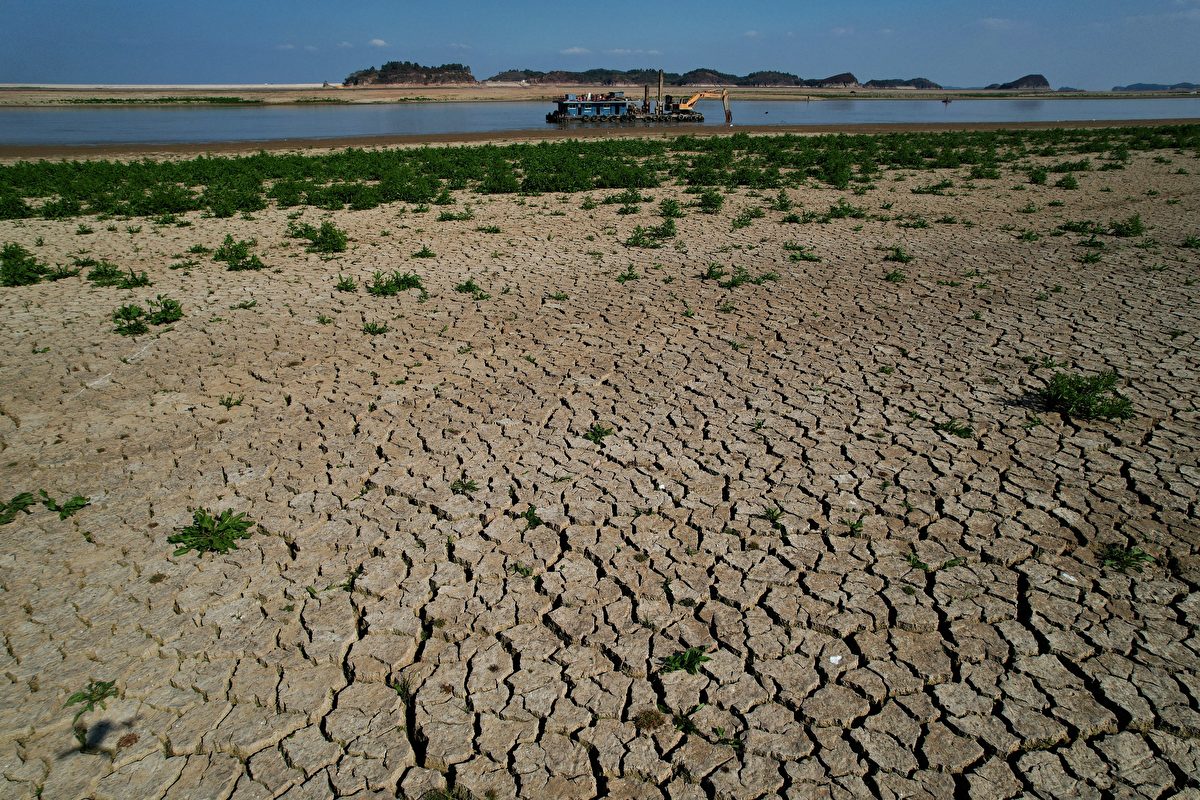
China’s largest freshwater lake, Poyang Lake, continues to see a decrease in water levels. Data from the hydrological monitoring center in Jiangxi Province shows that at 8 a.m. on September 29th, the water level at the Xingzi Station, a landmark hydrological station of Poyang Lake in Lushan City, Jiujiang City, Jiangxi Province, dropped to 10.26 meters. On September 20th, the water level at the Xingzi Station fell below the 12-meter mark, entering the dry season ahead of schedule, and then decreased by 1.73 meters in the following nine days.
According to a report by “Jiemian News”, on September 8th, the water level at the Xingzi Station was 15.55 meters, and by September 20th, it had dropped to 11.99 meters, a decrease of 3.56 meters in 12 days. On September 29th, it further decreased to 10.26 meters. From September 8th to 29th, the water level cumulatively dropped by 5.29 meters.
On September 20th, Poyang Lake entered the dry period, 42 days earlier than the average date of November 1st in previous years.
According to a report from the Jiangxi Provincial Department of Water Resources on September 22nd, from September 16th to 22nd, the water level at the Xingzi Station dropped from 13.76 meters to 11.29 meters, a decrease of 2.47 meters in six days, with a daily decrease of over 0.4 meters for five consecutive days. The recent rapid and intense decrease in water level is deemed rare.
During the period of rapid water level decline, some areas in Jiangxi Province still experienced rainfall. Data from the China Meteorological Administration shows that on September 29th, short periods of heavy rainfall occurred in parts of southern and eastern Jiangxi. The hydrological department in Jiangxi had previously stated that the recent weather conditions and reduced inflow from upstream are important factors contributing to the decrease in water levels, and they expect the water level to continue to drop.
Poyang Lake has clear seasonal hydrological characteristics, with the wet season usually occurring from May to October and the dry season from November to the following March. However, in the past 20 years, changes in the early onset of the dry season, prolonged duration, and decreased dry season water levels of Poyang Lake have drawn attention.
Data from the hydrological monitoring center in Jiangxi Province in 2023 showed that compared to the period from 1953 to 2002, the average water level of Poyang Lake from September to the following March after 2003 decreased by 0.93 meters. The onset of the dry season was advanced by 8 to 33 days, with the average duration of the 10-meter and 8-meter dry season levels increasing by 43 days and 19 days, respectively.
In 2022, Poyang Lake experienced extreme water level decreases. On August 6th of that year, the water level at the Xingzi Station dropped to 11.99 meters, entering the dry season ahead of schedule and setting the earliest recorded date since 1951 with complete hydrological records. By September 23rd, the water level further decreased to 7.10 meters, setting a new historical low.
Since then, instances of Poyang Lake entering the dry season early have occurred multiple times. On July 20th, 2023, the lake entered the dry season, breaking the record for the earliest entry at that time. In 2025, the lake entered the dry season on August 8th, 87 days ahead of the average date of November 2nd, making it the third earliest recorded entry.
After entering the dry season this year, the rate of water level decline has accelerated. As of September 22nd, the area of the water body flowing into the Yangtze River from Poyang Lake had decreased to 41% of its level at full capacity and the water volume had decreased to 18%, exposing large tracts of sandbars and grasslands.
As the water level continues to drop, concerns are being raised about the impact on water supply, agricultural irrigation, navigation, and wetland ecology in the surrounding areas of Poyang Lake.