
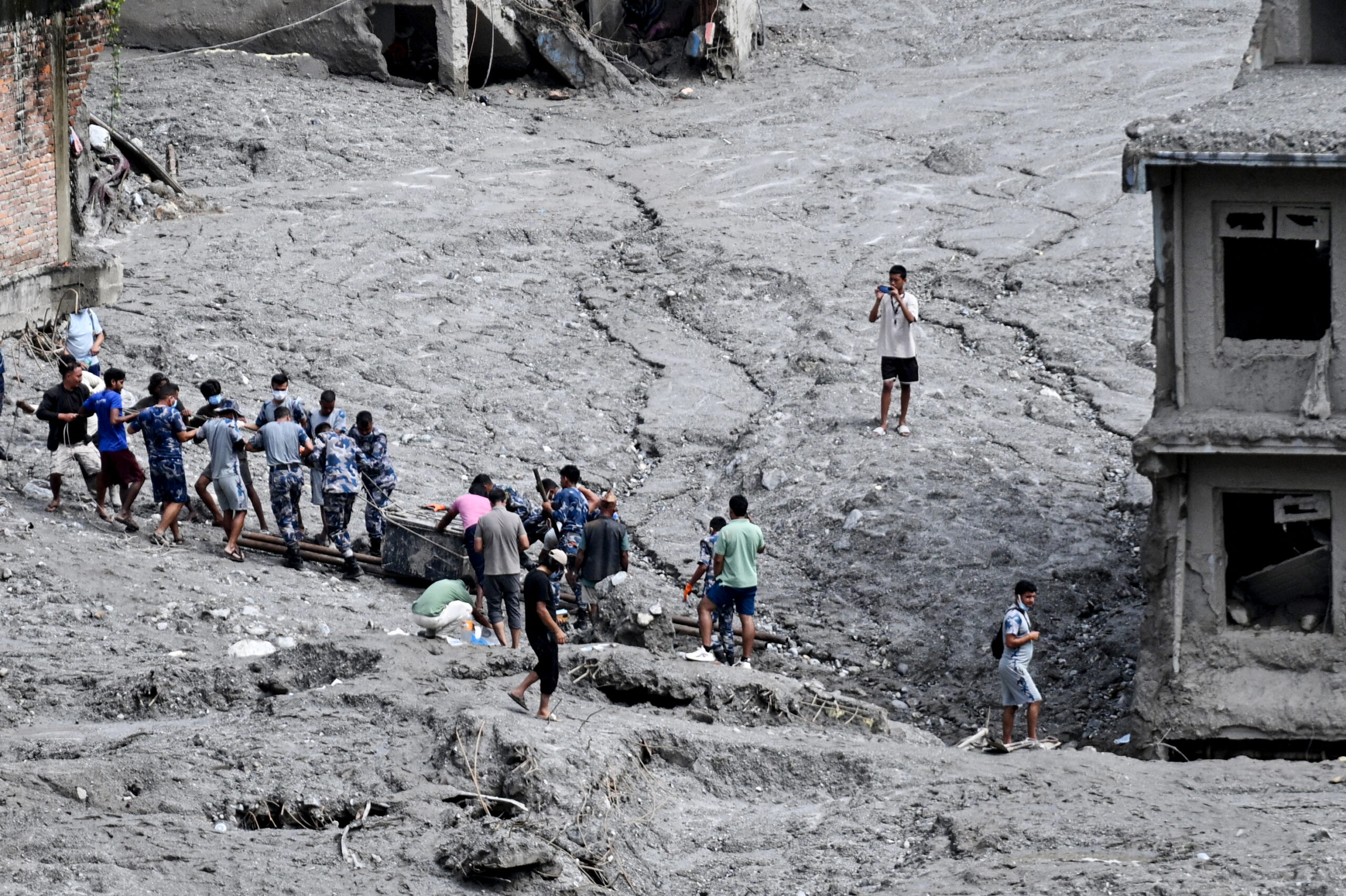
A devastating flood that occurred in Nepal and China’s Tibet on August 26 has claimed the lives of over 1,000 people as of Tuesday (September 1). Nepalese authorities have confirmed 987 deaths and 3,916 missing persons, including 583 foreigners; while Beijing authorities reported 16 deaths and 546 missing persons on Sunday.
According to official figures from both regions, the current death toll is at least 1,003 with 4,462 people missing. Nepalese authorities have stated that at least 11,814 individuals have been rescued so far. As some roads, electricity, and communication networks gradually recover, rescue teams are now entering remote areas that were previously isolated due to floods and landslides.
One of the ongoing focuses of search and rescue efforts is the hydroelectric projects severely affected by the floods. Nepalese Prime Minister Balendra Shah mentioned that nearly 1,000 workers were once trapped in the hydroelectric projects, with 279 rescued and around 600 individuals still stranded at damaged hydroelectric stations.
Rescue workers estimated by the Associated Press believe that around 500 people may be trapped in tunnels.
Images released by the Nepalese military show rescue workers searching in dimly lit tunnels filled with mud, water, and debris, climbing rocks to look for signs of life.
Reported by Reuters, rescue teams have set up temporary bridges and restored partial road networks leading to the heavily affected Nuwakot region, expediting rescue operations and aid delivery. Some areas have seen the restoration of electricity and communication services.
Police official Bipin Regmi stated that a search team discovered 24 bodies inside a house in the Betrabati village of Nuwakot.
“We are reaching new areas and finding more bodies,” Regmi told Reuters.
The Nepalese government announced that over $42 million in aid has been received post-disaster, with expectations of further assistance. Neighboring countries like India and China are also aiding in the rescue efforts, including assisting in constructing Bailey bridges to reach remote disaster areas.
As the search and rescue missions delve deeper, the humanitarian toll of the disaster is increasingly apparent.
In Nepal’s capital, Kathmandu, a wall outside the Tribhuvan University Teaching Hospital, approximately 25 meters long, is covered with photos of missing persons, including Nepali residents, Chinese hydroelectric workers and engineers, Indian pilgrims, and an American tourist.
Crowds continuously gather in front of the photo wall, with some taking pictures of rows of missing individuals. Families still hold onto hope of finding their loved ones’ whereabouts from various missing persons information.
Debu Sapkota, a 58-year-old driver, has posted photos of his 83-year-old mother-in-law and granddaughter who were swept away by floodwaters in Trishuli Bazaar last week. Despite alarms sounding, the elderly woman was unable to run due to her age. Her granddaughter tried to help her escape, and both were eventually carried away by the flood.
Sapkota expressed that he no longer expects the two to be found alive.
“I am here hoping to find their bodies,” he said.
Near the hospital morgue, photos of bodies recovered from the mud, yet to be identified, are displayed. Om Bahadur Rana, the officer in charge of the task, informed Agence France-Presse that 94 bodies had been received locally, with only 12 identified and returned to their families at that time.
The disaster originated from a glacier collapse in the Himalayan region, with large rocks, ice chunks, and meltwater cascading into valleys, triggering powerful floods that destroyed houses, roads, and bridges along the way. Scientists analyzing satellite images suggest that this collapse may involve destabilization of bedrock beneath the glacier, with the resulting vibrations recorded as a seismic event of magnitude 5.2.