
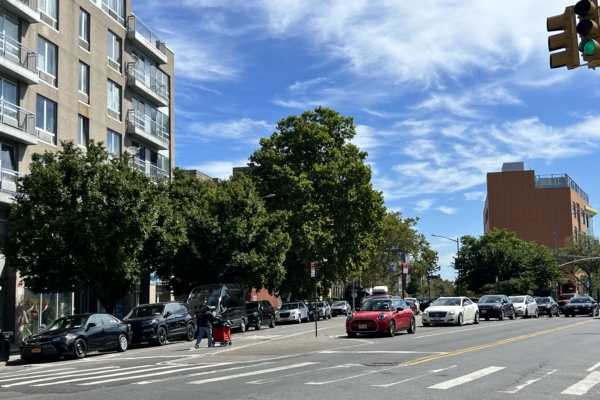
Facing increasingly frequent hot weather, New York City has launched a new “Urban Forest Plan” to address the issue. The plan aims to increase the city’s tree canopy coverage to 30% by 2040, incorporating tree planting, existing tree care, and community engagement into a long-term strategy. Areas like Bensonhurst and Sunset Park are included in the tree planting plan, but the community holds differing opinions on this initiative.
City council member Cindy Chuang of Bensonhurst is concerned not only about the need for more trees but also about whether the city government is adequately communicating with the community in advancing this work. She discovered the potential tree planting in the local streets only after workers were seen surveying sidewalks. Although the Parks Department had inquired with the community about tree planting, the lack of sufficient background information made it difficult for her to assess the specific plan. Chuang also noted that many residents have limited English proficiency, making it challenging for them to understand the arrangements based solely on street signs or simple notices.
“Many times, they need to listen to the community’s opinions, but they fail to do so,” Chuang expressed. She mentioned that after identifying the issue and reaching out to the city government, the Parks Department stated they would communicate with the community, and both parties are currently arranging a meeting.
State Assemblyman Kevin Coton suggested that residents may have various concerns regarding tree planting, such as trees being too close to underground gas pipelines, sloping terrain leading to water accumulation and safety concerns. Certain tree species like beech trees, despite their aesthetic value, could have large volumes and thick roots that may damage sidewalks and house structures. Moreover, he highlighted instances where inadequate municipal management allowed tree branches to extend and damage roofs, causing residents to have concerns.
Coton stated that some residents may be reluctant to have trees planted in front of their residences due to worries about obstructed sunlight and air, or the added burden of leaf cleaning. According to current regulations, the upkeep of property fronts along streets is usually the responsibility of homeowners, so increasing trees could potentially mean residents must undertake additional maintenance work.
President of the Bay Parkway Chinese Association in Bensonhurst, Lee Chipau, noted that some streets in the area indeed lack trees, with some properties having none at all. Personally, he believes that enhancing greenery is “great” and can improve the environment and air quality.
However, he also pointed out that some homeowners are cautious about tree planting in front of their residences, primarily concerned about tree roots damaging drainage facilities or sidewalks and the added cleaning work from fallen leaves. As per current regulations, cleanliness and maintenance in fronts of properties along streets are typically the responsibility of the owners, so the addition of trees may imply that residents need to take on corresponding maintenance duties.
President of the Prosperous Brooklyn Association, Huang Qiwang, also supports the city government’s efforts to enhance community greening. He believes that it would be more reasonable to discuss with the community before deciding on planting locations, tree species, and quantities, as “homeowners understand their neighborhood best.”
This plan is spearheaded by the Mayor’s Office of Climate and Environmental Justice in collaboration with the New York City Parks Department and several non-profit organizations. The policy direction behind it is related to “climate justice,” aiming not only to increase the total number of trees citywide but to prioritize improving communities historically lacking tree canopy coverage and more susceptible to high temperatures and air pollution.
According to 2021 data, New York City’s tree canopy coverage is 23.4%, about 45,000 acres, but there are still significant differences between various communities. Stanton has the highest tree canopy coverage at 33.4%, followed by the Queens area at 26.7%, the Bronx at 22.7%, and Manhattan and Brooklyn each at 19.5%.
Some Brooklyn communities have even lower coverage rates, such as around 10% in the Sunset Park West area and around 13% in Gravesend and Bensonhurst.
This unequal distribution is one of the reasons the new plan emphasizes “equity.” Trees are seen as a form of “natural infrastructure” for urban climate adaptation. They can provide shade, lower ground and surrounding air temperatures, absorb rainwater, improve air quality, and provide habitat for birds and insects.
Currently, New York has approximately 7 million trees. According to relevant data, these trees can annually remove about 1,100 tons of air pollutants, store around 51,000 tons of carbon, reduce approximately 69 million cubic feet of stormwater runoff. Trees are also believed to help reduce the risk of heat-related illnesses and deaths, and could have positive impacts on mental health and overall quality of life.
The new plan differs somewhat from the MillionTreesNYC initiative launched during former Mayor Bloomberg’s tenure. The new plan shifts the core measure of urban greening towards “tree canopy coverage,” while stressing the protection of existing trees, long-term maintenance, and mobilizing private landowners and communities.