
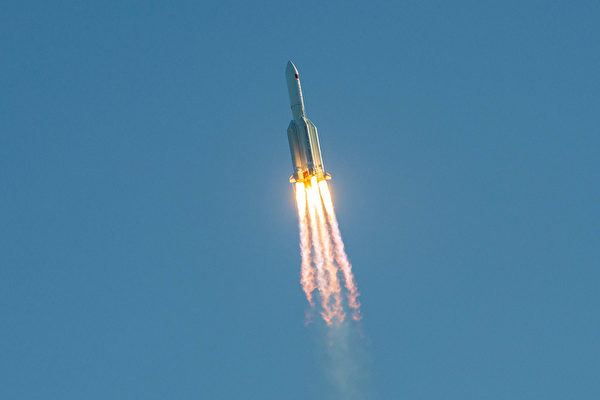
Abandoned upper stage rockets are the most dangerous type of space debris. In recent years, the Chinese Communist Party (CCP) has vigorously developed aerospace engineering, resulting in a large amount of space debris. Analysts believe that as the CCP continues to launch rockets, the situation with abandoned rockets will only worsen.
Until a decade ago, the CCP had never launched more than 20 rockets into orbit each year. However, starting from 2022, the CCP launched 64 rockets, reaching a record high of 93 launches last year. One hazard of CCP rocket launches is their disregard for established norms regarding the disposal of abandoned upper stage rockets. The upper stage rocket is responsible for pushing satellites or spacecraft into their designated orbits after separating from the rocket’s first stage.
Over the past 20 years, most countries (including private enterprises within their borders) have taken a more responsible approach to disposing of upper stage rockets. This is because allowing massive metal chunks weighing tons to uncontrollably rotate in low Earth orbit will eventually lead to major issues.
According to an article published on May 26th by the well-known US tech news and commentary website “Ars Technica,” data provided by the European Space Agency’s Space Debris Office and the “Jonathan McDowell’s Catalog of Objects Launched into Space” indicate that the Soviet Union (and later Russia) is the “biggest culprit” in this issue. Approximately 800 tons of their rocket bodies remain in long-lived orbits ranging from 600 to 2000 kilometers above Earth’s surface. In comparison, the US has abandoned upper stage rockets weighing only around 57 tons in these orbits. However, these figures have generally remained stable, which is in contrast to the slow decreasing trend seen during the Russian era as rocket stages fell out of orbit.
In contrast, the mass of CCP rocket debris has seen a significant increase. According to a recent analysis by space situational awareness expert Jim Shell, the mass of CCP rocket debris lingering in long-lived orbits has surged from less than 100 tons to 252 tons in the past five years.
“China (CCP) is still continuing to abandon a large number of rocket debris in the high-altitude regions of low Earth orbit,” Shell wrote in a LinkedIn post on Monday, May 25th. “The total mass of orbital debris is a critical variable affecting the long-term sustainability of the space environment. The industry generally agrees that abandoning rocket upper stages in long-lived orbits is not a ‘best practice.’ In fact, all major spacefaring nations have recognized this.”
Shell pointed out that the recent increase in the quantity of CCP rocket upper stage debris is mainly attributed to the country’s increased launch frequency. With Beijing beginning to deploy large-scale “Satellite Mega-constellations,” launch missions have surged.
“Satellite Mega-constellations” refer to massive networks consisting of hundreds to tens of thousands of artificial satellites that collaborate in low Earth orbit (LEO), forming a seamless interconnected space network structure.
Currently, China’s aerospace industry is in the early stages of deploying large satellite constellations, which means that if Beijing does not curb the practice of abandoning rocket debris, the already congested space environment will further deteriorate. Projects like “Guowang” and “Spacesail,” typical Chinese satellite constellations, usually operate at higher orbital altitudes (above 800 kilometers). In order to support the operation of these constellations, the CCP may launch 1000 or more rockets in the coming decade.
“Guowang” is CCP’s first nationally-funded giant low-orbit satellite network project led by the China Satellite Network Group under the direct control of the State Council’s State-owned Assets Supervision and Administration Commission. “Spacesail,” known as the “G60 constellation” in China, is a giant low Earth orbit satellite constellation project. This project is led by Shanghai Yuxin Satellite Technology Co., Ltd.
On August 6, 2024, China’s state-owned Shanghai Aerospace Satellite Technology Co., Ltd. (SSST) launched the Long March 6A rocket, sending 18 Internet satellites into orbit, which were the first batch of satellites for the CCP’s “Thousand Sail Broadband Network.” Shortly after the deployment of these satellites, the upper stage rocket exploded, causing more and more fragments. The US Space Command at that time stated that the disintegration of the upper stage rocket created a cloud of debris that is now hurtling around the Earth, posing risks of collisions to more than a thousand satellites and other objects in the high-traffic area of Earth’s orbit.
On June 30, 2024, the Chinese private aerospace company Space Pioneer conducted a static test of the propulsion system of its new “Sky Dragon III” carrier rocket. While researchers were analyzing its thrusters, the rocket, which was supposed to remain on the launch pad, unexpectedly lifted off and exploded. The rocket body eventually crashed in the mountains near Gongyi City in Henan Province. Increasing videos show that burning rocket components fell close to civilian infrastructure.
The article states that although the number of satellites far exceeds that of abandoned rocket debris (with a ratio of over 10:1), the former is usually smaller in size and can mitigate collision risks through orbit maneuvers when orbital intersections occur. In contrast, rocket debris is considered “inanimate” and cannot undergo attitude control or orbital maneuvers. Therefore, the majority of the space debris listed as “most worrisome” consists of rocket debris.
The best practice in modern space launches is to reserve a portion of propellant in the upper stage to properly dispose of the stage after fulfilling the mission. For low-orbit launch missions (such as SpaceX’s Falcon 9 rocket carrying the “Starlink” satellites into orbit), rockets usually initiate a “de-orbit burn” maneuver to guide the upper stage to splash down in oceanic regions far from land—usually near the “Point Nemo.” For high-altitude launch missions, some rockets may inject their stages into a heliocentric orbit.