
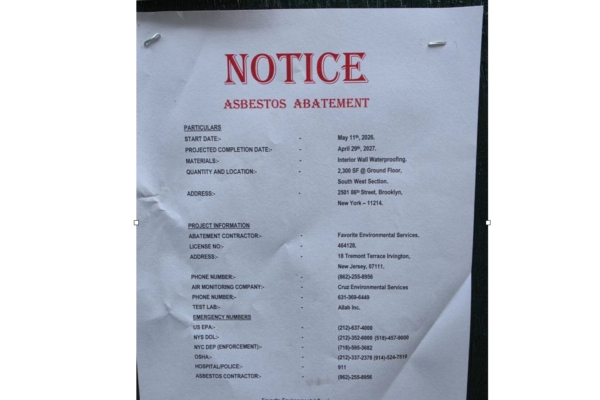
In Brooklyn, New York, a notice was posted at the construction site of a homeless shelter at 2501 86th Street on May 8th. The notice indicated that asbestos removal work will commence from May 11th (Monday) and is expected to be completed by April 29th next year (2027). State Senator Chen Xueli’s office reminded nearby residents to be cautious during the construction period, as pollutants may be present in the air, and to avoid approaching the vicinity of the site to ensure health and safety.
Asbestos is a known carcinogen, with the danger stemming from ultra-fine fibers that can be inhaled into the lungs. Unlike typical dust that the body can expel, these fibers may linger in the body for decades, linking asbestos exposure to diseases like lung cancer, asbestosis, and mesothelioma with latency periods often lasting 10 to 40 years. Many patients who were exposed to asbestos at a young age often develop illnesses only after retirement.
Both the U.S. Environmental Protection Agency (EPA) and the New York City Department of Environmental Protection have stringent regulations regarding asbestos work. Therefore, the dismantling of asbestos-containing structures often takes several months to a year. The core principle of asbestos removal projects is not speed but preventing fiber leakage.
According to regulations, asbestos removal must undergo multiple steps, including comprehensive testing of the entire building to quantify the types, quantities, and distribution of asbestos, followed by the development of a detailed asbestos abatement plan which can start only after approval from the competent authority.
Subsequently, the construction area must be completely sealed off. Construction sites typically construct airtight isolation areas sealed with thick plastic sheets and install negative pressure ventilation systems to ensure that air can only flow in, not out, preventing asbestos fibers from dispersing into surrounding communities.
Disrupting asbestos can generate large amounts of carcinogenic dust. Therefore, workers cannot use heavy machinery for rough dismantling; instead, materials must be wetted before careful manual removal, piece by piece, to prevent fiber dispersion. Continuous monitoring of air quality is required during construction, and clearance can only be granted after passing inspections. The process is slow and costly.
All removed asbestos materials must be double-sealed and packaged as hazardous waste for transportation to specialized landfills for disposal, and cannot be discarded at will.
The building’s Certificate of Occupancy issued by the Department of Buildings shows that the structure was initially built in 1959, with subsequent changes in the intended use in 1996 and 2004. The Department of Environmental Protection noted that nearly all buildings constructed before 1989 may contain asbestos. Due to its fire resistance, insulation properties, and cost-effectiveness, asbestos was extensively used in ceiling tiles, floor tiles, cement products, fireproofing materials, and insulation boards. The United States did not ban asbestos until 1989.
Since 1987, New York City has rigorously regulated any “disturbance activities” involving asbestos materials. Failure to report or hire licensed contractors in compliance with regulations can result in fines ranging from $1,200 to $10,000 per violation.