
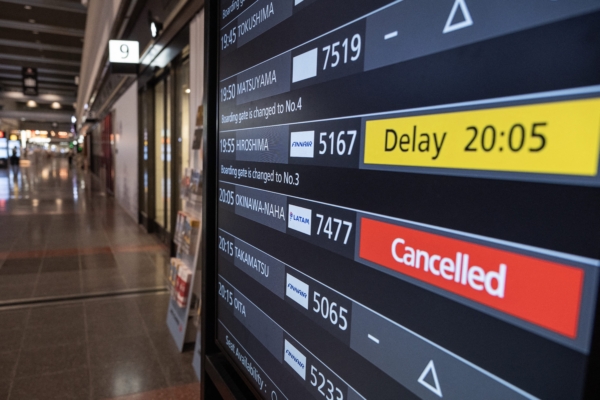
Typhoon “Jangmi” made landfall in the southern part of Wakayama Prefecture in Japan on the morning of June 3rd, causing over 850 flights to be canceled and multiple bullet trains and railways to be suspended or delayed due to strong winds and continuous heavy rain. The Japan Meteorological Agency has issued a “special warning of river flooding,” urging people to take immediate life-saving actions.
The Japan Meteorological Agency has urged the public to remain vigilant and guard against landslides, river flooding, flooding in low-lying areas, and coastal waves disasters, advising against unnecessary outings to ensure life safety. Residents in areas threatened by flooding should move to buildings above the second floor or higher for shelter if they are unable to evacuate safely.
As Typhoon “Jangmi” moves northward, heavy rain continues to affect the Tokai, Kanto, and Tohoku regions of Japan. Meteorological data shows that as of 6:00 a.m. on the 3rd, hourly rainfall in Omaezaki City, Shizuoka Prefecture reached 57.5 millimeters, while Miyakejima in the Izu Islands recorded 48.5 millimeters of rain, and Owase City in Mie Prefecture accumulated 473 millimeters of rain in the past 12 hours.
The Japan Meteorological Agency and Wakayama Prefecture issued the highest level of “Level 5 special warning for flooding” at 6:10 a.m. Tokyo’s Meguro River, Kanda River, Nogawa River, and Sengawa were put on a Level 4 flood warning, while Setagaya Ward issued a Level 3 alert.
The Meteorological Agency predicts that within the next 24 hours, rainfall in the Tokai and Kanto regions may reach 200 millimeters, while the Tohoku region could experience up to 120 millimeters of rainfall. Moreover, the formations of “linear rainbands” in the Tokai, Kanto, and Izu Islands regions could lead to more intense rainfall, highlighting the need to be vigilant about disaster risks.
In addition to heavy rain, strong winds and high waves pose threats to various parts of Japan. The average maximum wind speeds are forecasted to exceed 20 meters per second in Shikoku, Kinki, Tokai, Kanto, Chubu, Izu Islands, and the northeast region on the 3rd, with maximum gusts reaching up to 35 meters per second (approximately 126 kilometers per hour).
Furthermore, wave heights along the Izu Islands and Kinki coasts could reach up to 9 meters, while the Kanto and Tokai regions and the northeast may experience waves reaching 8 meters, with the Tohoku and Shikoku regions expecting waves up to 6 meters.
Typhoon “Jangmi” has disrupted air and rail travel in Japan. Several train operators announced cancellations or delays for trains in the Tokyo metropolitan area, advising passengers to check the latest information on official websites before heading out. Airlines also remind travelers to stay updated on flight information as further flight disruptions are possible.
JR East Japan announced partial suspensions on the Shonan Shinjuku Line, Chuo Line, Ome Line, and Tokaido Line, with plans to resume service by 8:00 p.m. The Uchibo Line, Sobu Main Line, Kashima Line, Sotobo Line, Narita Line, and Kururi Line all suspended services for the entire day.
According to NHK, major Japanese airlines have canceled approximately 760 domestic flights on the 3rd, including flights to and from Haneda Airport, and over 90 international flights, totaling over 850 flight cancellations.
Among them, Japan Airlines (JAL) canceled 292 flights, All Nippon Airways (ANA) canceled 232 flights, Skymark Airlines canceled 70 flights, Peach Aviation canceled 32 flights, and Jetstar Japan canceled 31 flights. For international flights, ANA and JAL each canceled 55 and 37 flights, respectively.
Shizuoka Prefecture issued a Level 4 warning for landslides in Ito City, Shimoda City, Atami City, as well as Level 3 warnings in Iwaki City, Fukushima Prefecture, and other regions. Evacuation orders have been issued in Omaezaki City in Shizuoka Prefecture, Kihoku Town in Mie Prefecture, Yokosuka City in Kanagawa Prefecture, Totsuka Ward and Oamishirasato Town in Chiba Prefecture.
According to Kyoto Shimbun, Kansai Electric Power Distribution Company reported that as of 7:00 a.m. on the 3rd, 14,410 households in the Kinki region and southern parts of Mie Prefecture were without power. The power outage peak occurred between late night on the 2nd and early morning on the 3rd, with some areas still awaiting restoration.
As of 7:00 a.m. on the 3rd in Japan, the highest number of power outages was in Hyogo Prefecture with 7,980 households, followed by Nara Prefecture with 1,860 households, southern Mie Prefecture with 1,800 households, Wakayama Prefecture with 1,330 households, Kyoto Prefecture with 1,040 households, and Osaka Prefecture with 410 households.