
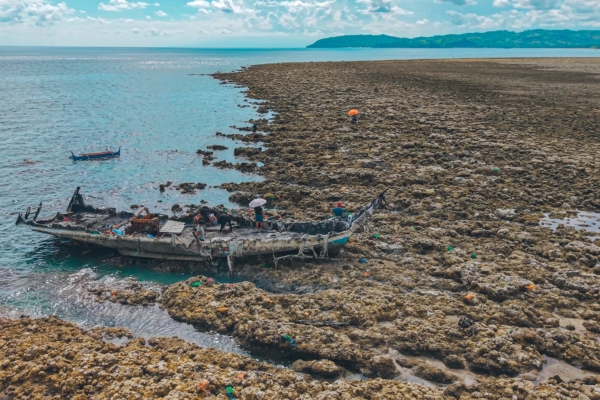
The Philippine Department of Environment recently announced that the strong earthquake that struck the southern waters of the Philippines earlier this month not only caused significant loss of life but also triggered an extremely rare geological event. Parts of the seabed in the affected area were physically elevated by about two meters, leading to a phenomenon known as “coastal uplift.” This phenomenon has resulted in vast stretches of seabed and coral reefs that were previously submerged underwater now being completely exposed to the air, causing mass deaths of marine life and posing a catastrophic threat to coastal ecosystems.
According to various media reports, a 7.8 magnitude earthquake hit the waters off the southern Philippine island of Mindanao on June 8. The National Disaster Risk Reduction and Management Council of the country confirmed last Sunday (June 14) that the earthquake had claimed at least 61 lives, with 40 people missing and 1,403 injured. Additionally, over 54,000 homes were damaged by the disaster.
Shortly after the earthquake, local residents along the coast began to notice unusual changes in the landscape. The sea level remained abnormally low and showed no signs of returning to normal. They reported this anomaly to authorities on June 10.
Upon receiving the reports, the Philippine Department of Environment and Natural Resources dispatched a team of experts to investigate the situation. The team discovered that vibrant colored coral reefs and seagrass beds that were once submerged in the sea had now been fully exposed to sunlight. The Pangyan Marine Protected Area in Sarangani province was particularly hard-hit.
Investigations revealed that the epicenter of the earthquake was near the highly active Cotabato Trench. The movement of tectonic plates during the quake released an incredible amount of energy, causing significant displacement of the coastlines in Sarangani and Davao Occidental provinces, pushing them seaward.
The latest survey data shows that parts of the seabed near the affected area have been raised by about 2 meters. Simultaneously, the land area has expanded, with the coastline extending about 200 meters further into the ocean.
Official surveys and reports indicate that the sudden uplift trapped marine life instantly. As a result of the lack of water and nutrients, extensive coral reefs and seagrass began to wither, leading to the deaths of reef fish, eels, clams, and other marine animals unable to retreat to deeper waters in time. The carcasses of numerous marine creatures now litter the exposed seabed, transforming shallow coral platforms into rocky plains.
Local residents initially feared toxic gases emerging from the seabed. However, subsequent investigations by the environmental department revealed that the foul smell detected by residents was primarily from the vast numbers of dead marine organisms. Environmental monitoring has been initiated to prevent secondary disasters.
Experts stress that while such significant uplift of coastal crusts is rare in history, each occurrence has the potential to rapidly and drastically alter the coastal landscapes and surrounding ecosystems.
The Philippine Department of Environment stated that due to the extensive nature of the crustal movement, authorities are currently unable to accurately estimate the overall scale of ecological damage. However, preliminary assessments suggest that the widespread destruction of coastal habitats will result in irreversible harm to local marine resources, severely impacting the livelihoods of fishermen who rely on these waters for survival. Authorities are continually monitoring environmental changes while evaluating plans for ecological restoration in the aftermath of this extensive natural landscape transformation, acknowledging the immense challenges faced in rebuilding efforts.