
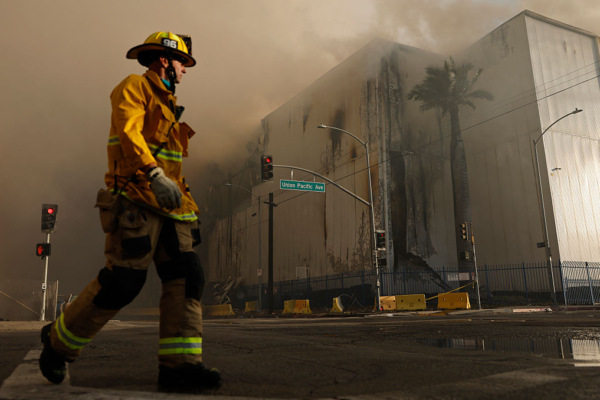
As of Monday, June 22, the fire at the Lineage Company cold storage facility in Boyle Heights, Los Angeles has entered its sixth day. While the fire has been contained, flames still occasionally flare up inside the collapsed building, often accompanied by billowing smoke. Officials have stated that the open flames will be completely extinguished by the weekend, but in the coming days, thick smoke will continue to envelop the surrounding areas. On Sunday, around the SoFi Stadium, where the World Cup matches are being held, air pollution remains a concern.
30 miles away from the fire site in the Pomona community, a resident mentioned during a phone interview on Monday afternoon that they could still feel the air pollution caused by the fire. Monitoring data from the Los Angeles County Department of Public Health on Sunday indicated that the smoke has drifted towards central Los Angeles County, San Gabriel Valley, and eastern San Fernando Valley, where the PM2.5 concentrations have reached levels classified as “unhealthy to very unhealthy” for sensitive individuals.
Why has this fire continued for nearly 6 days before being controlled? According to Los Angeles Fire Department Chief Jaime Moore’s briefing last Saturday, the outer walls of the cold storage building are made of corrugated steel panels with a very dense foam filling.
Describing the material, Moore explained that the walls and roof of the cold storage are made of Insulated Metal Panels (IMP). This lightweight composite panel consists of metal layers on both sides with insulation foam in between, providing excellent thermal insulation, and is a standard construction material for large cold storage facilities. However, once the foam inside ignites, it is challenging to extinguish; and the metal panels block water streams, making it difficult to penetrate the interior of the walls.
Moore likened the burning building to a large refrigerator, stating, “We are dealing with a 500,000 square foot commercial building for frozen foods. The best description is: it’s like a giant cooler, imagine if your refrigerator caught fire inside, and it has a hard shell on both the inside and outside.”
Why is there a significant amount of thick smoke being produced? Moore explained that this is due to the ignition of Class A combustibles. Compared to Class B and Class C combustibles, Class A materials produce the most and darkest smoke during a fire.
To prevent the spread of the fire, firefighters have been forced to dismantle parts of the cold storage’s exterior walls. According to the Fire Department’s report, every time they cut open a section of the wall or roof near the fire, a large amount of pent-up smoke erupts from the cold storage like a volcano suddenly, as well as the smoke produced from cutting through the smoldering foam inside the walls.
The widespread air pollution is also influenced by the shifting winds. Typically, the Greater Los Angeles area experiences land breezes (blowing from the east and northeast towards the west) during the late night and early morning hours, and shifts to west or southwest winds by noon and afternoon, causing the spread of polluted air.
According to the South Coast Air Quality Management District, the smoke is most severe during the late night and early morning hours due to the “June Gloom” phenomenon in Southern California. This atmospheric condition traps smoke near the surface, preventing it from dissipating into the atmosphere, and instead causing it to spread to the surrounding areas.
Regarding the cause of the fire, according to the latest statement released by the Lineage Company, it is suspected to have started during testing of the solar panel array on the roof by a contractor.