
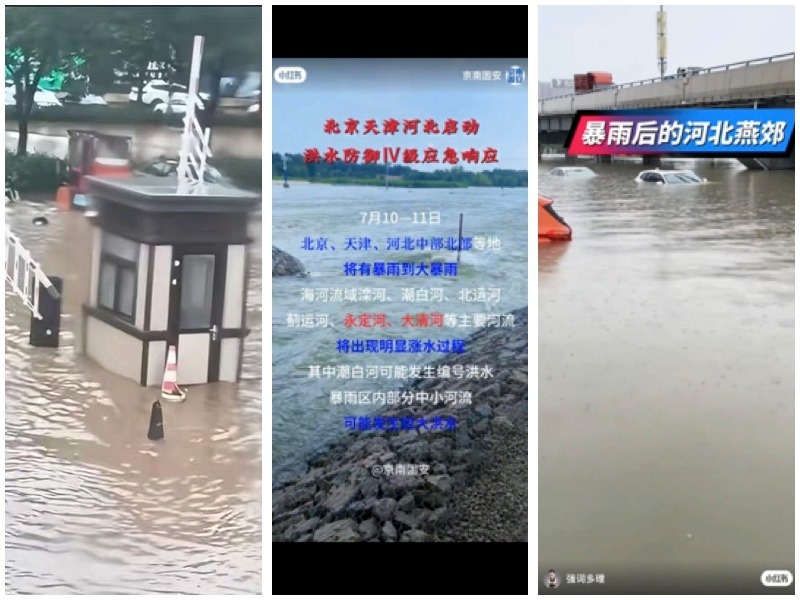
Beijing and parts of Hebei Province in China have been closely monitoring the approach of Typhoon Bavi as it made landfall on the night of July 11th. On the morning of July 11th, areas such as Tangshan and Chengde in Hebei Province have already entered a state of anticipation known as “watching the sea,” with nearly 100,000 people in Beijing having been evacuated the day before. By the evening of July 11th, parts of Yanshou were already experiencing waist-high water levels. The capital city, Beijing, lifted its red rainstorm warning for the entire city on the morning of July 12th, although some areas in the east and southeast continued to experience heavy rainfall.
In the early morning of July 11th, Tangshan City issued red rainstorm warnings for Fengrun District, Zunhua City, and Qian’an City, where northern areas had already received over 100 millimeters of rainfall.
Rainfall persisted throughout the day and night on July 11th, with heavy to torrential rain continuing in various counties and regions in the central and northern parts of Tangshan City, and some areas experiencing severe rainstorms.
In urban areas, as well as in Zunhua, Qianxi, Qian’an, Yutian, Fengrun, and other regions, accumulated rainfall over a 24-hour period exceeded 200 millimeters, with some areas potentially receiving over 250 millimeters of rain, and peak hourly rainfall intensities reaching 50 to 80 millimeters.
At 11:00 am on July 11th, the Water Resources Department and Meteorological Bureau of Hebei Province jointly issued a flood risk weather warning. From 11:00 on July 11th to 11:00 on July 12th, a red flood warning was issued for Qianxi County and Zunhua City, a yellow warning for Yutian County, Fengrun District, and Qian’an City, and a blue warning for Luancheng City.
Speaking to reporters on the evening of July 11th, Wang Hua (pseudonym), a resident of Zunhua City in Tangshan, reported that by midday, roads were heavily flooded, making travel extremely difficult. She emphasized that despite evacuation notices, the flooded conditions rendered evacuations nearly impossible, as all roads and bridges were submerged.
Meanwhile, Tangshan residents currently away from home expressed concerns about large amounts of water in their villages, with ongoing heavy rain and forecasts predicting several more days of rainfall, leading to heightened anxieties.
Although Cangzhou in Hebei Province did not issue a red rainstorm warning, heavy rainfall persisted intermittently. Local villagers reported significant thunderstorms on the previous day, with rain falling heavily at times and stopping at others. By the evening, the weather had improved, but strong winds and unpredictable rain patterns continued.
Neighboring Yanjiao in Hebei Province faced severe flooding following the rainstorm. Videos recorded on July 12th showed cars submerged in water up to their windows on the streets. Residents lamented that each heavy rain spell brought disaster to Yanjiao, where inadequate urban infrastructure management led to severe waterlogging issues.
An informed source in Hebei pointed out that Yanjiao’s inadequate drainage systems and urban infrastructure maintenance contributed to the severe flooding incidents. The Ministry of Water Resources had activated a level IV emergency response for flood defense in Beijing, Tianjin, and Hebei Province, due to forecasts of severe rainstorms between July 10th and 11th in the central and northern parts of these regions.
In response to the flooding in Hebei, mainland Chinese social media users expressed criticisms towards Beijing, suggesting that the capital frequently diverts water to surrounding areas to protect itself. Some Hebei residents expressed frustrations, claiming that they are often the first to suffer when Beijing experiences flooding.
Online discussions among netizens noted the increasing frequency of extreme weather events and suggested preparing to invest in boats for future occurrences.
Tangshan in Hebei Province is situated downstream in the Hai River basin and plays a crucial role in the flood control system. When water levels increase in upstream regions of Beijing and Hebei, rivers such as the Luan River and Dou River in Tangshan will also be impacted.
Hebei officials recently emphasized the need to be prepared during the main flood season, focusing on potential flood risks in the Yongding River, North Sanhe River, and Luan River areas.
Official reports indicated that nearly 100,000 people in Beijing were evacuated on July 10th, with mountainous accommodations closed and over 180 scenic spots temporarily shut down. Water management authorities in Beijing announced increased discharge from 20 medium to large reservoirs, with approximately 500 million cubic meters of flood capacity preserved.
Furthermore, the Qingshui River, Beiyun River, and urban lakes began releasing water to create additional flood storage space, totaling around 10.49 million cubic meters.
Despite Mentougou being on red rainstorm alert, significant rainfall only began in the area at 10:30 pm on July 11th, prompting locals to humorously comment on the awaited “thunderstorm’s arrival.”
On the night of July 11th, Beijing experienced widespread heavy rainfall, with the highest precipitation recorded at 186.1 millimeters in Jianguo River, Pinggu District, reaching the level of a severe rainstorm.
Up until the time of writing on July 12th, official reports had not indicated the formation of floodwaters in the Beiyun River as forecasted earlier.
On the morning of July 12th, Beijing lifted its city-wide red rainstorm warning, maintaining it only in Pinggu District, while still highlighting the potential for heavy rainfall in some eastern and southeastern regions according to the meteorological station.