
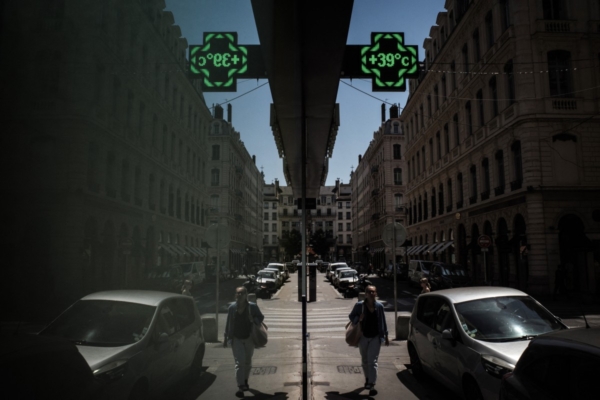
As the early summer sets in, an extreme heatwave has swept through most parts of Western Europe. The soaring temperatures have already led to at least 7 deaths in France. Meanwhile, both France and the United Kingdom have set record-high temperatures for May. On Tuesday, temperatures continued to rise.
With the heatwave intensifying, as forecasted by the meteorological department, temperatures across many parts of France soared on Tuesday. Several cities recorded temperatures nearing or exceeding 39℃, with Lyon in the east registering temperatures of 39℃ to 40℃ on pharmacy thermometers, breaking historical records in many areas.
French government spokesperson Maud Bregeon confirmed on Tuesday to TF1 that “there have been 7 fatalities directly or indirectly related to the high temperatures, including 5 deaths from drowning.”
Data from Météo France revealed that on Monday, the southwestern French department of Les Landes near Hossegor recorded the highest national temperature at 37.1℃. The average temperature measured by 30 meteorological stations across the country on Monday was 24.4℃, surpassing the 1944 record of 23.7℃ to become the hottest May day in France’s meteorological history.
The UK’s Met Office also announced that on Monday, temperatures reached 34.8℃ at Kew Gardens in southwest London, marking the hottest day in May on record in the UK. The weather agency described this figure as “very rare even in midsummer in the UK, let alone in May.”
This heatwave is also sweeping across Southern Europe. The Spanish National Meteorological Agency, Aemet, reported widespread temperatures ranging from 36℃ to 38℃ in the valleys of the Guadiana, Guadalquivir, and Ebro rivers, with some areas possibly nearing 40℃.
In the Lazio region, including Rome, Italian authorities have prohibited outdoor operations exposed to sunlight for extended periods from 12:30 to 16:00.
In France, the sudden heat has resulted in multiple tragedies. Two deaths on Sunday were directly attributed to the high temperatures: a woman participating in the Hyrox fitness competition in Lyon died from heatstroke, and a 53-year-old man in Paris suffered a heart attack and died during a 10 km race.
Furthermore, during another road race in Maisons-Alfort in the Paris suburbs, 16 individuals required medical treatment due to heat-related discomfort, with 10 of them in critical condition.
The high temperatures have led many people to seek relief by swimming in beaches and rivers. However, with lifeguard surveillance at most beaches not commencing until July, several drowning incidents occurred over the weekend, including three teenagers among the fatalities.
Following the setting of new historical May highs at over 350 meteorological stations in France, 8 out of the country’s 96 mainland departments have been placed under orange heat alerts (the second-highest level), with another 20 departments under yellow alerts. This marks the first activation of the national heat alert system in May since its establishment in 2004.
French Prime Minister Sébastien Lecornu has urgently convened a meeting with key ministers on Thursday to assess the government’s preparedness for the heatwave.
Climatologist Christophe Cassou, in an interview with Le Monde, stated, “This is an unprecedented event. Considering the climate background from 1979 to 2025, the probability of such events occurring at this time of year is only one in a thousand. In pre-industrial times, this was almost impossible.”
Climate researcher Robert Vautard also told AFP that as the heatwave season prolongs, “eventually, we will see similar heatwave events in April and October.”
Global data indicates that extreme heat annually contributes to around 500,000 deaths, known as the “silent killer.” Extreme high temperatures are rarely listed directly as causes of death; they primarily exacerbate chronic illnesses like heart disease, respiratory conditions, and kidney diseases that indirectly lead to fatalities.
The current heatwave in Western Europe exhibits three particularly threatening characteristics:
Heat Dome Effect:
Météo France pointed out that this heatwave is caused by a “heat dome,” with hot air trapped from Morocco within a high-pressure area, leading to prolonged high temperatures.
Increased Humidity Heightening Heat Perception:
When the air is hot and humidity levels are high, sweat adheres to the skin and cannot evaporate to cool the body, causing the perceived temperature to be higher than the actual air temperature, often determining life or death.
“Sleepless Nights” Prevent Recovery:
When nighttime temperatures do not drop below 20℃ (known as “tropical nights” in European meteorology) or 25℃ (referred to as “equatorial nights” in Spain), the inability for the body to rest and recover through the night exacerbates heat-related injuries during the day.
Medical experts and meteorological departments advise the public to take the following preventive measures:
Reduce Outdoor Exposure:
Avoid going outdoors during the hottest periods of the day (noon to 4 pm), staying in shaded areas when necessary.
Adjust Home Ventilation:
Close blinds or curtains during the day to block direct sunlight and keep windows shut to prevent hot air from entering; open windows for ventilation when outdoor temperatures are lower than indoors at night.
Stay Hydrated and Avoid Heatstroke:
Regularly drink water, wear loose, lightweight clothing even when not feeling thirsty.
Care for Vulnerable Groups:
Elderly individuals, those with underlying health conditions, homeless individuals, and women are at higher risk of heat-related issues. Pay special attention to the health of these groups in the community.
(Information referenced from The Guardian and other sources.)