
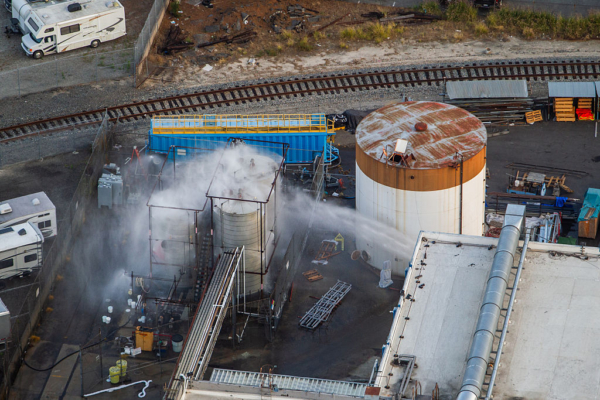
Orange County’s dangerous chemical leak incident has entered its fifth day. Officials on Monday (25th) stated that the threat of a large-scale chemical “vapor explosion” has been largely eliminated, and the tank temperatures are decreasing. However, the danger has not been fully resolved, and mandatory evacuation orders remain in effect.
On Monday morning, Orange County Fire Authority (OCFA) Fire Captain and Unified Incident Commander Craig Covey announced that the possibility of a “Boiling Liquid Expanding Vapor Explosion (BLEVE)” has been ruled out.
A BLEVE is considered the most dangerous type of explosion, capable of triggering powerful shock waves, flying tank fragments, and deadly fireballs, with a widespread impact.
Fortunately, according to the latest update on Monday, this worst-case scenario has been averted. “The temperature has stabilized. It is currently at 93 degrees Fahrenheit (about 33.9 degrees Celsius), down from the previous 100 degrees Fahrenheit,” Covey said, “This has lessened the impact of the accident.”
But officials warn that the danger is not over yet, and emergency rescue workers are continuing to work around the clock.
The chemical crisis began last Thursday afternoon at GKN Aerospace in Garden Grove, Orange County, where a tank containing about 7,000 gallons of methyl methacrylate, a highly toxic and highly flammable liquid chemical, malfunctioned and overheated, releasing vapor into the air. The facility is located about 10 minutes away from Disneyland in California. As of now, approximately 50,000 residents are under evacuation orders.
Following the incident, as the tank could not be effectively controlled, the rescue teams prepared for the two worst-case scenarios: a tank rupture leading to the release of thousands of gallons of chemicals, or a catastrophic explosion.
As of Monday, OCFA Acting Chief TJ McGovern stated that the team’s greatest concern, the threat of a “vapor explosion,” has been largely eliminated, but the risk of leaks and other forms of explosions still exists.
Currently, firefighters are continuously spraying water on the outer walls of the tanks to cool them down and help prevent an explosion. McGovern said, “We want to reiterate that the evacuation area is still in effect. Please adhere to the regulations of the evacuation area.”
The elimination of the worst-case scenario “vapor explosion” threat is attributed to a “crack.”
Officials revealed on Sunday that they discovered a suspected crack inside the damaged chemical tank, which is considered a “positive intelligence.” Firefighters conducted a reconnaissance mission on the tank at night.
McGovern pointed out that “this crack may be helping to release some of the accumulated pressure within the tank,” thereby reducing the risk of a severe explosion.
In response to the emergency event, California Governor Newsom declared a state of emergency for Orange County on Saturday morning, with the California Governor’s Office of Emergency Services (CalOES) and all state government agencies providing full support to Orange County.
The evacuation zone is centered around the tank facility and extends outward to parts of Cypress, Stanton, Anaheim, Buena Park, and Westminster.
Regarding public health, Orange County health official Dr. Regina Chinsio-Kwong stated that methyl methacrylate is heavier than air and may carry a fruity odor; exposure to its vapors could cause severe respiratory irritation, dizziness, nausea, as well as itching or burning sensation in the eyes.
At this stage, the public can access emergency directives issued by the emergency management department and seek rescue assistance from the city’s official website (https://ggcity.org/emergency). The situation on-site may change at any time, so please stay tuned for real-time updates. ◇