
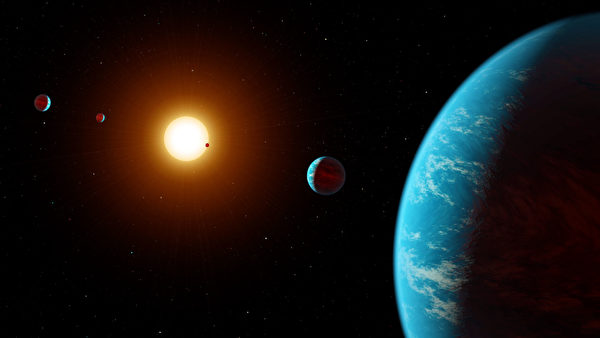
Scientists are currently documenting a planetary system within the Milky Way that is starkly different from our own solar system, to the extent that experts are struggling to find suitable terms to describe it.
This system contains a red dwarf star, CD-35 2722, with a mass approximately 40% of the Sun’s, orbited by a brown dwarf (an object between a planet and a star). Furthermore, this brown dwarf is orbited by a gaseous, Jupiter-sized object. The European Southern Observatory’s Very Large Telescope in Chile has revealed this celestial body in the system.
Compared to the frame of reference defined by our solar system, an object orbiting a star would typically be called a “satellite,” or in this case, an “exomoon” as it is situated outside our solar system. However, the object circling the brown dwarf in this system is substantially different in composition and size from the numerous satellites in our solar system, most of which are relatively small rocky or icy bodies.
According to a press release from the European Southern Observatory, if confirmed, the object orbiting the brown dwarf could be the first “exomoon” discovered outside our solar system.
This new discovery was published in the journal “Nature.” Kevin Hoy, a doctoral student in astrophysics at Universidad Diego Portales in Chile and the lead researcher, acknowledged the potential controversy surrounding the terminology for such objects beyond our solar system, suggesting “exosatellite” as a temporary name for these newfound celestial bodies until a formal definition is established.
Hoy remarked, “Given its role as a ‘third party’ in this system, it tempts us to call it a moon, but it is fundamentally distinct from the smaller rock and ice satellites in our solar system.” He explained that describing other systems has pushed the limits of terminology created to describe the solar system.
The system is located approximately 71 light-years away from Earth. The mass of the exomoon is at least equivalent to 90% of Jupiter’s mass. It takes 170 days for this object to complete one orbit around the brown dwarf, with its orbit distance approximately one-fifth of the Earth-Sun distance.
Alice Zurlo, an astrophysicist at Universidad Diego Portales and the director of the YEMS group studying exomoons, highlighted the complexity of defining such objects within the CD-35 2722 system due to the blurred boundaries among a star, planets, and satellites compared to the clear distinctions in our solar system.
She noted, “We intentionally refrain from labeling it as a ‘moon’ as this object differs significantly from any satellite within our solar system in terms of mass and its orbit around the brown dwarf rather than a planet. As we have never encountered such a planetary system before, we are still exploring the best way to describe it.”
Despite the discovery of over 6300 exoplanets (planets outside our solar system), identifying exomoons remains challenging, with only a few strong candidates confirmed so far.
Zurlo emphasized, “While this system is very peculiar, it is truly unique and represents a breakthrough as the first credibly detected exomoon.”
Research efforts are underway to determine the origin of this exomoon. Zurlo suggested possibilities involving formation within the gas and dust disk around the brown dwarf similar to planet formation around stars or later capture by the brown dwarf through gravitational forces.
Brown dwarfs are classified as “failed stars” since their mass during formation did not trigger nuclear fusion as in stars, yet their mass exceeds that of the largest planets.
In this system, the brown dwarf’s mass is around 33 times that of Jupiter, with a volume 50% larger and significantly higher temperature than Jupiter.
Zurlo added, “Due to the system’s youth, the brown dwarf still emits residual heat from its formation.”
Since the detection of exoplanets in the 1990s, scientists have identified various planetary systems ranging from ones resembling our solar system to those vastly different. The system examined in this new study falls into a unique category.
Hoy commented, “Yes, this system is indeed bizarre. Its current state likely stems from a rather chaotic dynamical evolution, but pinpointing the exact nature of its tumultuous history proves challenging.”
(This article is partially based on reports from Reuters)