
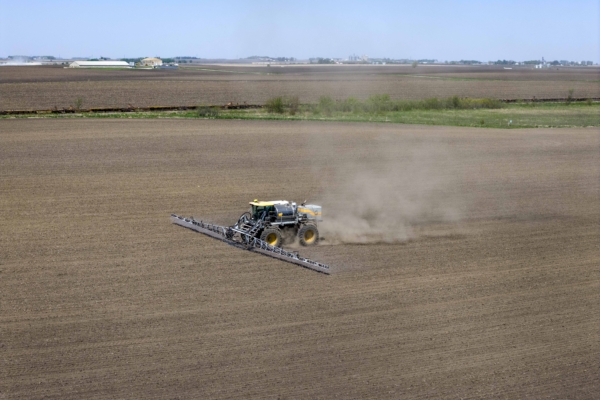
California Governor Gavin Newsom signed a scaled-down bill this week requiring California to start labeling pesticides containing “per- and polyfluoroalkyl substances” (PFAS) in its public use reporting database.
This bill, signed on September 27, will mandate the California Department of Agriculture to begin labeling pesticides containing PFAS in its public use reporting database no later than January 1, 2028, or upon the 2026 data release, whichever is earlier. According to a review article published in 2024 in Environmental Health Perspectives, PFAS are increasingly being used as active ingredients in insecticides.
Monica Amarelo, Media Relations Deputy Director of the Environmental Working Group, an advocacy organization supporting the bill, stated that this will enable the state government to track which pesticides containing PFAS are currently being used, where they are being applied, and further research how to gradually phase out these pesticides.
The initial version of this bill was proposed by Burbank State Assemblyman Nick Schultz, who originally sought to prohibit state regulatory agencies from approving new pesticides containing PFAS chemicals. However, some agricultural groups opposed the bill. Renee Pinel, President and CEO of the Western Plant Health Association, expressed concerns in an interview with Chemical & Engineering News in June, stating that the bill “restricts safe, common-use products… without scientific justification.”
According to a 2020 report by the U.S. Department of Agriculture, California is the largest producer of agricultural products (including crops and livestock) in the United States, accounting for approximately 11% of the total production. The Central Valley of California, including the San Joaquin Valley, is often referred to as the “world’s breadbasket,” as it produces a significant portion of fruits, nuts, and vegetables for the U.S. and global supply. In 2024, California accounted for 13.5% of total U.S. agricultural exports according to the California Department of Food and Agriculture.
Legislators in California claim that PFAS substances are a category of “persistent and highly toxic chemicals” causing widespread contamination in various parts of the United States, including California.
They also estimate that 98% of U.S. residents have PFAS in their blood, and the state government’s water quality testing data shows that PFAS has been detected in the drinking water of 25 million Californians.
A study published in the Journal of the National Cancer Institute in 2024, focusing on 400 mother-child pairs in Finland, found a correlation between higher prenatal exposure to certain “per- and polyfluoroalkyl substances” and an increased risk of childhood leukemia.
Products that may contain PFAS include cookware with nonstick coatings, as well as textiles and fabrics with waterproof and stain-resistant properties, including outdoor clothing, carpets, upholstered furniture, and furniture treated with waterproof coatings.
A study published by the U.S. Department of Health and Human Services in 2016 found evidence that chemicals in the PFAS family may interfere with the human immune system. According to the National Institutes of Health website, “Evidence supporting alterations in immune function due to these chemicals includes conclusions that PFOA and PFOS can alter human immune function.”
While PFAS can be destroyed, it requires strict handling procedures. According to a review by the UK Environment Agency, high-temperature incineration under tightly controlled conditions is currently the only method to effectively destroy PFAS on a large scale.
Last month, a federal judge approved a settlement agreement exceeding $2.5 billion between the state of New Jersey and DuPont, Chemours, Corteva, and 3M for PFAS “forever chemicals” contamination at four industrial sites across the state.
Chief Judge Renée Marie Bumb of the federal district court in New Jersey stated in a ruling announced on August 7 that these settlement agreements were submitted in 2019 and reached last year, calling it a “noteworthy windfall.” DuPont, Chemours, and Corteva will pay $875 million over 25 years for natural resource and other damages, cleanup of the four former industrial sites, and establish a $1.2 billion remediation fund. Meanwhile, 3M will pay up to $450 million during the same period. ◇