
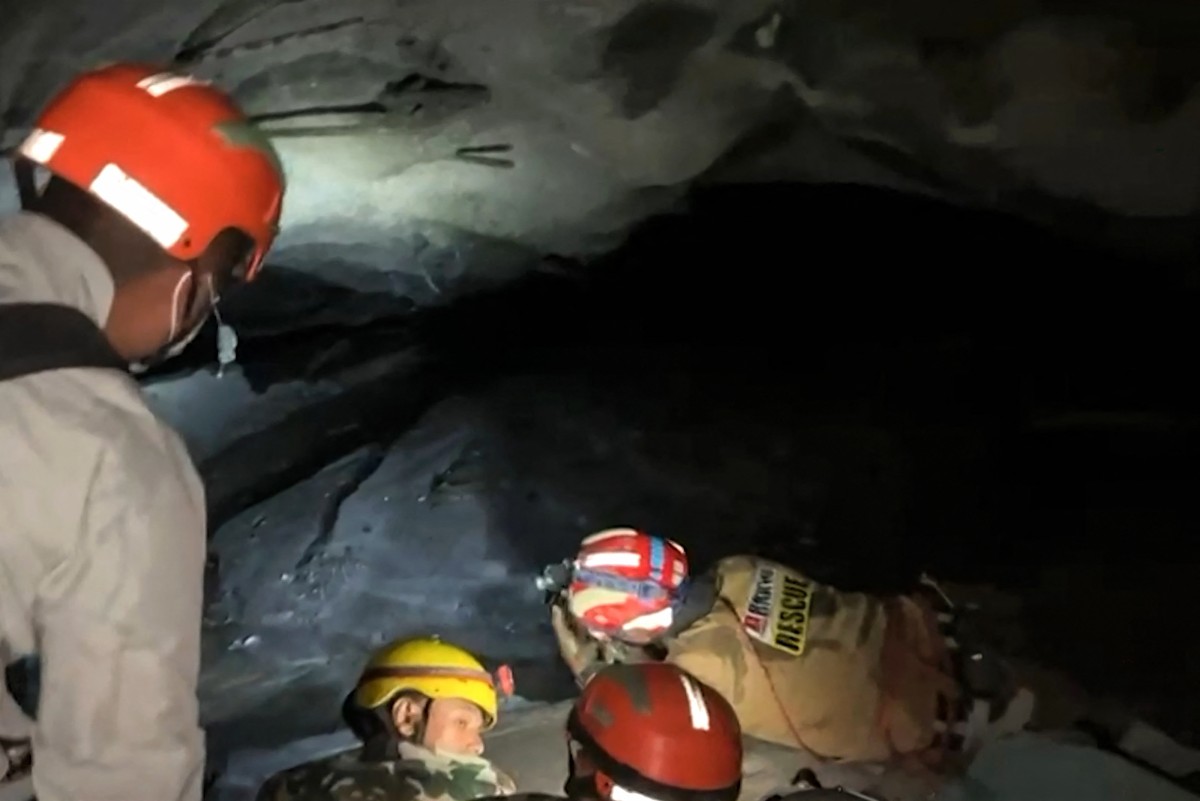
Last week, a devastating flood and mudslide broke out at the China-Nepal border, trapping nearly a thousand hydroelectric project workers in Nepal inside tunnels with over a thousand people dead. Dhan Bahadur Tamang, one of the hydroelectric workers, shared his terrifying escape experience from the flooded dark tunnel. He described the scene of bodies everywhere in the tunnel that still haunts him to this day.
When the flood hit, the 32-year-old Tamang was inside the underground tunnel of the Upper Trishuli 1 hydropower project. He recalled sensing a sudden change in air pressure, noticing dust rising under the industrial lights, signaling an impending disaster. The raging flood had already flattened an entire settlement upstream of the Trishuli River and was surging down the valley with massive destruction, resulting in at least 1,252 deaths in Nepal.
Tamang, a support staff hired for the project, mentioned that there might have been hundreds of people on-site when the disaster struck.
“Suddenly, people started running, shouting, and frantically trying to escape,” Tamang said. Water began rushing into the tunnel area where he was, and before he knew it, he found himself on top of a fuel tanker. The vehicle started moving.
“I felt like I was going to die multiple times,” he said, recalling how he desperately held onto anything he could, climbing pipes to prevent being engulfed by the rushing floodwaters. He injured one of his legs in the process.
“My mind was filled with thoughts of my family. I thought of home, my parents, and those I might never see again. I shouted loudly, I cried,” he said.
When the flow of the flood slowed down, Tamang discovered he was still alive. He was relieved to find that the others with him had also survived.
They attempted to walk towards the entrance they had entered the tunnel from but found it blocked, making it impossible to pass through. They had no choice but to seek another way out deeper into the tunnel.
“We kept on moving and started seeing bodies,” he said. Some people were injured and immobile.
“Bodies were everywhere. We desperately tried to escape and save our lives. Some were crushed too severely to be rescued. They were already dead,” he said.
At that time, the tunnel was almost pitch black. Therefore, Tamang and others held hands to avoid getting separated. With the illumination of a flashlight, they carefully navigated through the debris, progressing step by step.
“It was a long and exhausting struggle. We moved forward amidst darkness, floodwaters, debris, and bodies,” he said, adding, “Suddenly, a beam of light appeared.”
“When we finally emerged from the tunnel, the light outside felt surreal,” he said.
The trembling survivors were quickly surrounded by others and provided with dry clothes. However, due to thick fog, helicopter rescue operations were stalled, causing overall rescue progress to be slow.
Tamang was determined to reunite with his family and continued his journey with the help of villagers but was later taken to a hotel and then transferred to a hospital for examination.
“When I finally saw my wife, she cried,” Tamang said. “She refused to eat for four or five days until she saw me again. After I returned, we made a meal together, and only then did she eat a little. But it hit her hard. She fell ill the next day.”
Since returning, Tamang has been plagued by nightmares, constantly reliving the tunnel’s scenes and memories of his deceased colleagues.
“I will never work in a hydroelectric project tunnel again,” he said. “I don’t want to risk my life anymore.”