
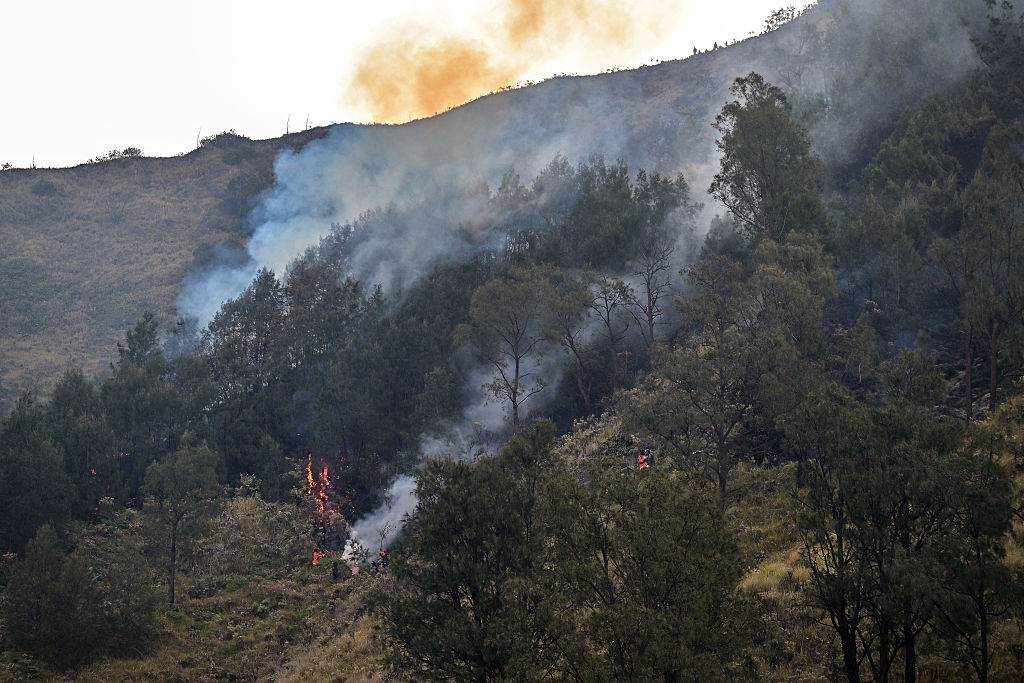
On Tuesday, in response to the ongoing spread of wildfires and haze, dozens of schools in Indonesia have been closed for a second consecutive day. The Indonesian government has stated that they are intensifying efforts to control forest and land fires in six key provinces to slow down the spread of haze.
According to reports from Reuters, with the intensification of the El Niño phenomenon, Indonesia is facing a longer and more severe dry season this year, increasing the risks of forest fires and air pollution.
The six key fire-prone provinces identified by the government include Riau, Jambi, and South Sumatra on Sumatra Island, as well as West Kalimantan, Central Kalimantan, and South Kalimantan on the island of Borneo.
The wildfires have also affected other provinces on Java Island, Papua Island, and the Nusa Tenggara Islands. A major fire in the Bromo Tengger Semeru National Park in East Java Province has reportedly burned around 900 hectares of land, with authorities stating that the fire is mostly under control.
Data from the Indonesian Ministry of Forestry shows that from January to June, a total of 107,465 hectares (265,552 acres) of land have been affected by fires, an increase of 110% compared to the same period in 2023.
Minister of Political and Security Coordination Djamari Chaniago stated on Monday to reporters, “Given the current climate conditions that could indeed lead to further expansion of fires, we are maintaining a high level of vigilance.”
The mayor of Pontianak City, the capital of West Kalimantan Province, mentioned that due to deteriorating air quality caused by smoke, all schools in the city have switched to online classes.
Chaniago mentioned on Monday that Indonesia has deployed 43 helicopters and up to 15 fixed-wing aircraft for cloud seeding in necessary areas.
Furthermore, Chaniago indicated that there are signs suggesting that the El Niño phenomenon may have reached its strongest level in Indonesia.
Dana Prima Tarigan from the Indonesian Forum for the Environment (WALHI) stated that the main causes of these fires are deforestation for palm oil plantations, mining, and other land clearing activities, leading to dry and flammable land.
“El Niño exacerbates this situation by reducing rainfall, prolonging the dry season, and weakening the water supply of ecosystems,” added Tarigan.
As Indonesia prepares to tackle the most severe impacts of the El Niño phenomenon, the Indonesian Meteorology, Climatology, and Geophysics Agency (BMKG) reported an average temperature of 27°C in July, higher than the average of 26.2°C.
BMKG noted that this is the largest temperature increase in July since 1991.
Data from the Malaysian Department of Environment shows that as of August 11th, 11 areas in the Malaysian state of Sarawak on Borneo Island have recorded unhealthy air quality levels, bordering Indonesia.
The Sarawak State Education Department has instructed schools to suspend outdoor activities when temperatures are too high or the Air Quality Index exceeds 100.
El Niño is a naturally occurring climate phenomenon that causes changes in wind patterns, air pressure, and rainfall patterns globally. In Indonesia and Southeast Asia, it typically results in drier climates.