
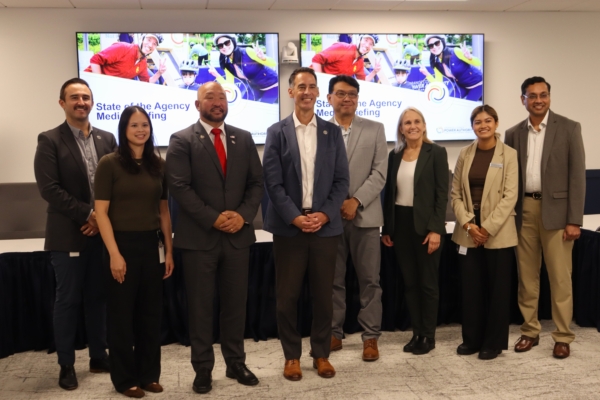
On August 18, the non-profit community energy provider, Orange County Power Authority (OCPA), held a briefing for Asian media to introduce their efforts in maintaining stable prices for renewable energy and affordable rates for residents, as well as discount programs available for using green energy.
James Mai, Vice Mayor of Irvine City and Vice Chairman of Orange County Power Authority, mentioned that OCPA originated in Irvine City but has expanded its services beyond the city, reaching various areas in Orange County.
In 2002, California passed the AB117 law establishing the Community Choice Aggregation (CCA) program, allowing counties, cities, and authorized entities to collectively purchase or generate electricity for residents and businesses within their jurisdiction. Currently, about one-third of California’s users, approximately 15 million, have joined 25 different CCA programs in various regions.
Irvine City invested $7.5 million in 2020 to assist in the establishment of Orange County Power Authority, being the largest user of OCPA. Initially, OCPA faced controversies regarding management and transparency, leading to a change in leadership. While one of the initial four cities, Huntington Beach, withdrew in 2023, Irvine City discussed but ultimately decided to remain in OCPA. Currently, Irvine, Fullerton, and Buena Park serve approximately 188,000 users. With Fountain Valley set to join operations next year, the total number of users is expected to reach 200,000.
Even in Irvine City, about 70% of users have opted to join OCPA through the free choice mechanism. New residents automatically enroll in the default basic plan upon moving in (including 44% renewable energy). Residents who wish to opt-out can do so at any time and return to Southern California Edison (SCE). Those who prefer to support green energy can choose a 100% renewable energy plan at slightly higher rates than the basic one.
James Mai added that OCPA has implemented fixed-rate plans this year to reduce price fluctuations. Although Southern California Edison adjusted rates last year, the cost difference between the two providers is minimal. He emphasized that every Irvine resident has the right to choose between Edison and OCPA. For those valuing green energy and climate change mitigation, OCPA provides a good option, offering discount programs for seniors or low-income individuals to reduce electricity costs.
Joe Mosca, CEO of OCPA, took on the role as interim CEO in June 2023 and officially became CEO in March 2024. Mosca stated that OCPA’s mission is to provide stable rates for renewable energy, support community sustainability, and reduce carbon emissions. Over 200 communities in California have benefited from the CCA program, collectively taking on a quarter to a third of the state’s energy load with California Independent System Operator (CAISO).
Mosca noted that OCPA successfully issued its first green tax-exempt bonds, allowing prepayment for long-term energy contracts spanning 10 to 15 years. With a total expenditure of $1 billion over 15 years, institutions can save about $5 million annually, reinvesting these profits into user programs. In the 2025-2026 fiscal year, OCPA not only achieved profits but also increased reserve funds, ranking among the top three renewable energy suppliers in the U.S. for three consecutive years.
In terms of operations, OCPA procures a high percentage of green energy while Southern California Edison remains responsible for electricity transmission and billing. To date, the CCA program, particularly OCPA, has reduced over 20 billion pounds of carbon emissions locally.
Additionally, OCPA actively promotes California’s programs for low-income households, such as the California Alternate Rates for Energy (CARE) and Family Electric Rate Assistance (FERA), offering an “Incentive Finder” tool on its website to help users find suitable subsidy programs. This fiscal year, OCPA allocated around $2 million for community programs and received $3 million in funding from organizations like the California Energy Commission.
To address peak electricity usage, OCPA promotes time-of-use energy consumption and battery storage programs, offering subsidies for residential and portable batteries. They also provide subsidies for home energy efficiency upgrades, small business cost assessments, Net Energy Metering (NEM) for solar energy, and free electric vehicle charging stations, continually reinvesting profits back into the community. OCPA also offers internship opportunities for young people.