
During the hot summer days in Southern California, many residents and tourists have been flocking to the beaches to cool off, but this year’s marine heatwave has also brought an unprecedented number of stingrays, injuring thousands of people with their sharp tails.
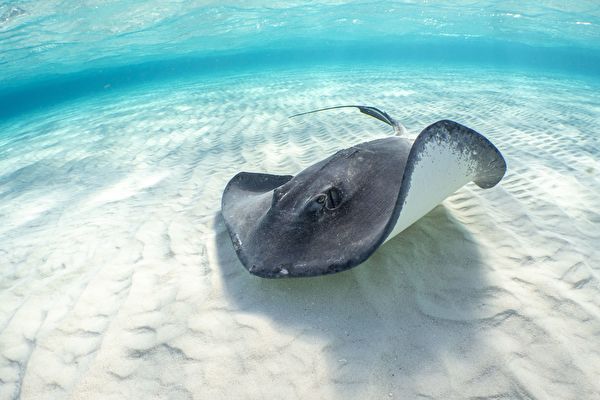
Stingrays, also known as devil fish, yellow stingrays, or stingarees, are cartilaginous fish that have flat bodies and typically inhabit the bottom of water bodies. They are usually gray-brown or brown-gray on their dorsal side and white on their ventral side, making them hard to spot. Stingrays have long, thin tails with a venomous gland on their serrated main spine. When stepped on by humans in the water, they instinctively use their tail spines to inflict pain through neurotoxins entering the bloodstream.
Stingrays prefer warm water environments. Chris Lowe, a marine biology professor at California State University, Long Beach, told the Associated Press, “During El Niño events, these species coming up from the south increase in numbers and move closer to the coast. This year, we expect the numbers to reach record levels.”
Researchers recently caught over 200 stingrays at Seal Beach using a 75-foot-long net, with sizes comparable to dinner plates, filling the seabed with their presence.
Lowe mentioned that lifeguards in Southern California handle over 10,000 stingray injury incidents annually.
So far this year, there have been over 3,100 reported stingray injuries at Bolsa Chica Beach in Orange County and Huntington State Beach, doubling the total number from last year. In particular, over 2,000 incidents were reported along the 5.6-kilometer coastline of Huntington State Beach. The city of Huntington Beach has issued warnings on social media.
Since only incidents handled by lifeguards are officially recorded, the actual number of injuries could be much higher, as many victims may leave the beach on their own without reporting.
If stung by a stingray, beachgoers should seek help from lifeguards immediately.
The Los Angeles County Fire Department’s lifeguard division posted on social media advising beach visitors to shuffle their feet along the seabed when entering or exiting shallow waters, known as the “stingray shuffle,” to avoid stepping on them. If the water visibility is low, it’s best to avoid moving forward.
According to the California Lifeguard Association website, upon being stung by a stingray, it’s important to notify a lifeguard immediately. To treat the wound, ensure no barb remnants are left inside, clean the wound with soap and water to reduce infection risk, soak the injured limb in hot water to alleviate pain or swelling, and avoid applying alcohol on the wound.
Initial pain from the sting may last 1 to 2 hours. If symptoms such as persistent redness, itching, or pus occur in the following weeks, it could indicate an infection, and prompt medical attention should be sought.