
Nepal-China Border Flash Flood and Landslide Result in At least 392 Dead and Over 1,400 Missing
The death toll from the flash flood and landslide at the Nepal-Tibet border has risen to 392, with over 1,400 people missing. While external sources initially attributed the disaster to extreme weather conditions, there are now discussions on the possible human causes as well. The founder of the Taiwan Artificial Intelligence Lab and the founder of Taiwan’s popular online community PTT analyzed pre-disaster aerial photos and concluded that beyond natural factors, this catastrophe should be seen as a human-made disaster, involving issues like encroachment on river territories. It is worth noting that the major buildings on both sides of the affected valley were constructed by Chinese companies.
An international geological research team, in conjunction with climate scientists, analyzed satellite images and proposed that this large-scale disaster may have been triggered by the impact of global warming on the 7,227-meter Langtang Lirung peak, causing a sudden glacier collapse at over 5,000 meters altitude. The resulting flood reached over 30 meters high, aggressively eroding the narrow terrain downstream and devastating the border region.
However, the exact cause of the glacier collapse remains unclear, leading some to question the attributions to natural disasters.
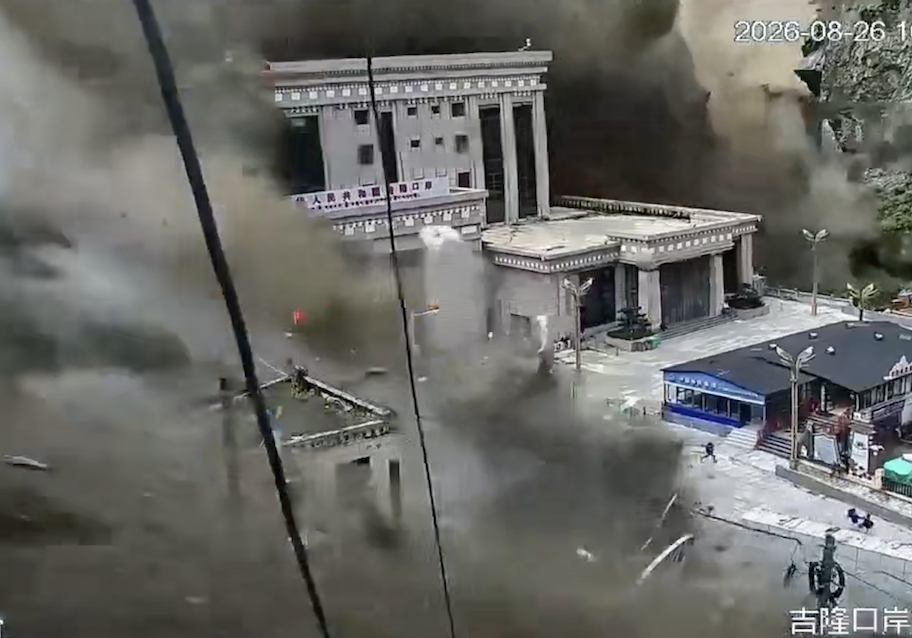
Videos circulating online depict the moment when the flash flood and landslides swept away roads and buildings, especially the heart-wrenching scene of the Gyirong Port Joint Inspection Building in Gyirong County, Shigatse City, on the Nepal-China border being engulfed by the flood, trapping civilians underneath.
On social media, the founder of PTT posted pre-disaster aerial photos of the Gyirong Port in Tibet, expressing frustration that such human-made missteps are often falsely labeled as acts of nature. Critically, he pointed out the inappropriate construction in the river channel, which funneled the floodwaters, exacerbating the disaster.
He lamented that building large permanent structures in river mouths, valleys, or floodplain areas hinders the natural flow of floodwaters, leading to increased water levels, accelerated flow, and concentrated erosion along mountain slopes, exacerbating disasters and casualties.
Moreover, citing the Nepal-China border as an example, he advocated for the construction of temporary, easily replaceable, and low-resident structures within river channels to minimize potential human losses in the face of flooding.
The founder emphasized that while natural disasters dictate the scale of water, the quality of engineering determines the human cost when the water arrives. At an elevation of approximately 1,900 meters, Gyirong Port could have possibly averted this magnitude of disaster if large structures were not built alongside the river valley.
Public records reveal that the main massive buildings in the Gyirong Port area were constructed by Chinese enterprises. These structures, including the National Gate Joint Inspection Building on the Chinese side and the Rasuwagadhi Joint Inspection Building on the Nepalese side, were severely impacted by the recent flash flood and landslides.
On August 26, Nepal and the Tibet border region experienced devastating flash floods and landslides, resulting in nearly 400 deaths, over 1,400 people missing, and 466 others injured.