
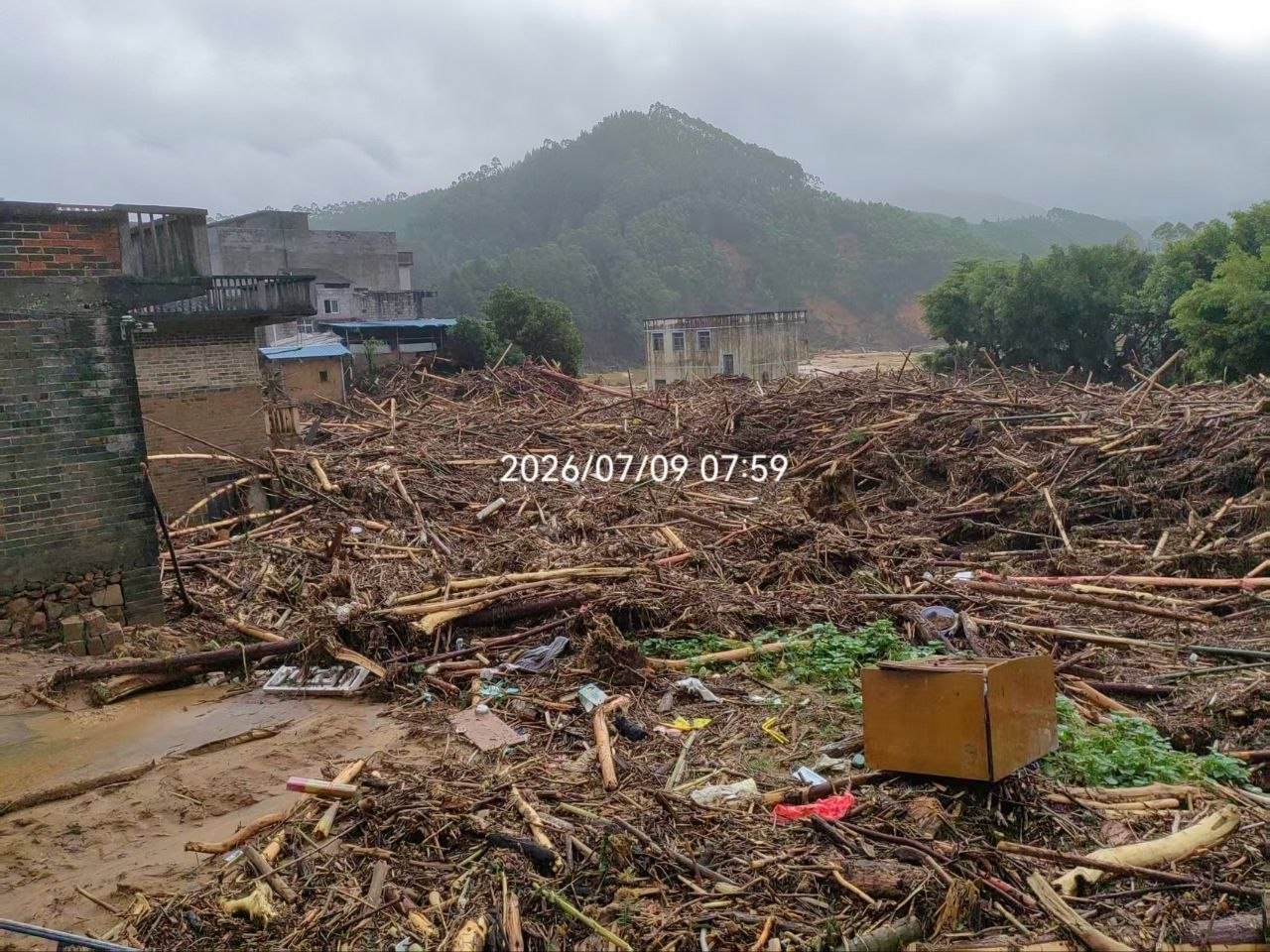
Due to the impact of Typhoon “Mesak”, Guangxi experienced rare and sustained heavy rainfall in early July, leading to severe flooding. On August 21st, local authorities announced after a 6-week interval the number of people affected by the disaster. The disaster has affected over 1.65 million people in the cities of Nanning and Guigang, with 159 reported deaths and 10 individuals still missing, tripling the death toll from the previous announcement. Due to the consistent concealment of disaster information by the Chinese Communist Party, there are suspicions that the actual situation may be even more severe than officially reported.
Public reports indicate that although Typhoon “Mesak” did not directly land in Guangxi, the abundant moisture it carried resulted in continuous heavy rainfall in the region. This heavy rainfall caused the collapse of the Liulan Reservoir and Yunbiao Reservoir in Hengzhou City, Nanning, flooding several villages, destroying numerous homes, and displacing countless families. Guigang City downstream also suffered from severe flooding, with power and communication interruptions, leaving over 10,000 teachers and students temporarily stranded.
On August 21st, Guangxi authorities provided updates on the data for the heavily affected areas of Nanning and Guigang. As of midnight on August 21st, the disaster has affected over 1.65 million people in 16 counties and districts in the two cities, resulting in 159 deaths and 10 missing individuals.
Nanning City has been the most severely affected, with 90 towns and streets in 11 counties experiencing disasters, affecting nearly 579,700 people. As of midnight on August 21st, there have been 136 fatalities and 10 missing persons due to the disaster. Specifically, the collapse of the Liulan and Yunbiao reservoirs resulted in 107 deaths and 7 missing persons. In Guigang City, 1.073 million people in five counties and districts have been affected, resulting in 23 deaths.
The authorities did not clarify why the updated death toll was released six weeks after the disaster occurred, with the death toll being more than four times that of the previous announcement. On July 9th, the official report from the Chinese Communist Party stated that as of 11 a.m. July 9th, a total of 39 deaths and 9 missing persons were reported due to the flooding across Guangxi.
Regarding the updated data released by the authorities, netizens expressed surprise and disbelief, saying, “Oh? The losses are so great, I never expected that,” and “There weren’t this many deaths before!” Some raised questions about the lack of rescue efforts, wondering why there were so many casualties.
Some netizens bluntly stated, “Natural disasters are the main cause, but the collapse of the reservoirs also involves human factors, and those responsible should be held accountable,” and “Economic losses must be accounted for, and those responsible should be permanently dismissed and banned from office.”
Affected by Typhoon No. 10 “Mesak” this year, the Liulan Reservoir in Hengzhou City, Nanning, collapsed on July 6th, releasing a massive flood that devastated downstream towns. Many houses were swept away, and numerous residents who were unable to escape were carried away by the floodwaters, turning several towns into disaster zones. Some mountainous areas became isolated islands due to road and communication disruptions.
According to previous reports by Dajiyuan, several local villagers informed the news outlet on July 13th that the actual death toll from the flood is at least four digits (in the thousands), with entire villages losing all their residents.
A villager from Guantang Village in Yunbiao Town recounted that many people remain missing, with those near the reservoir suffering the most, as they had no time to escape, resulting in many casualties. “Eight out of the eight villages in Zhonglong Township are gone, with many people permanently buried underneath. At least 500 people.”
Volunteers participating in private disaster relief efforts told Dajiyuan that the extent of damage in the disaster area far exceeds public imagination, with scenes that are shocking. “I have visited many villages, and it’s like scenes from the end of the world or the end of the Earth.” Many villages were submerged by floodwaters reaching three to five meters deep.