
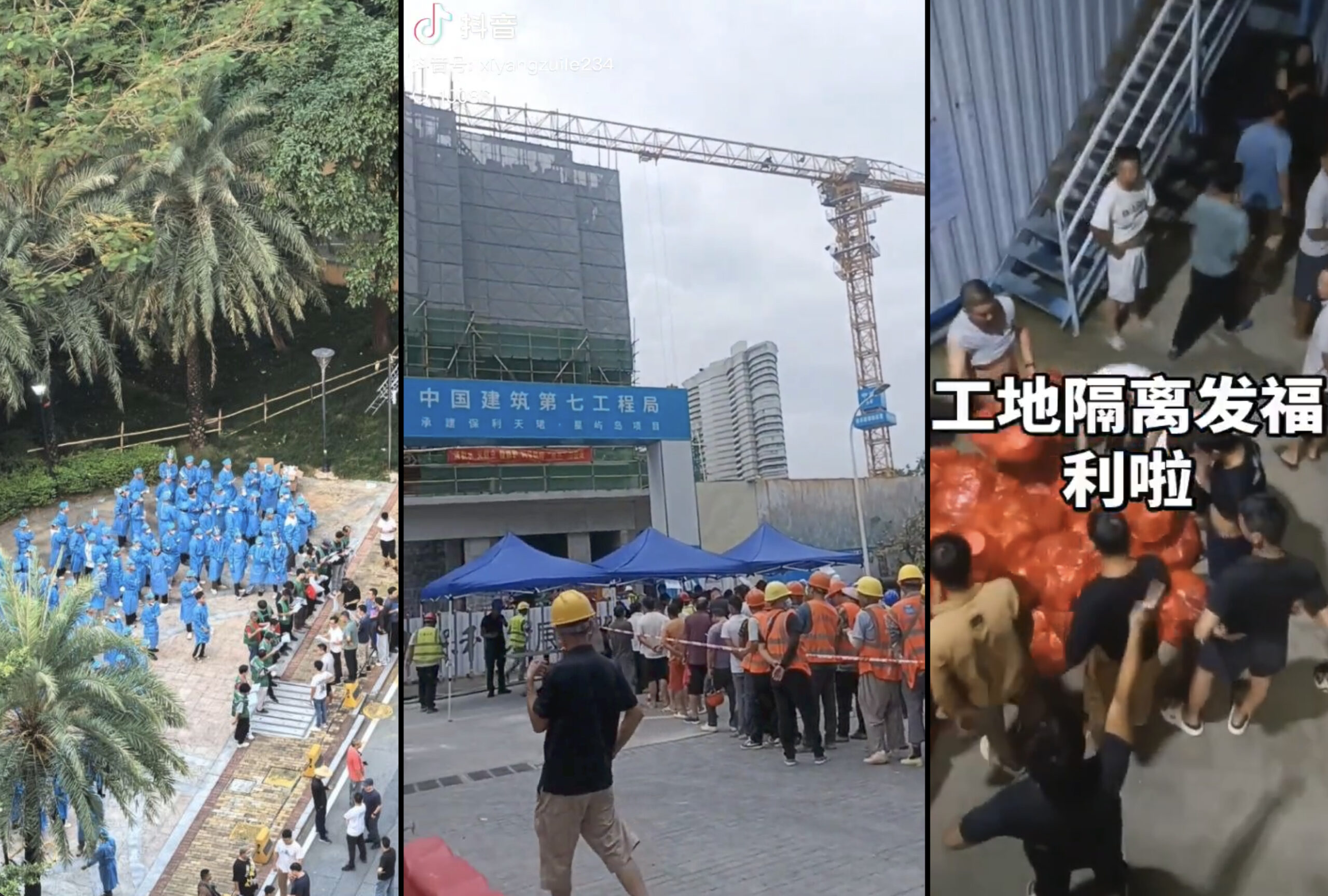
In recent weeks, multiple high-end residential construction sites in Sanya, Hainan Province, have witnessed an outbreak of dengue fever, resulting in thousands of construction workers being placed under lockdown. Several workers have disclosed to news sources that the number of infections may range from dozens to hundreds, leading to mass blood tests for all personnel involved. Some workers have been relocated to local hotels or residential communities, much to the dissatisfaction of homeowners who were unaware of these developments.
This outbreak has occurred during a sensitive political timeframe, coinciding with the Chinese Communist Party’s Fifth Plenary Session of the 20th Central Committee in Beijing, prompting an escalation in control measures. Reports indicate that the mayor of Sanya has personally visited the affected sites to oversee the response, while police are enforcing strict access controls around the clock, limiting entry and exit for construction sites.
One notable location involved in the outbreak is the “Sanya Poly Tianjun” project, situated in the Jiyang District of Sanya. It encompasses several construction sites, and affected workers have reported that operations rapidly ceased across these sites following the outbreak, with both living and working areas under strict lockdown, impacting thousands of laborers.
A worker still on-site, identified as Sun Zhiyong, shared his experience during a phone interview, stating that the lockdown had lasted for about a week and affected approximately a thousand workers. He explained, “We are isolated in the living quarters on site; all external personnel have been brought to the Meilizhiguang Dazhu Hotel, a landmark in Sanya.”
Sun estimated that nearly 20 vehicles were used to transport workers to the hotel, with each construction site accommodating around 800 to 1,000 laborers. He further elaborated that the outbreak affected not just one construction site, but multiple projects within the vicinity, despite different contractors.
“When one site encounters issues, the surrounding sites also halt operations. There must be four to five thousand workers in total across all sites,” he explained, revealing that after the outbreak, workers were instructed to remain in their living areas under lockdown.
Regarding the actual number of infections, Sun noted that his site had not disclosed specific figures but surmised that the number of cases was likely significant, adding, “There must be several dozen cases here; otherwise, the measures wouldn’t be this stringent.”
Sun also mentioned that some infected individuals were directly transported to hospitals, but precise numbers remain elusive as the government has not provided official updates. He emphasized that his construction site was not the only one experiencing an outbreak, as other areas in the locality had also implemented preventive measures.
Another worker, Zhao Jianguo, who had recently departed from a construction site, revealed that hundreds of workers were affected at his location, where workers had to queue for blood tests after the outbreak. The prolonged wait and lack of payment during the standstill period ultimately led him to leave.
“I’ve already left; I’m afraid to work there now. Dengue fever, blood tests—I’ve had three tests done, and I went without pay for days while waiting, so I decided it was best not to go back,” he said.
Zhao illustrated how recent developments triggered by the outbreak led to direct impacts on the earnings of construction workers. He reported that during the waiting period for testing and lifting of restrictions, he received no wages, pushing him to exit the site.
The workers’ comments suggest that the construction sites have indeed enforced measures such as centralized quarantine, blood tests, and environmental disinfection. However, they still lack comprehensive and transparent data regarding infection rates, transmission scope, and the origins of the cases.
Sun indicated that at the initial stages of the outbreak, the project management had not taken the situation seriously. However, this changed after local authorities intervened. “Once the Sanya city government took over, the project’s management became attentive. The police have been guarding the entrances 24 hours a day, and the mayor himself visited to supervise the response,” he recounted.
Notably, the outbreak in Hainan coincided with the convening of the 20th Central Committee’s Fifth Plenary Session in Beijing—a critical time that imposed additional pressure on epidemic prevention strategies.
Throughout the lockdown period at construction sites, police presence has been relentless, preventing workers from entering or leaving freely. Simultaneously, various construction sites have been undergoing extensive disinfection and pest control.
Another laborer from China Construction Second Engineering Bureau’s Hainan branch, Zhou Dafu, recounted his experience to the news outlet, stating, “Our site experienced a lockdown that lasted two days; we were all confined to the living quarters.”
Zhou described the local precautionary measures, mentioning the use of ground-level pesticide spraying, as well as drone applications for insect repellent. However, he noted that the drones did not fly high enough to adequately cover the rooftops of the buildings.
He revealed that workers underwent multiple blood tests, and the frequency of testing has caused confusion among them. “I’ve had blood drawn five times—four times before the lifting of the lockdown and then again just a couple of days later,” he shared.
Zhou’s observations reflected the concerns among the construction workforce, as he and other workers were unsure of the necessity of such repeated blood tests. They were only informed that testing might lead to the lifting of restrictions for returning to work.
The impact of the outbreak has transcended the construction site boundaries, affecting local residents as well. Reports indicate that hundreds of workers from nearby construction sites have been housed in the “Sanya Evergrande Meilizhiguang” residential community. Local residents recently witnessed a significant number of workers congregating in hallways to undergo blood tests. Upon inquiry, they learned that these workers were quarantined due to the identification of dengue and other infectious diseases at their construction sites.
A homeowner, Ms. Fan, expressed her concern, stating that neither property management nor relevant authorities advanced any notifications or sought homeowner consent prior to the workers’ relocation. She worried about potential exposure to infection, especially with an infant in the household, prompting her to refrain from opening windows or doors for several days out of fear.
Personnel from the Chun Guang Community Committee of Jiyang District disclosed that cases of dengue fever and chikungunya had previously arisen at nearby construction sites, leading to sick workers being transported to hospitals. Following this, the project unit opted to consolidate asymptomatic workers in the “Sanya Evergrande Meilizhiguang” community for ongoing health assessments.
Reports highlighted that this relocation process began approximately two weeks prior and involved four buildings in the community. Workers relocated there had undergone initial blood testing and were subject to continuous health monitoring and assessments while residing in the units.
Personnel from the Sanya Center for Disease Control and Prevention confirmed that all workers had been transferred to separate accommodations. The Health Commission of Jiyang District stated that the results of all tests conducted during the relocation period returned negative. However, officials noted that negative test results only reflect the findings at the time of sampling and do not guarantee the absence of new infections following this period.
In addition to official statements, online discussions have heightened public concern regarding the situation. On October 29, a netizen from Jiyang District reported receiving an urgent directive instructing all residents in their dormitory area to prepare for comprehensive lockdown measures. The notice urged workers to purchase essential items in advance and indicated that those who did not return would risk police action.
Another netizen shared videos reporting that alarms had been sounded in various locations in Sanya for extended periods, creating panic among residents. Additionally, news of nucleic acid tests and centralized quarantine measures in Jiyang District due to the dengue outbreak began circulating on October 30, with claims from some individuals of having already been isolated for nine days.
Concurrently, discussions about the increase in COVID-19 infections across various parts of China have surfaced online. Some users have reported experiencing symptoms such as fever, severe sore throat, joint pain, and persistent coughing, with some indicating that their illnesses have lasted for several days without significant improvement. There are also updates suggesting a rising number of infections in multiple regions of Guangdong.
(The names of the interviewees Sun Zhiyong, Zhao Jianguo, and Zhou Dafu are all pseudonyms.)