
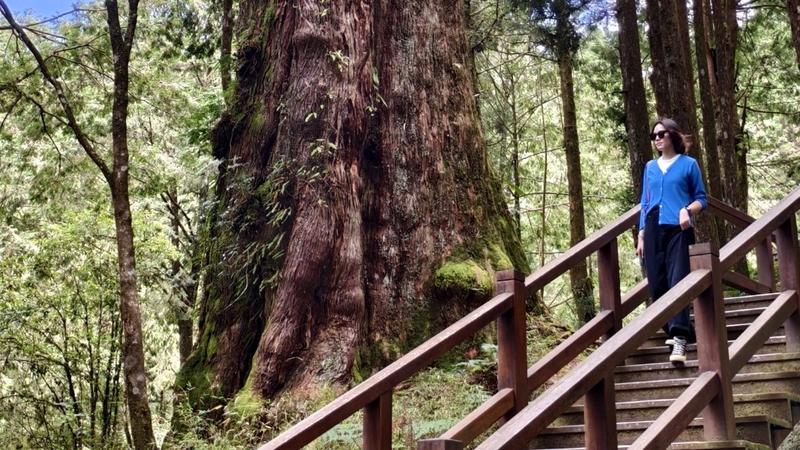
【Epoch Times Report from Taiwan, October 1, 2026】Taiwan’s Alishan is renowned for its spectacular thousand-year-old red cypress forest. Photographer Song Yongtai shared that they recently visited Alishan Township in Chiayi County to admire the ancient cypress trees, with the estimated age of the Sacred Tree in the Fragrant Forest exceeding two thousand years, evoking a sense of grandeur in the midst of nature.
Song Yongtai mentioned to Epoch Times that they saw many foreigners visiting to admire the giant cypress forest in Alishan. He recommended that tourists visit the Alishan National Forest Recreation Area to admire the ancient trees, starting from the Zhaoping Station and passing through the tranquil high-mountain natural lake, Sister Pond, to enjoy the reflections. Then, walking along the forest trail past the Zhen Gong Temple, will lead visitors to the second phase of the giant cypress forest walkway.
The second phase of the cypress forest walkway is approximately 500 meters long. Song Yongtai remarked that they were able to appreciate the dense array of sacred trees along the way. The Fragrant Forest Sacred Tree is a representative landscape in the giant cypress forest, standing at 45 meters tall with a trunk circumference of 12.3 meters. It is an ancient red cypress tree approximately 2,300 years old, currently the largest and oldest tree in the Alishan cypress forest walkway.
“In the Sacred Tree area, observing numerous ancient trees over a thousand years old, one feels a profound reverence for the passing of time and life in nature,” Song Yongtai remarked. The wooden walkway in the Sacred Tree area is well-maintained, ensuring a safe and comfortable walking experience for visitors, including those less physically active and elderly individuals.
He shared his conversation with the sacred trees, “These trees are truly remarkable, standing quietly in such a high mountain environment, having withstood the tests of time for thousands of years to grow into towering sacred trees.”
Song Yongtai, with over 30 years of experience in photography both domestically and internationally, has traveled to many countries in pursuit of natural beauty. When discussing topics of ecology and urban green spaces, he pointed out that trees provide oxygen and improve the environment for human life, with green spaces being significant indicators of urban development and living standards.
With modern individuals frequently staring at computer screens and overusing electronic devices such as smartphones, issues such as eye fatigue, dry eye syndrome, worsening nearsightedness, and retinal and macular degeneration have become prevalent. Song Yongtai stated that gazing at trees and green plants is beneficial for the eyes, allowing the strained ciliary muscles to relax and rest. He urged for urban progress to incorporate a variety of trees to strike a balance between urban development and natural preservation.
Song Yongtai mentioned that phytoncides released by plants are natural volatile organic compounds produced for self-protection. Coniferous plants such as pines, cypresses, junipers, and cypresses have the highest levels of phytoncides, offering benefits to the human body including stress relief, immunity enhancement, anti-inflammatory and antimicrobial properties, and improvements in sleep and focus.
He emphasized that immersing oneself in the forest cultivates respect for trees, plants, and the environment. It also serves as a reminder for individuals to slow down, carefully observe nature, and strive for harmony between people and the environment.
He suggested that visitors embarking on an autumn trip to Alishan’s Sacred Tree area can rest and use the restroom at the Fragrant Forest Service Area. In terms of transportation, utilizing electric cars and forest railways in Alishan can save time and energy, allowing elderly visitors to comfortably complete their journey.
Song Yongtai noted that visitors to Alishan can savor aiyu jelly and high-mountain tea; when traveling to Alishan, do not forget to purchase some high-mountain tea to bring home, preferably from local tea farmers for better quality control.
Lastly, he mentioned that autumn is the season for families to enjoy maple leaves. The Alishan Museum, built in 1935, is a fully cedarwood Japanese-style architecture, surrounded by the giant cypress forest walkway and located near famous red leaf viewing spots such as Ciyun Temple, a cultural and natural intersection not to be missed during the maple leaf season.