
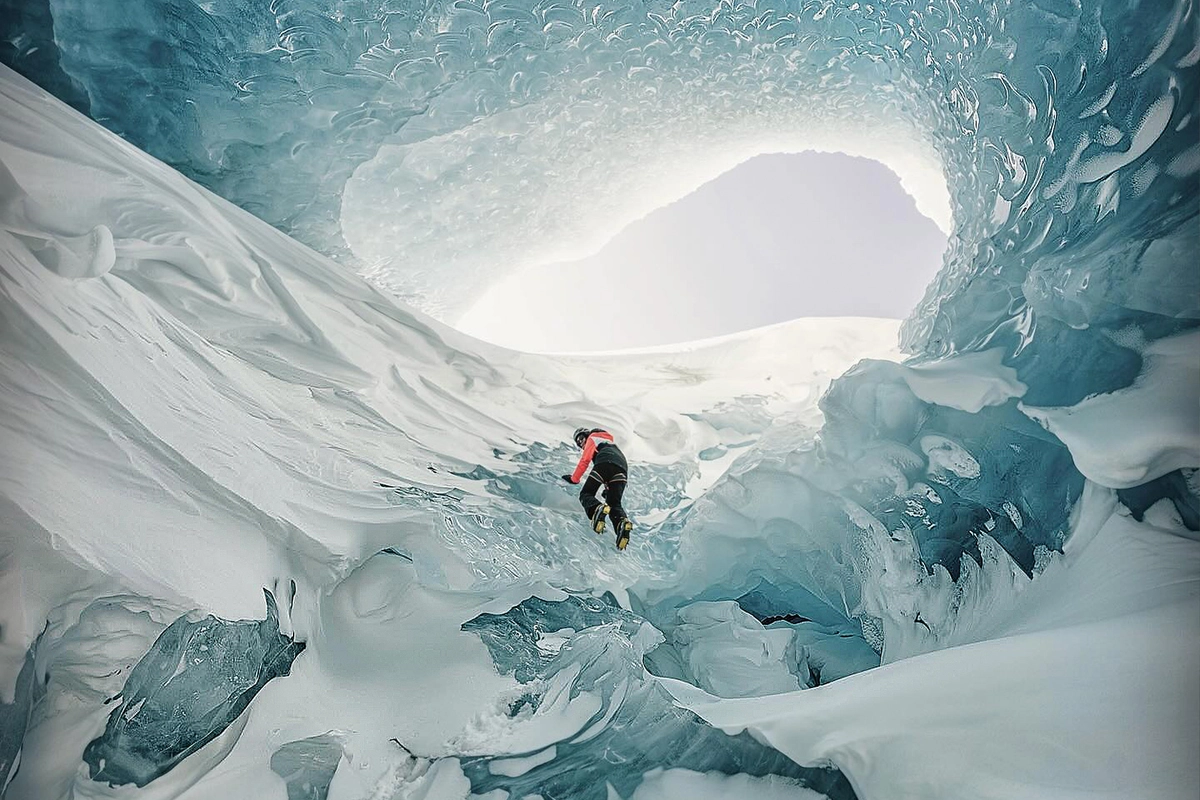
When Chandresh Kedhambadi stepped into the cavern that resembled a grand banquet hall, he sensed that the glacier had been standing still for centuries. At the end of 2020, Kedhambadi, then a chemical engineer living in Calgary, Canada, and only four years into photography, ventured deep into the Athabasca Glacier, a massive glacier spilling from the Canadian Rockies in western Alberta. Gazing at the crystal clear ice walls, he felt like he was witnessing a world frozen in time.
“When you look at the ice layers, and see the bubbles and ancient air trapped inside, you know you are witnessing a long history,” the 50-year-old Kedhambadi told The Epoch Times during an interview. “The first time I saw the glacier cave, it felt like being transported to another world.”
Kedhambadi noted the inherent paradox of glaciers: while the glaciers themselves have a long history, the caves within them are fleeting, melting at a pace that seems to be merely a blink in the glacier world.
“From a compositional standpoint, it really drew me, because each cave is so unique,” he said, adding that this rapid freeze-thaw cycle in winter provided fresh and undocumented photography subjects for his camera.
He said, “Glaciers just fascinate you.”
Kedhambadi became increasingly drawn to the unpredictable nature of the ice fields, approaching them with an engineer’s perspective to understand the ever-changing landscapes.
“People think they are just stationary structures, but they’re not,” he said. “They’re dynamic, constantly moving. It’s almost like a river. But you can see a river flowing, you can’t see the glacier moving.”
To capture the fleeting ice and snow environments, he had to venture beyond the tourist viewing paths in the Athabasca region to remote locations like the Columbia Icefield and the Hector Glacier. There, he had to undergo rigorous wilderness survival training. With no cell phone signal, failing to spot hidden crevasses beneath the ice could have deadly consequences.
“These places are very remote,” Kedhambadi said. “Once you’re in trouble, you better have the confidence and training to get yourself out of those situations.”
The photographer usually explores with four or five experienced climbers, each carrying a backpack with about 50 pounds (about 23 kilograms) of gear. The backpacks contain ropes, pulleys, spare gloves, jackets, heated socks, and other essentials, along with heavy cameras and tripods. As these ice caves are safest when the temperature drops below 20 degrees Fahrenheit (about -6.7 degrees Celsius), each expedition requires meticulous planning. The journey into the wilderness for hours is a race against the winter twilight. In case of emergencies, they have to rely on the collective skills of the team members to act swiftly, without depending on rescue teams.
In March 2023, during an expedition to Hector Glacier, Kedhambadi’s photography skills were put to the test. The towering mountain system guards the southern entrance of the Icefields Parkway. To showcase the grand scale of the football field-sized ice dome, Kedhambadi integrated a fellow ice climber into the frame, placing them amidst towering ice-wall whirlpools, creating a visual symphony intertwining reflections from crevices. Operating three cameras manually, he captured the piece titled “Yatra” (meaning “Journey” in Sanskrit) and secured the second place in the outdoor adventure category of the 2023 Photos of the Year Competition by Canadian Geographic magazine.
But by autumn, the landscape had completely transformed. “When we returned in October or November, we found that the entire ice mass had completely melted,” he said.
Kedhambadi’s photography journey began thousands of miles away from the sub-zero ice caves of the Canadian Rockies. As a child, he spent summers wandering through the lush Western Ghats in India at his grandparents’ coffee plantation, a sharp contrast to his urban upbringing in Bangalore.
“The national forests there are truly wild,” he said.
Later, pursuing a career in chemical engineering, he traveled to Alberta’s oil fields in the southern part of the province, on the other end of the earth. In 2009, he first witnessed the Northern Lights during a midnight drive. This aurora became a visual catalyst that permanently altered his life trajectory, leading him to co-found the Alberta Aurora Chasers—a community dedicated to photographing the night skies. He then shifted his focus to the glaciers near Banff National Park.
“It was during winter in COVID times that I first set foot on that land,” he said, referring to his journey to the Athabasca Glacier.
Kedhambadi’s exploration quickly expanded from independent cave ventures and aurora hunting to collaborations with NASA and partnerships with Sony to archive these natural wonders shaped by water and wind.
In March 2026, he delved into the largest cavern to date—an undisclosed location within the project “Anitya Nila”—which holds a prominent position in the recently published atlas “The Canadian Rockies.”
Regarding this coordinate considered one of the largest ice caves in Alberta, Kedhambadi remained tight-lipped. He explained, “In recent years, due to the influence of social media, the number of glacier tourists has been ‘crazy’,” citing the reason for not disclosing the coordinates. But “Anitya Nila” now offers a glimpse into the icy world—a world destined to vanish in an instant.
For the English version of the report, please refer to The Epoch Times for “Another World: Photographer Explores Giant Ice Caves in the Belly of a Glacier—And The Photos Are Surreal.”