
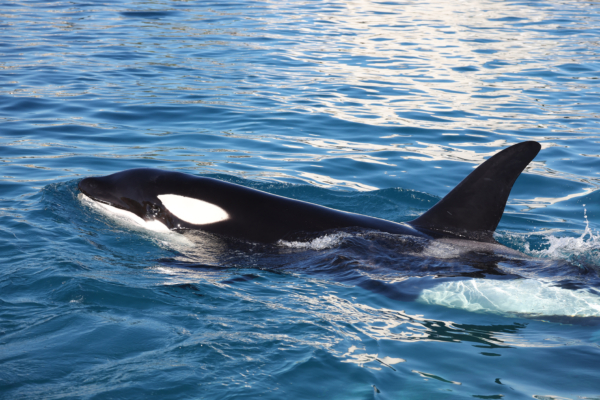
This week, a huge and legendary killer whale, also known as an Orca, appeared near the eastern end of Long Island, Montauk Coast, causing excitement and screams among scientists and students on board a ship, making it very likely the first recorded killer whale sighting in the waters off Long Island in decades.
According to the New York Post, the marine giant was only about 10 nautical miles from the popular vacation spot of South Fork, Long Island. A video captured by witnesses showed the awe-inspiring moment of the killer whale breaking through the blue waves with its dorsal fin reaching up to 7 feet (approximately 2.1 meters) high, spraying high water columns from its blowhole.
This rare and extraordinary sight was witnessed by the renowned host of the Discovery Channel, Dr. Craig O’Connell, also known as “Dr. Shark,” and his students from the Shark Camp program. At the time, O’Connell was leading high school students in learning how to tag and study sharks at sea.
O’Connell expressed his astonishment, saying that everyone on board could hardly believe their eyes and were screaming in disbelief, feeling like they had hit the jackpot!
Interestingly, as one of the few top predators that can prey on sharks, the appearance of the killer whale seemed to have scared off the local “great white sharks.” Furthermore, the killer whale was not traveling with its kind but with a group of dolphins—a unique social behavior that happened to be a signature characteristic of the famous lone killer whale of the area, “Old Thom.”
O’Connell mentioned that he had been working in the Montauk waters for 13 years, spending almost 12 hours at sea every day during the summer, yet had never seen a killer whale before.
In fact, the last confirmed killer whale sighting in the waters off Long Island dates back to 1986, forty years ago, and in 1958, a killer whale harpooned near the Long Island coast rammed and sank a fishing boat.
O’Connell explained that the killer whale’s sudden appearance near Long Island was most likely due to “hunting for prey,” as the area they were in had extremely rich food sources. While killer whales are a globally distributed species, their appearance in Montauk, although rare, is not difficult to comprehend.
The National Oceanic and Atmospheric Administration (NOAA) reminded boaters and anglers that if they encounter a killer whale at sea, they should maintain a safe distance of at least 100 yards (approximately 91 meters) and keep their engines in neutral, refraining from chasing or approaching.
Despite the name “whale” in its name, the killer whale actually belongs to the dolphin family (Delphinidae) and is the largest species within this family, rightly earning the title of “giant dolphin.”
The killer whale sits at the top of the global marine food chain with no natural predators. They are highly intelligent, possess complex social language, and group hunting tactics, with even great white sharks and giant blue whales being part of their menu, hence the name “killer whale.”
The classic appearance of the killer whale features a black and white color scheme, with a distinctive white patch behind the eye, and the dorsal fin of male killer whales is exceptionally tall and erect, reaching up to 2 meters high. While they are known to be very friendly towards humans in the wild with almost no recorded instances of unprovoked attacks on humans, they remain the most awe-inspiring ultimate rulers of the ocean.