
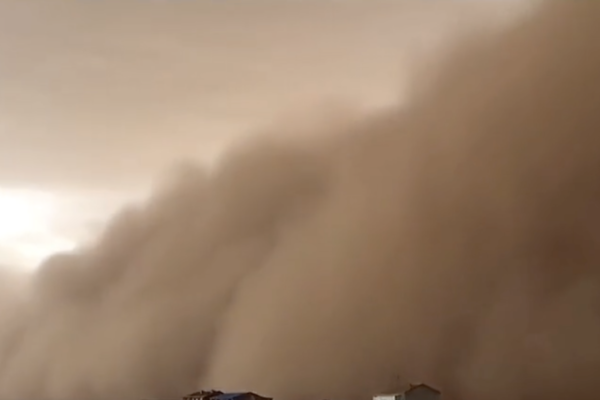
On February 21, 2026, the Central Meteorological Observatory in Beijing issued multiple weather warnings including a yellow alert for strong winds, a yellow alert for sandstorms, a blue alert for heavy snow, and a blue alert for cold wave. This comes on the fifth day of the Chinese New Year with many northern regions experiencing sandstorms and even sand blowing as far south as the Yangtze River, covering nearly half of China. Beijing is facing severe pollution levels and has witnessed the rare phenomenon of a “blue sun.”
At 6:00 on February 21, the Beijing Central Meteorological Observatory continued to issue a yellow alert for sandstorms. Officials stated that due to the impact of cold air and strong winds, between 8:00 on the 21st and 8:00 on the 22nd, areas such as eastern and southern Xinjiang, central and western Inner Mongolia, northeastern Qinghai, central and western Gansu, Ningxia, most of Shaanxi, Shanxi, Beijing, Tianjin, Hebei, Henan, northern Hubei, central and northern Anhui, and central and northern Jiangsu may experience blowing sand or dust.
Specifically, parts of western Inner Mongolia, western Gansu, central-northern Ningxia, and northern Shaanxi may encounter sandstorms and even severe sandstorms.
Today, the Central Meteorological Observatory continued to issue yellow alerts for strong winds and sandstorms, a blue alert for heavy snow, and a blue alert for cold wave.
In the afternoon, Beijing experienced windy weather accompanied by sand blowing, leading to significantly reduced visibility in the city.
The entire city of Beijing is under a yellow alert for strong winds and a blue alert for sandstorms. The area of strong winds continues to move eastward, affecting most parts of the city.
The topic of “Beijing sandstorms” trended on social media. Many videos uploaded by netizens showed a grey sky and strong winds blowing sand in Beijing.
According to Beijing Daily, visibility in Beijing decreased on Saturday afternoon, with the sky appearing hazy and the sun emitting a faint blue light. In western areas, visibility ranged from two to four kilometers.
Official reports indicated that from daytime on the 20th to daytime on the 21st, many regions in northwest China experienced severe to extremely severe pollution levels with PM10 concentrations reaching 5 to 6 levels.
The PM10 concentration in the northwest Beijing-Tianjin-Hebei region notably increased. At 14:00 on the 21st, Zhangjiakou in Hebei Province recorded a PM10 concentration of 2031 micrograms per cubic meter, indicating severe pollution at level 6. In Yanqing District of Beijing, the PM10 concentration reached 594 micrograms per cubic meter, also at level 6 of severe pollution.
In the afternoon of the 21st, the Beijing Ecological Environment Monitoring Center announced that PM10 concentrations were expected to significantly rise in Beijing, reaching peak levels above 500 micrograms per cubic meter during the afternoon and night.
Chinese netizens expressed their concerns, with comments like “Beijing is so scary,” “This sandstorm in Beijing is terrifying,” “Too scared to go out,” and “Eating dust on the fifth day of the Lunar New Year.”