
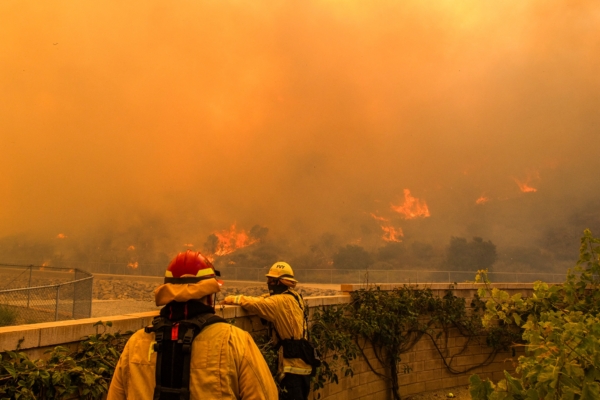
On Tuesday afternoon, May 19th, the air quality in most parts of Southern California deteriorated significantly. The “Sandy Fire” that broke out in Thousand Oaks in northwest Los Angeles on Monday had led to multiple cities issuing smoke and haze warnings, reminding residents to be cautious. Dr. Jiaoyu Deng, a family physician in Southern California, advised patients with lung and respiratory diseases to wear masks when going outside to prevent health issues caused by air pollution.
The Los Angeles County Health Department’s statement on Wednesday cited a report from the South Coast Air Quality Management District, indicating that wildfires across California have worsened the air quality. Officials anticipated that the smoke from the Sandy Fire would affect areas from San Fernando Valley to Arcadia in northern Hollywood.
According to real-time air quality data monitored by Airnow website, as of 6 pm on Wednesday, the air quality index in the Los Angeles area was 58 (moderate level), posing a certain risk to individuals sensitive to air pollution.
Living in Diamond Bar, eastern Los Angeles County, Dr. Deng, who is also a council member of the city, mentioned that the impact of deteriorating air quality extended beyond the mentioned areas. He could already smell the scent of smoke when he went out in the morning. Residents of El Monte, south of Arcadia, also noticed a significant deterioration in air quality when they went out on Tuesday evening.
Dr. Deng emphasized that during poor air quality conditions, it is best to stay indoors and avoid going outside, especially for those with chronic asthma, obstructive pulmonary diseases, as they are more likely to experience respiratory allergies. When indoors, using air conditioning or air purifiers can help reduce the health risks posed by toxic substances.
According to the Health Department’s notification, wildfire smoke consists of a mixture of solid particles, gases, and water vapor; the main health hazards come from fine smoke particles, leading to eye irritation, runny nose, itchy throat, headaches, bronchitis, and other illnesses. High-risk groups, including children, the elderly, individuals with respiratory or cardiac diseases, and those with weakened immune systems, may experience severe symptoms such as difficulty breathing, wheezing, coughing, fatigue, or chest pain.
The burn area of the Sandy Fire is located in Ventura County, about 50 miles from Los Angeles, yet the smell of smoke had already drifted to the city within a day. Dr. Muntu Davis, a health officer in Los Angeles County, emphasized the difficulty in predicting the direction of winds and the dispersal of smoke and dust, urging everyone to closely monitor local air quality, devise plans, and take actions to protect their own and their family’s health.
Dr. Davis stressed that smoke and ash can harm everyone, including healthy individuals. The County Health Department recommended schools and recreational facilities affected by wildfire smoke to follow official guidelines from the California Department of Education and the Department of Environmental Protection based on local air quality levels.
1. If you see or smell smoke, or notice particles and ash in the air, please stay indoors to reduce exposure, especially for those with heart or lung diseases, the elderly, pregnant women.
2. Keep doors and windows closed to maintain clean indoor air. Use circulating air conditioning to filter out harmful particles.
3. Avoid using air conditioning that only brings outdoor air inside without recirculating indoor air. Regularly check and replace air filters. Filters labeled “MERV13” or higher are most effective in removing smoke particles. HEPA air purifiers can further reduce indoor particulates.
4. If you must spend a long time outdoors in areas with smoke or ash, wear N95 or P100 masks. Masks can protect against larger particles, but most masks cannot block more harmful fine particles or toxic gases.
5. If it is too hot to close doors and windows and there is no air conditioning at home, go to public places like libraries or shopping malls to cool down and protect yourself from harmful air.
6. If you experience severe coughing, shortness of breath, wheezing, chest pain, palpitations, nausea, or unusual fatigue, please contact a doctor or go to the emergency room; in case of life-threatening symptoms, call 911.