
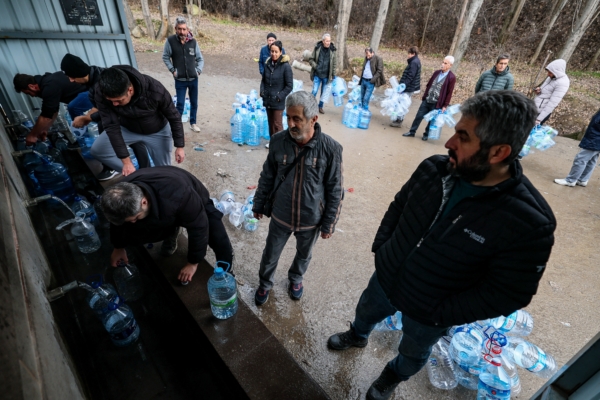
The World Bank announced on the 15th that it has officially launched the “Water Forward” global initiative in collaboration with multiple multilateral development banks and development financial institutions. This initiative aims to improve water security for 1 billion people worldwide within the next four years, by 2030.
This program will expand investments in water resource management and encourage governments to consider water as a strategic economic resource rather than a low-cost public utility. The World Bank emphasized that the future will involve a coordinated effort among multilateral development banks, governments, charitable organizations, and the private sector to provide financing and technical support to enhance access to reliable water services for the public.
Water resources are crucial for ensuring health, sanitation, food production, and energy supply, making them essential for economic functioning. The primary focus now is to ensure the mass provision of stable and reliable water services to enable normal operations of societies and industries worldwide.
The World Bank estimates that by the end of this decade (2030), global demand for freshwater will exceed supply by 40%, and water-related impacts have already caused several countries to lose a significant percentage of annual economic growth.
Climate change continues to exacerbate droughts and floods, putting heavy pressure on public finances and vulnerable groups, particularly in rapidly growing urban areas. A report from last year estimated that over 2.1 billion people lack access to safe drinking water, while over 3.4 billion people live in environments without sufficient sanitation facilities.
The World Bank pointed out that approximately 4 billion people globally still face water scarcity. Factors such as unclear policies, weak regulations, and a lack of financial sustainability in public water utilities hinder progress in the water resource sector and impede related investments.
The “Water Forward” initiative aims to address these challenges by supporting developing countries in building more robust and reliable water resource systems, thereby unleashing productivity, improving livelihoods, and promoting private investment opportunities.
At the core of this initiative is the country-led “Water Resource Compact,” through which governments outline their reform priorities, commit to institutional strengthening, and establish investment pathways in the water resource sector.
Currently, 14 countries in water-stressed regions such as Africa, the Middle East, and South Asia have published their Water Resource Compacts, focusing on reducing urban water leakage, modernizing irrigation systems, enhancing wastewater reuse, and strengthening data governance. More countries are also progressing with related initiatives.
The initiative will support countries in implementing necessary reforms to strengthen relevant mechanisms, improve financial performance, and develop investable projects.
Participating institutions include the Asian Development Bank, Asian Infrastructure Investment Bank, European Bank for Reconstruction and Development, European Investment Bank, Inter-American Development Bank, Islamic Development Bank, New Development Bank, OPEC Fund for International Development, and the International Fund for Agricultural Development.
The World Bank has committed to ensuring water security for 400 million people by 2030, and with additional contributions from partner organizations, the “Water Forward” initiative is expected to benefit over 1 billion people worldwide.
Ajay Banga, the Chief Executive Officer of the World Bank Group, stated, “Water resources are the foundation of economic operations. Only when water resource systems function effectively can farmers produce, businesses operate, and cities attract investments. Our current mission is to coordinate reforms, financing, and partnerships to enable the large-scale provision of reliable water services.”