
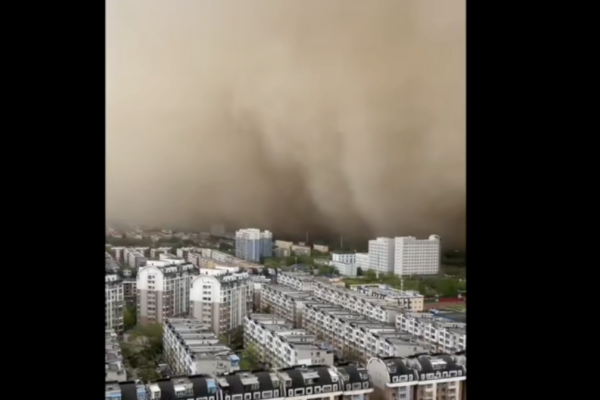
On April 17, Xinjiang’s Shihezi City was hit by a severe sandstorm attack, with a sand wall hundreds of meters high covering the sky, causing visibility to drop to less than 500 meters in some areas and leading to the suspension of outdoor activities and transportation disruptions.
Videos uploaded by local residents showed the rapid spread of a sand wall hundreds of meters high, engulfing the sky.
Internet users commented, saying, “It’s too frightening,” “It feels like the end of the world, causing special panic, because it was only 8 o’clock at that time, the sun hadn’t even set yet, and suddenly it turned dark, like today’s sandstorm, I think it’s the first time I’ve seen. “Not a movie scene, but a real scene in front of my eyes. The moment the sandstorm swept in, I understood what it meant for the world to lose its color.”
Another internet user posted, saying, “In my seventh year in Xinjiang, I saw a real sandstorm for the first time and it scared me to tears.”
On April 18 at 6 a.m., the Beijing Central Meteorological Observatory issued a blue warning for strong winds, a yellow warning for heavy fog, and a blue warning for sandstorms. It is expected that in the next two days, many parts of China will experience significant strong winds, heavy fog, and sandstorm weather.
From 8:00 on April 18 to 8:00 on April 19, some areas in northeastern Xinjiang, southern Xinjiang basin, Inner Mongolia, northern Tibet, western and northern Qinghai, northern Gansu, Ningxia, northern Shaanxi, northwestern Hebei, and southeastern Heilongjiang will have winds of 5-7 levels, with gusts reaching 8-9 levels. In some areas of northeastern Xinjiang, southern Xinjiang basin, central and western Inner Mongolia, local wind speeds can reach 8-9 levels, with gusts of over 10 levels. In the northeastern part of the East China Sea, there will be 7 levels of wind and gusts of 8 levels from the southeast.
From 8:00 on April 19 to 8:00 on April 20, the range of strong winds will further expand to eastern Xinjiang, southern Xinjiang basin, northern and western Tibet, northeastern Qinghai, northern and eastern Gansu, central and eastern Inner Mongolia, Ningxia, northern Shaanxi, central and northern Shanxi, central and northern Hebei, northwestern Beijing, Tianjin, most of Liaoning, central and western Jilin, southwestern Heilongjiang, central and eastern Henan, among other areas. Some areas such as central and eastern Inner Mongolia will have winds of 8-9 levels, with gusts of over 10 levels. The southern part of the Bohai Sea will experience 7-level winds and gusts of 8 levels from the north.
Furthermore, from 8:00 on April 18 to 8:00 on April 19, the northern part of the Bohai Sea, Bohai Strait, most of the Yellow Sea, and the northwestern part of the East China Sea will experience thick fog with visibility less than 1 kilometer. In the morning of April 18 until noon, parts of Liaoning, Beijing, Tianjin, Hebei, Shandong, Henan, Anhui, Jiangsu, Hubei, Hunan, Jiangxi, Guangxi, Guangdong, and other areas will have dense fog, with locally visibility dropping to less than 200 meters.
Due to the influence of cold air and strong winds, from 8:00 on April 18 to 8:00 on April 19, there will be sand and dust weather in some areas of Xinjiang, Inner Mongolia, Gansu, Qinghai, Ningxia, and Shaanxi. Among them, some areas in the southern and eastern parts of Xinjiang, northwestern Inner Mongolia, and western Gansu will experience sandstorms, with some areas even seeing severe sandstorms.
In 2026, it is the year of the Fire Horse in Chinese astrology, coinciding with the traditional belief in the “Red Horse and Red Goat Calamity,” which indicates that natural disasters will occur more frequently, and society may experience turmoil and drastic changes.