
France officially launched a national rare earth and permanent magnet supply chain rebuilding plan on Tuesday (May 5th) in an effort to reduce dependence on China in this field and protect key industries such as electric vehicles, offshore wind power, electronics, and national defense.
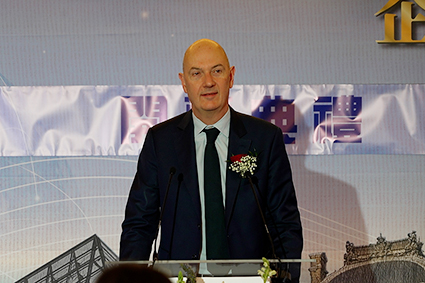
According to a report by Reuters on Tuesday (May 5th), French Minister of Economy, Finance, Industry, Energy, and Digital Sovereignty, Roland Lescure, announced the launch of the national rare earth and permanent magnet supply chain rebuilding plan in the town of Lacq in southwestern France.
After inspecting a rare earth processing plant in Lacq that is about to start production, Lescure stated that the Beijing authorities have long dominated the rare earth market and in 2025, they used rare earth exports control as a trade weapon, causing serious impact on French and European related industries.
He said, “China (CCP) has taken a very large market share, and the key now is the need to rebuild competitive industries.”
Among the measures announced by France on Tuesday is a requirement for large automotive companies to submit plans to expand the source of high-strength magnets supply – rare earth being a key component – in order to continue receiving government subsidies. Offshore wind power developers in upcoming tenders must also commit to developing diversified supply plans.
The French government also pledged to streamline policy aspects and extend the Green Industry Investment Tax Credit until 2028, simplifying it and increasing funding through existing long-term investment plans and special metal funds.
Additionally, the government will support research and development of automotive components that do not require rare earth minerals, engage with international trade merchants on securing critical mineral supplies, and possibly provide government guarantees for project financing.
France’s strategy covers the entire rare earth supply chain, from ensuring overseas mineral supplies to refining, alloy production, and magnet manufacturing within France.
The goal for France is that by 2030, the produced rare earth oxides will be able to meet 100% of Europe’s heavy rare earth demand and about one-quarter of light rare earth demand, as well as satisfy about 10% of Europe’s demand for alloys.
Furthermore, Lescure announced that France has convened a ministerial-level online meeting of the Group of Seven (G7) countries on Thursday (May 7th) to discuss breaking the CCP’s monopoly on critical materials.
This online meeting will prepare for the G7 Leaders’ Summit scheduled for mid-June in the spa town of Evian, France, where diversifying critical materials supply chains will also be on the agenda.
France will also host a meeting of G7 trade officials on Wednesday (May 6th) in Paris.
Drawing lessons from history in responding to China’s monopoly, Lescure said, “One of the projects we are considering within the G7 framework is to ensure that we develop alternative solutions through international cooperation, similar to the establishment of the International Energy Agency when the Organization of the Petroleum Exporting Countries (OPEC) held production monopolies in the 1970s.”
France’s action this time is the latest response from Europe to China’s implementation of rare earth export controls. Currently, China controls the vast majority of the global rare earth refining market, and the export restriction measures expanded in 2025 have accelerated the process of European countries reexamining the vulnerability of their own critical mineral supply chains.
Previously, the French government has invested in a fund aimed at enhancing Europe’s ability to access critical minerals. The national plan launched this time is a further systematic deployment on this basis.