
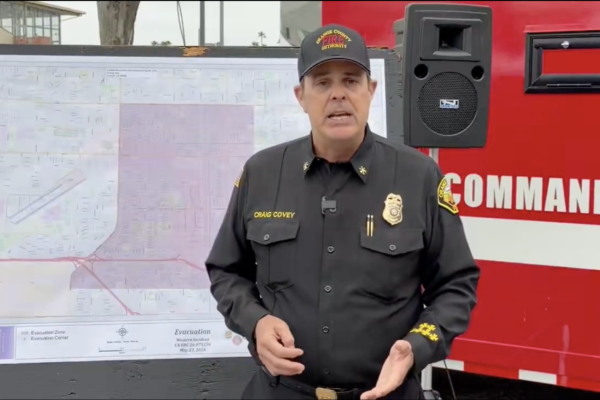
On May 25, 2026, a hazardous chemical tank steam leak incident occurred in Garden Grove, Orange County, California. Over 40,000 people have been evacuated so far, with no casualties reported among rescue personnel or residents. The Orange County Fire Authority (OCFA) held a press conference on Sunday morning, stating that experts have tried all conventional methods with no success, and the ultimate danger could be tank rupture or explosion.
Approximately 15% of residents asked to evacuate have refused, and police are conducting door-to-door checks. The county has activated the “911 reverse call” system to notify all residents in the evacuation area, and the latest updates are being disseminated through social media.
OCFA Acting Chief TJ McGovern mentioned that the incident in Garden Grove on Western Ave involved three tanks storing plastic chemical raw materials. The main tank had an overheated interior triggering the pressure relief valve and top automatic sprinkler system to cool the chemicals inside.
Within 6 minutes of the incident, firefighters were on the scene conducting cooling procedures based on existing facilities inside the tank and external sprinkler systems, while evacuating residents from Garden Grove and Stanton. “The tank has a valve that is damaged, making it impossible to completely eliminate the danger,” said McGovern. “Once we gain effective control, we will strive to help people return home.”
OCFA Division Chief and on-site Commander Craig Covey stated that they are closely cooperating with the equipment manufacturer’s emergency response team. He revealed that experts estimated about 7,000 gallons of chemicals remain inside the main tank, which experienced structural deformation due to initial heating and temperature rise, edging close to the point of steam explosion (BLEVE), with potential shock waves reaching fragments up to half a mile away. As a result, safety alert zones and evacuation areas have been expanded.
Covey mentioned, “Another tank has been neutralized with a neutralizing agent, completely eliminating volatile risks; the third tank has not undergone the same treatment but poses lower danger.”
Westminster Councilwoman Amy Phan West added that Tank 1 was found with a crack, holding about 6,500 gallons of chemicals, Tank 2 with 4,500 gallons, and Tank 3 with 15,000 gallons that have been treated.
Covey disclosed that they have formed a special action team contacting experts from across the state to find innovative solutions. According to the manufacturer’s technical representative, there are two possible outcomes for the tank: either rupturing due to structural failure leading to chemical leakage or explosion.
He mentioned, “For the first scenario, we have taken containment measures, constructing sandbag barriers to prevent leaked substances from seeping into storm drains, river channels, and nearby marine waters.” He added, “When the time comes, hazardous materials handling team members in protective suits will enter the site, allowing us to effectively control the situation.”
Regarding the second scenario, he stated, “Today, we decided to expand the evacuation zone due to the highly volatile, toxic, and flammable nature of these chemicals.” The exhaust valve no longer emits chemicals, and if the temperature reaches the critical threshold, it signifies the tank has entered a state of thermal runaway, at which point all on-site personnel will evacuate, allowing the tank to evolve without human intervention.
He stressed that temperature changes and wind direction are crucial factors determining whether the circular evacuation area will be expanded and evacuation orders issued.
OCFA Battalion Commander Nick Freeman elaborated that the tank contains Methyl Methacrylate, a toxic substance damaging to the respiratory system and causing irritations to the skin, nose, and eyes. “This substance is heavier than air, settling inside facilities, and if leaked, would accumulate in low-lying areas.”
Freeman explained there are multiple valves on the main tank but are internally blocked, preventing the material from being drained or stabilizer injected.
County Health Officer Dr. CK mentioned that reports of cases involving such toxic substances are extremely limited, with the long-term effects remaining uncertain, recommending avoidance of any contact.
Beyond Garden Grove and Stanton, affected cities include Cypress, Anaheim, Buena Park, and Westminster, with several evacuation centers being established. Garden Grove Police Chief and on-site Joint Commander Amir El-Farra emphasized the importance of residents to “heed instructions.”
Mayor Stephanie Kloffenstein expressed understanding for the concerns residents have over their homes, businesses, pets, and loved ones, urging residents still in the evacuation area to evacuate so rescue personnel can focus on the emergency at hand, also extending hope for everyone to return home safely.
Currently, government agencies at all levels are coordinating efforts, including the county health department, police, air quality management district, EPA, and the Governor’s emergency operations office. Orange County District 1 Supervisor Janet Nguyen highlighted the importance of clear, timely, and accurate information during emergencies, with hotlines, social media, and government websites available for residents to stay updated on the latest developments.