
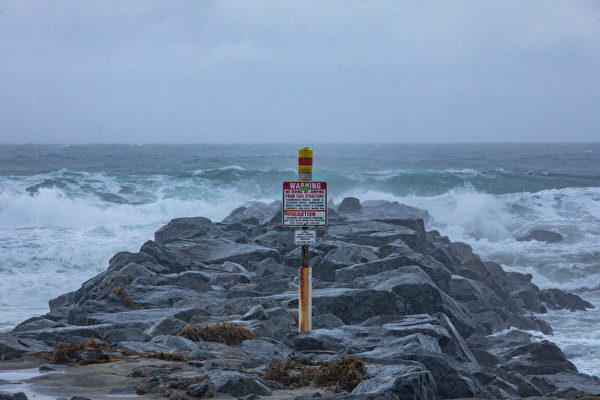
In recent days, the California coast has been experiencing rare high waves reaching several meters in height, providing thrilling excitement for surfers while claiming the lives of three individuals.
Last week, at least three people drowned on California beaches, including a five-year-old girl who drowned at Laguna Beach in Southern California, and two local university students who drowned in Santa Cruz County. These tragic incidents are all related to the surging giant waves along the coast. Officials have warned the public to stay away from rocks and breakwaters in areas where the waves are larger as the raging waves and dangerous rip currents can pose a threat to life at any moment.
Last Tuesday, the Wedge beach, a popular surfing spot at the tip of Balboa Island in Newport Beach, Southern California, experienced waves as high as 20 feet. Many tourists gathered near the beach to watch the surfers’ performances, unaware that standing at the edge of the beach could be extremely dangerous for those unfamiliar with the local beach conditions.
Lifeguards informed ABC 7 News that they had conducted over 500 rescues at the Wedge beach alone in the past week. Even surfers who love the thrill of it all acknowledged the danger of the giant waves at the beach. One surfer mentioned, “The waves can toss you to the crest of a 10-foot wave and then slam you straight down onto the sand, it’s really terrifying.” Some individuals have even sustained severe injuries, including broken necks.
On Wednesday, the National Weather Service (NWS) in San Francisco, Los Angeles, and San Diego issued multiple beach hazard statements warning areas include Ventura County beaches, Malibu coastline, Los Angeles County beaches, San Diego County coastal areas, Orange County coastal regions, San Francisco Peninsula coast in Northern California, southern Monterey Bay, and Big Sur coastline.
The warning stated that large-scale swells from the southern hemisphere, combined with rising sea levels, are causing waves ranging from 3 to 7 feet, with local areas potentially reaching up to 10 feet. Specific dangers include sudden strong rip currents that can drag swimmers and surfers far from the shore, as well as waves rushing onto the beach that can sweep people off rocks and breakwaters.
The beach hazard warning in Orange County, California, will remain in effect until Friday. The meteorological agency mentioned that south-facing beaches may experience waves ranging from 3 to 6 to even 7 feet, along with increased risks of rip currents and tidal hazards.
During high tide periods, low-lying coastal areas may be flooded by the rising seawater. Parking lots and sidewalks near the coast could suddenly be inundated with seawater. Areas near Malibu and Long Beach have seen flooding due to the giant waves, with warnings extending until Wednesday morning. The NWS has extended the expiration of the beach hazard advisory for Los Angeles beaches until late Wednesday, estimating the presence of waves ranging from 3 to 6 feet during this period.
The meteorological agency advises tourists to check local weather conditions before heading to the beach. If unfortunate enough to be caught in a rip current, individuals should remain calm, yell for help, try to float as much as possible while waiting for rescue, avoiding excessive exhaustion. Alternatively, they should swim parallel to the shoreline towards the beach to escape the rip current, as attempting to swim directly against it may lead to rapid fatigue.
The NWS warns the public to stay away from rocks and breakwaters, remain vigilant about coastal conditions, and heed the advice of local lifeguards before swimming.
The prevailing giant waves along the California coast are primarily due to the combination of Southern Hemisphere Swells and the El Niño phenomenon. According to the National Oceanic and Atmospheric Administration (NOAA), during the El Niño phenomenon, the trade winds from east to west across the equator weaken, resulting in a slight rise in sea levels on the Pacific East Coast, leading to larger tidal ranges and giant waves. San Francisco set a record for the highest summer sea level last Saturday – 1.83 feet higher than normal water levels, marking the highest non-storm season level in 128 years.