
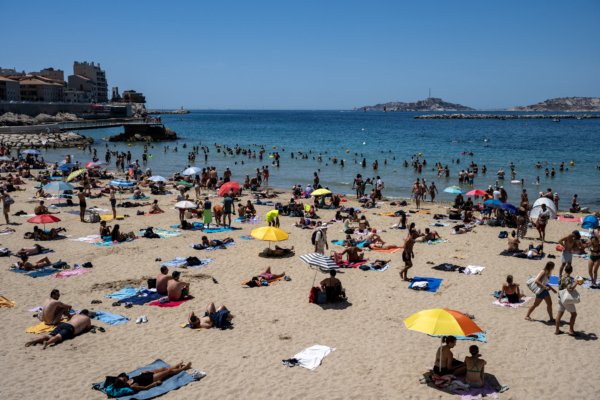
In a heatwave hitting Europe ahead of schedule, many countries are experiencing temperatures close to historical limits during the second wave of intense heat in the summer of 2026. In France, over half of the provinces have issued severe heat orange alerts, with some areas possibly facing the highest-level red alerts. Prime Minister has emergency meetings to address the crisis. Meanwhile, the UK has issued amber extreme heat warnings, and Germany has issued heat warnings covering the entire country to prepare for subsequent severe thunderstorms. Spain has also issued high temperature orange and yellow warnings for multiple regions in the south and central parts.
As a scorching heatwave sweeps across the European continent, Météo-France has expanded the coverage of the “orange heatwave alert” to 60 provinces, encompassing over half of the country’s population. Weather forecasts indicate that temperatures in the southwest to the Paris region will reach 39 to 40 degrees Celsius over the weekend, with some areas potentially soaring to 41 or 42 degrees Celsius.
Facing the possibility of equalling or breaking historical records of extreme weather, French Prime Minister Sebastien Lecornu called an emergency crisis response meeting on Saturday. Authorities warn that some central and northern areas next week may issue the highest-level “red alert” in June for the first time.
In response to the extreme heat, Paris Deputy Mayor Emmanuel Gregoire has ordered city parks to be open round the clock for the public to cool off.
Aside from impacting daily life, the extreme high temperatures are also taking a toll on infrastructure. The French power company EDF has issued warnings as several nuclear power plants within the country may have to reduce production or restrict electricity generation next week due to high river and water temperatures.
Emmanuel Moulin, the Governor of the Bank of France, noted that while the short-term impact of high temperatures on economic growth may appear blurry due to increased energy consumption and decreased productivity, frequent heatwaves will undoubtedly drag down overall economic activities in the medium term.
The hot air blowing in from the Sahara Desert has created a “Heat Dome” in combination with a stationary high-pressure system, rapidly spreading northward and eastward.
The German Weather Service (DWD) issued almost nationwide heat warnings on Saturday, with temperatures approaching 38 degrees Celsius in some southwestern areas. Meteorologists particularly caution that starting Sunday (June 21), the combination of high temperatures and humidity will likely trigger severe thunderstorms, hail, and intense short-duration rainfall.
The UK’s Met Office also issued amber extreme heat warnings for southern England and southeast Wales on Friday. Some areas are expected to reach temperatures of up to 34 degrees Celsius early next week, nearing the historical record set in June 1976.
South of the Alps, Italy and the Iberian Peninsula are also suffering from scorching heat. On Saturday, temperatures in many parts of Italy reached 36 to 37 degrees Celsius, potentially facing “tropical nights” with temperatures exceeding 25 degrees Celsius, making it difficult for the body to cool down at night.
In Rome, under the blazing sun, tourists queued outside the Colosseum, with some seeking refuge in the partially sheltered underground space of the Temple of Claudius to escape the heat. In the northern city of Bologna, residents and visitors gathered by the 16th-century Fountain of Neptune in the city center to splash water on their faces or seek shelter under the arches.
The World Meteorological Organization (WMO) and the European Centre for Medium-Range Weather Forecasts (ECMWF) attribute this widespread extreme heat to the Heat Dome phenomenon. According to the National Oceanic and Atmospheric Administration (NOAA) in the United States, when a high-pressure system lingers motionless over the European continent, it creates a heavy “lid” on the ground, causing the air inside to be forcibly compressed and drastically heated during descent, dispersing cloud layers and allowing unobstructed direct sunlight to the surface.
With this continuous accumulation of heat, the extreme hot climate that typically occurs in July and August has swept through Europe earlier in May and June.
Spain, located on the Iberian Peninsula, is also enduring intense scorching temperatures. The Spanish State Meteorological Agency (AEMET) issued orange and yellow high-temperature warnings for several regions in the south and central parts on Friday and Saturday. Temperatures soared above 40 degrees Celsius in areas such as the Tagus, Guadiana, and Guadalquivir river valleys. Authorities caution that due to persistently high nighttime temperatures, the prolonged heat has sharply increased the risk of forest fires, prompting fire departments in multiple areas to be on high alert.
(Reference from Reuters and The Guardian)