
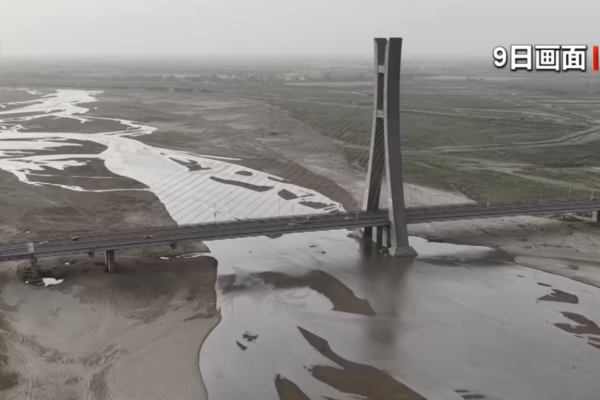
The first flood of the year in the Xinjiang desert arrived two months early. Beijing officials issued a warning today (June 12) that communities in northwest Xinjiang and neighboring areas should prepare for potential “extreme floods” this summer.
According to a report from CCTV News Client on June 12, as the summer temperatures gradually rise, the amount of snow melt in mountainous areas will continue to increase. On June 9, the Tarim River, China’s longest inland river on the edge of the Taklamakan Desert in Xinjiang, experienced its first flood of the year. The scene showed typically dry sand dunes being submerged by water.
Climate monitoring data from Reuters shows that the Taklamakan Desert has been experiencing floods of similar magnitude since 2021, but usually only when temperatures peak in August. This means that this year’s first flood of equal magnitude has occurred two months earlier. The temperatures this year have risen early, with Xinjiang’s temperature on June 12 being 7.3 degrees Celsius higher than the average temperature in previous years, reaching 38 degrees Celsius.
CCTV quoted Sun Qianqian, a meteorological analyst from the China Meteorological Administration, as saying that in early June of this year, Western and Southern Xinjiang experienced frequent rainfall, with significantly more rainfall than usual for the same period. In some areas, the rainfall was one to two times higher than normal. She also mentioned that in recent days, temperatures in southern Xinjiang have been persistently higher, even reaching extremes, causing widespread melting of glaciers and snow, which has contributed to the desert flooding.
According to a report by Reuters, officials predict that there may be “extreme floods” in northwest Xinjiang and surrounding areas this summer. Sun Qianqian stated that extreme floods could wash out roads, railways, oil and gas facilities, posing risks of disaster.