
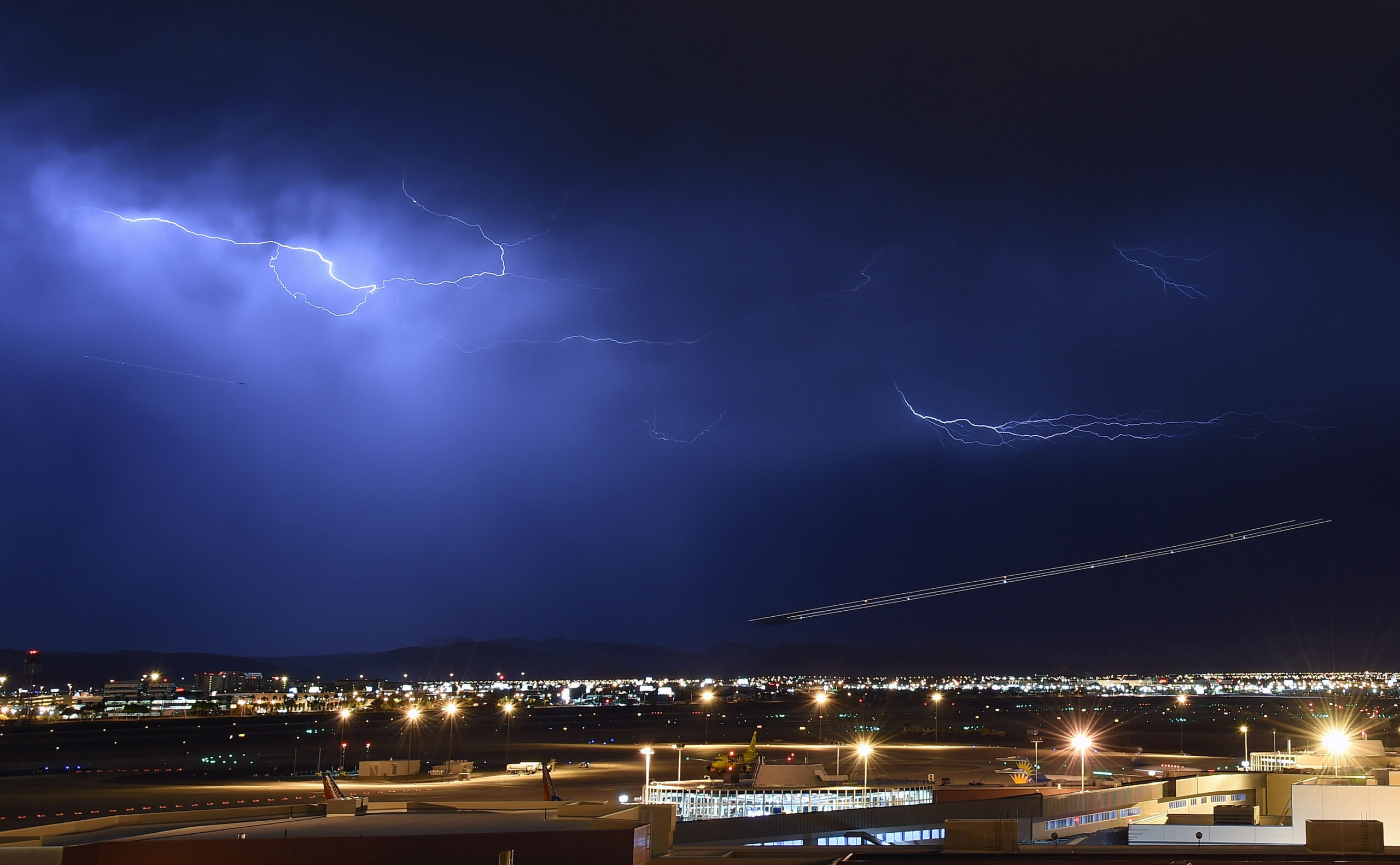
In cases of unfavorable weather conditions, airplanes may be struck by lightning during their flight. What kind of danger does this pose for the aircraft itself, as well as for the passengers and crew on board? Could the airplane actually fall from the sky due to a lightning strike? Let’s take a look at what aviation experts, who have previously served as pilots, have to say on this matter.
According to Reader’s Digest, airplanes may encounter lightning strikes as they frequently need to fly near or within electrified thunderstorm systems. As they enter these regions, they momentarily disturb the surrounding electric field, making it easier for the current to be struck by lightning rather than passing through the poorly conductive air surrounding them.
Airbus, the French aircraft manufacturer, has pointed out that on average, airplanes are struck by lightning once a year. This translates to roughly one strike every 3,000 flight hours. Statistically speaking, this means that an aircraft would need to fly back and forth between New York and Los Angeles for about 250 round trips (with each leg being a 12-hour flight) before encountering a lightning strike.
Is it very dangerous for an airplane to be struck by lightning? Professor Dan Bubb from the University of Nevada, Las Vegas, an aviation expert and former pilot, mentioned that even if lightning directly strikes an aircraft, it usually has minimal impact and does not affect the passengers.
Explaining further, Bubb, who authored “Landing in Las Vegas: Commercial Aviation and the Making of a Tourist City,” stated, “The design of commercial aircraft simulates the principles of a Faraday cage, acting as a receiver that can absorb the current.”
In practice, the metal structure of an aircraft conducts the current along its outer shell, ensuring that the current safely flows through the exterior surface and dissipates, thereby avoiding the passage of current through the cabin and personnel inside.
The same principle explains why passengers inside the cabin remain safe even if they come into contact with metal components such as seat frames during a lightning strike. The aircraft’s structure guides the current mainly along its metal exterior, maintaining an electrical balance within the cabin to prevent current flow through the interior space.
You can think of lightning as water flowing from a faucet and the aircraft as a sealed metal container placed under the flow of water. Even though the exterior may get wet, everything inside stays dry.
Bubb also mentioned that while rare, the current generated by lightning may interfere with aviation electronic equipment and instruments. This can result in pilots being unable to communicate with air traffic controllers or utilize certain cockpit systems. Fortunately, aircraft are equipped with numerous backup instruments and systems to mitigate such occurrences.
He stated, “Regarding aircraft lightning strikes, the biggest misconception people have is thinking that the aircraft will explode, suffer engine failure, or even fall from the sky. This possibility is zero.”
He emphasized that pilots always take preventive measures when facing adverse weather conditions. They cannot definitively predict the intensity of thunderstorms until they are actually in them, so they try to avoid them as much as possible.
Although there are weather briefings before takeoff and practical radar equipment in the cockpit, “an airplane at any stage of flight can encounter lightning strikes.”
In the event an aircraft is damaged due to a lightning strike, pilots will follow standard procedures to steer the aircraft away from the storm and land at the nearest airport.
If you find yourself on an airplane struck by lightning, you may see a flash and feel some turbulence, but typically, that is all. Bubb advises people to stay calm in such situations because even though it may be startling, the aircraft is safe, and the pilots are trained to handle any issues that arise from a lightning strike.
Additionally, if an aircraft is struck by lightning, maintenance personnel will conduct inspections before it is cleared to resume operation to ensure there is no damage.
For instance, Airbus has established guidelines that include multi-stage surface and system inspections after lightning strikes, along with strict maintenance procedures to ensure 100% flight safety of the aircraft.
It’s worth noting that although very rare, there have been incidents where early aircraft crashed due to lightning strikes. In December 1968, a Pan American World Airways (Pan Am, now defunct) aircraft was struck by lightning during flight, causing the ignition of fuel tanks and resulting in an explosion. This led to the aircraft crashing and the loss of 81 lives on board.
Since then, the Federal Aviation Administration (FAA) in the United States has mandated the incorporation of more safety technologies in aircraft to prevent any losses that could arise from lightning strikes.