
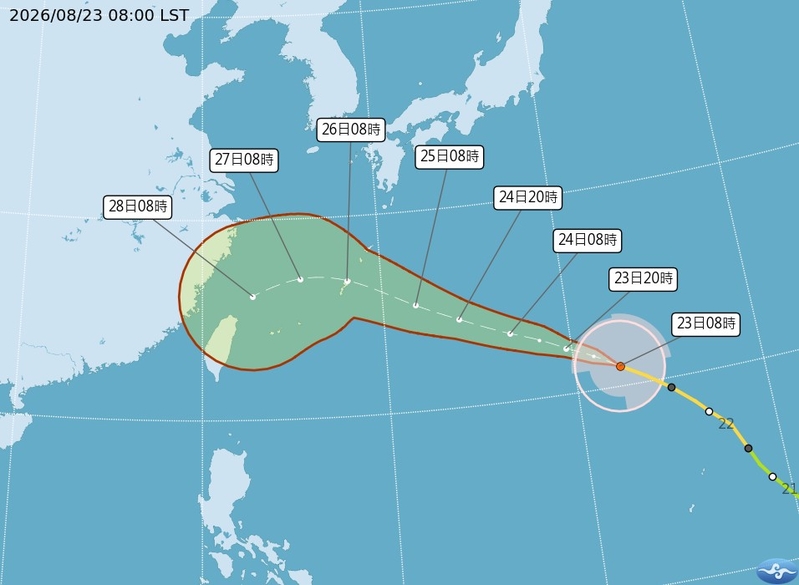
Taiwanese meteorological experts today (August 23) stated that Typhoon Shadell is predicted to pass through the waters near Taiwan on the 27th and 28th, potentially hitting Taiwan as a strong typhoon and possibly becoming the first typhoon to make landfall this year, but the situation is still being monitored and observed.
The Central Weather Bureau of Taiwan reported that as of 8 a.m. on the 23rd, the center of Typhoon Shadell was located at 21 degrees north latitude and 142.4 degrees east longitude, moving at a speed of 26 kilometers per hour in a west-northwest direction. The central pressure was 940 hPa, with maximum sustained winds near the center reaching 45 meters per second and gusts up to 55 meters per second. The radius of strong winds reaching gale force level was 250 kilometers on average (270 kilometers to the northwest, 290 kilometers to the northeast, 170 kilometers to the southwest, and 250 kilometers to the southeast), and the radius of storm force winds was 110 kilometers on average (110 kilometers to the northwest, 130 kilometers to the northeast, 80 kilometers to the southwest, and 110 kilometers to the southeast).
Wu Derong, an associate professor at the Department of Atmospheric Sciences at National Central University in Taiwan, mentioned in his column on the Meteorological Application Promotion Foundation’s “Skilled Classroom” that according to the latest information from the meteorological bureau, Typhoon Shadell, currently a strong typhoon, is moving northwest over the waters north of Guam and is expected to gradually turn westward near the Ryukyu Islands on the 26th.
Wu pointed out that Typhoon Shadell is forecasted to turn southwest and head towards Taiwan on the 27th and 28th, with its intensity continuing to increase. Starting from the 25th, it will enter an area with reduced ocean heat content and slowly weaken, but it is still expected to hit Taiwan as a strong typhoon, which should not be underestimated.
He stated that according to the latest European model simulation, from today until the 25th, a low-pressure zone will slowly move northward, and the southwest winds will bring moisture over Taiwan, especially affecting the southwest region. Intense convection may develop or move into the region sporadically, often expanding to other areas in the afternoon. People should be aware of severe weather conditions such as thunderstorms, strong winds, and heavy rainfall, as well as the risk of flooding due to consecutive days of heavy rainfall.
On the 26th, Taiwan’s weather is expected to slightly improve with daytime temperatures rising, but there may still be brief periods of rainfall in certain areas. The 27th and 28th will see the weather transitioning into a typhoon-affected period, with the distribution of winds and rainfall in each region closely related to the path of Shadell. The models are still being adjusted, and continuous monitoring is required.
At 10:27 a.m. today, the Central Weather Bureau of Taiwan issued a weather warning due to the influence of the low-pressure zone and the strong southwest winds. From this morning until the evening of the 24th, there is a probability of average winds of Beaufort scale 6 or higher, with gusts of Beaufort scale 8 or higher, occurring in certain areas of New Taipei City, Yunlin County, Chiayi County, Tainan City, Kaohsiung City, Pingtung County, Yilan County, Hualien County, Taitung County (including Orchid Island and Green Island), Penghu County, and Lienchiang County (yellow alert). Please pay attention to this warning.
Wu Derong mentioned that the latest European model ensemble (ECMWF Ensemble Prediction System) shows that the average simulated track of Shadell continues to veer westward on the 27th and 28th, with the center passing through the waters near northern Taiwan, while individual simulated paths are distributed on both sides of the average track. There is a possibility that Shadell could be the first typhoon to hit Taiwan this year, but the situation is still evolving and requires continuous observation.