
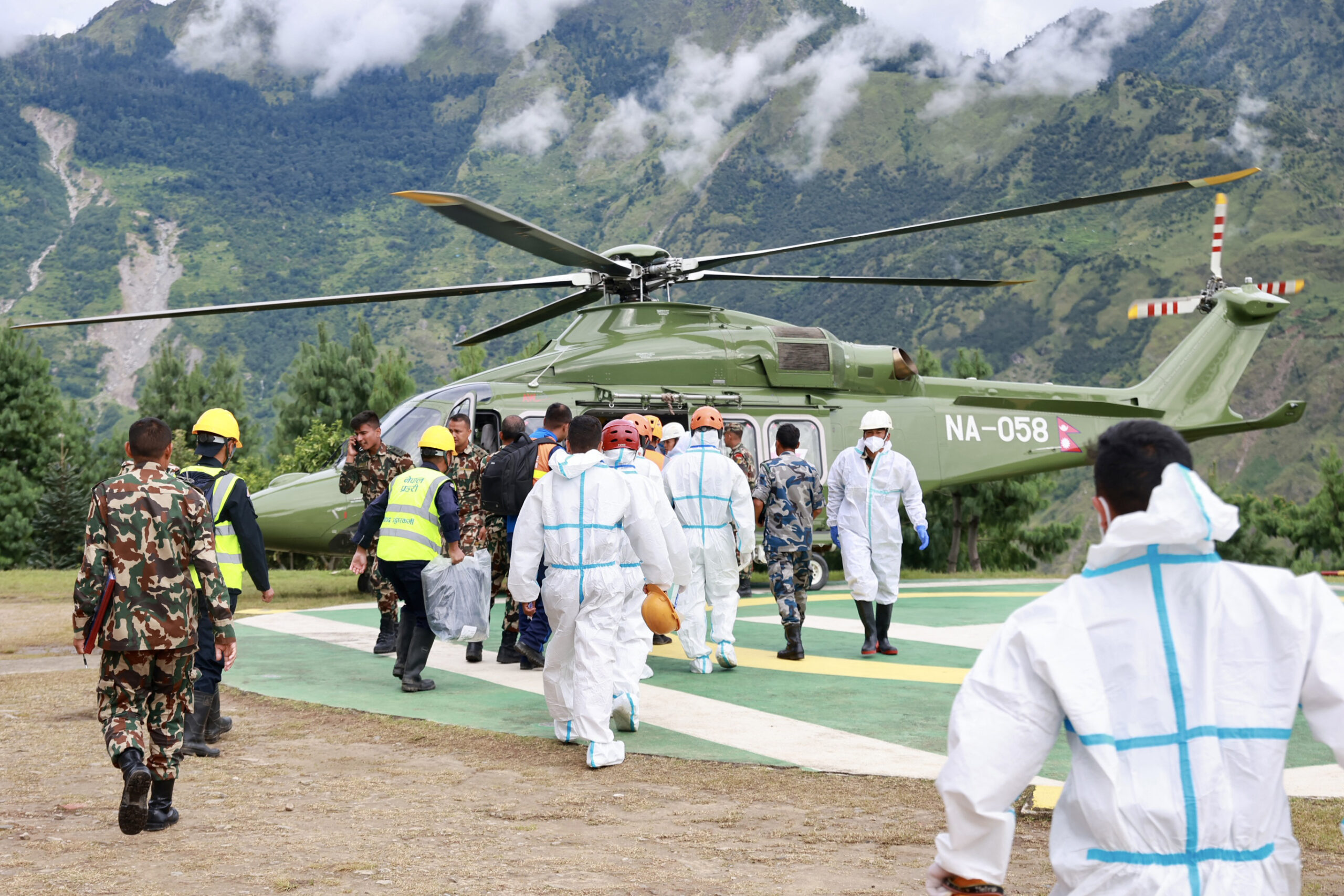
The devastating flood that erupted on the China-Nepal border has now been ongoing for over a week. Nepalese authorities stated on Wednesday (2nd) that the hope of finding survivors among the thousands of missing persons is gradually diminishing as the search and rescue efforts enter a critical phase.
According to data released by the Nepalese National Disaster Management Authority on the 2nd, this disaster has resulted in at least 1,114 deaths within Nepal, with approximately 3,916 people still missing. Officials fear that many of them may have been buried deep under the rubble left by the mudslides that swept through border towns and valleys, especially around hydroelectric tunnels and along river banks.
On the other side of the border in China’s Tibet, the official tally from the Chinese authorities has remained at 16 deaths and 546 missing persons since August 30.
Currently, the focus of Nepal’s rescue efforts is concentrated within the tunnels of several hydroelectric power stations. Raja Ram Basnet, spokesperson for the Nepalese military, noted that there is still space within the power plants and tunnels believed to potentially shelter survivors.
So far, 279 people have been rescued from the debris of the hydroelectric stations, but at least 639 people, mostly workers from the power plants, are still missing. Specialized rescue teams from countries like the United States and India have deployed high-tech monitoring equipment to aid in the search for possible survivors within the tunnels.
Ferrin Cole, a member of the American Crisis Response Team, told the Asia News International (ANI), “Our plan today is to fly by helicopter to the hydroelectric tunnels, where survivors may still be located. We are equipped with advanced monitoring devices to detect signs of life, followed by the safety team entering the scene for confirmation.”
Retired senior army general Binoj Basnet, who commanded the 2015 earthquake rescue operation, expressed, “Considering the nature of this disaster and the areas affected by the floods, as time passes, the chances of human survival are decreasing.”
Prime Minister Balendra Shah of Nepal stated that the focus is shifting towards post-disaster recovery and reconstruction while continuing search and rescue operations.
“The government is currently dedicated to post-disaster recovery efforts, striving to ensure the safety and well-being of the affected population, and providing necessary medical treatment and counseling,” Shah posted on social media late on the 1st.
Preliminary estimates by the United Nations Development Programme (UNDP) suggest that this disaster has left at least 2.2 million tons of debris, including building wreckage, rocks, and sediment, equivalent to the volume of six Empire State Buildings. This poses a significant challenge for community cleanup and road reconstruction.
UN spokesperson Stephane Dujarric expressed concerns about the escalating public health risks due to overcrowded shelters, contaminated water sources, and damaged medical facilities, especially during the rainy season, presenting heightened risks for women and children and potentially leading to infectious disease outbreaks.
Dujarric stated during a UN press briefing on the 1st that approximately 3,900 people are still missing, with nearly 3,500 individuals residing in temporary shelters. In severely affected areas such as Nuwakot and Rasuwa districts, authorities have established 27 relocation sites, many of which are set up within schools and public buildings.
The Nepalese government has implemented enhanced monitoring measures to prevent outbreaks in disaster-affected areas, including increased surveillance of drinking water and sanitation facilities.
Regarding the glacier collapse, Prime Minister Shah of Nepal and United Nations officials have emphasized that the global community must address the future risks of glacier flood disasters in the Himalayan region and incorporate such disasters into the climate change adaptation agenda.
Shah emphasized, “The causes of glacial collapses and the generation of such massive amounts of water must be addressed by the global community, thoroughly clarifying the climate and geological factors behind them.”