
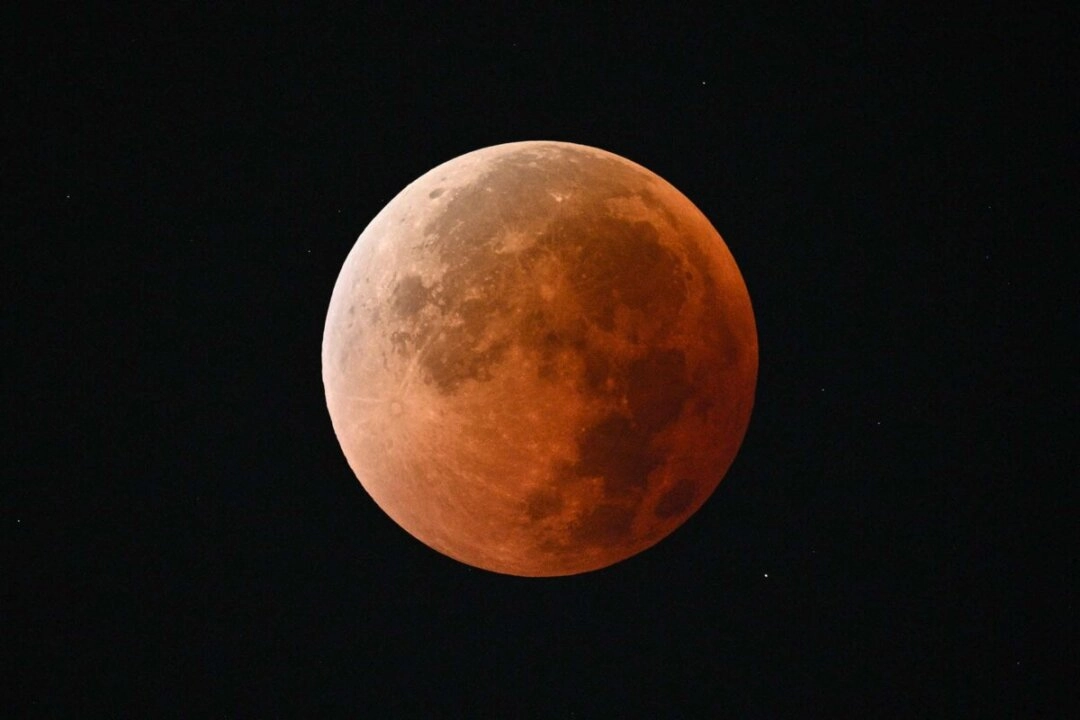
At the end of August, a total lunar eclipse will be visible across the United States. During this event, the full moon will pass through the Earth’s shadow, presenting a mysterious red hue.
Unlike the recent spectacular solar eclipse visible in Europe, this lunar eclipse does not require special glasses for viewing and can be safely observed with the naked eye.
A lunar eclipse occurs when the moon passes through the Earth’s shadow. Since this lunar eclipse falls on a full moon this month, it is called a “total lunar eclipse,” providing an excellent viewing angle to clearly see the shadow moving across the lunar surface.
The moon will not disappear from the sky during the eclipse; according to NASA, it will take on a “coppery rusty hue.” It is this distinctive color that has earned this August’s lunar eclipse the nickname “blood moon.”
According to NEXSTAR media reports, this astronomical phenomenon is expected to begin on the evening of August 27 (Thursday) and continue until August 28 (Friday).
The viewing range of this total lunar eclipse covers the entire North American region, with the most spectacular views expected in the eastern United States.
The Saint Louis Science Center stated that during the maximum eclipse, almost 96% of the moon’s surface will be covered by the Earth’s shadow.
The total lunar eclipse will begin at 9:38 p.m. Eastern Time on August 27 and end around 3:01 a.m. on August 28. However, the optimal viewing time is during the maximum eclipse, at around 12:12 a.m. on August 28 in Eastern Time.
In Hawaii and Alaska, where sunset times are later, it may be challenging to obtain the best view of the total lunar eclipse at its peak. Nevertheless, residents in these regions might catch the tail end of this rare astronomical event by looking up at the moon shortly after sunset.
Regardless of your location, weather conditions could potentially affect the ideal viewing experience, as cloud cover or smoke from wildfires may obstruct visibility.