
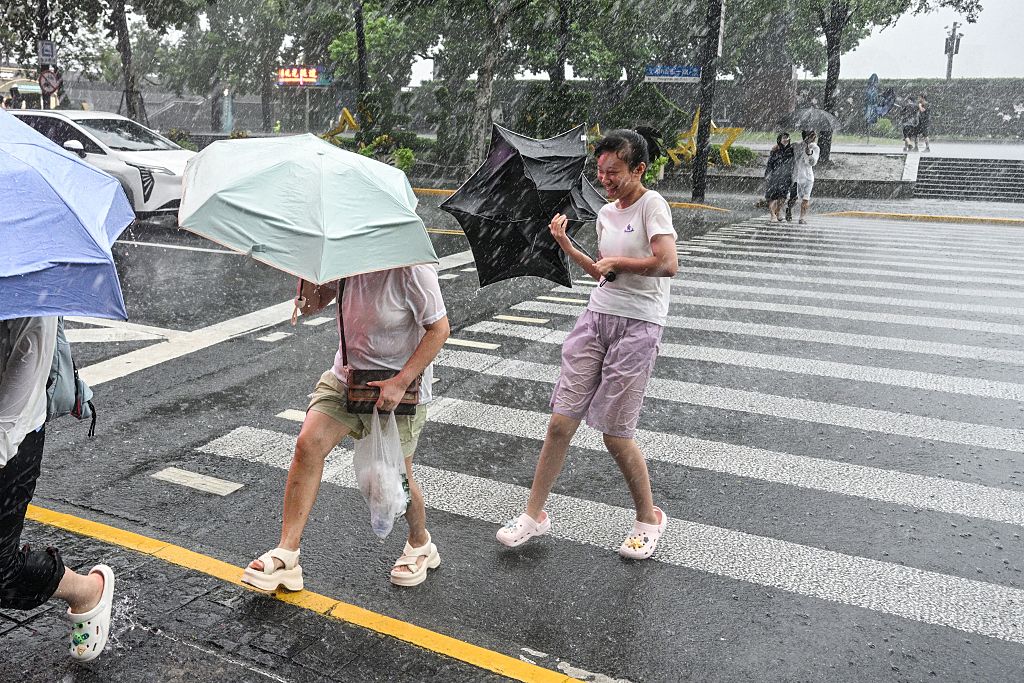
After Typhoon “Baihaidu” weakened, the residual circulation continued to carry a large amount of moisture northward, causing heavy rain in Beijing, Hebei, Tianjin, and Henan. In some areas of Beijing, the hourly rainfall exceeded 96 millimeters, with Tianjin experiencing heavy rain in multiple districts. In Henan, over 65,000 people have been evacuated while the rain is expected to persist in some areas until August 14th.
A white-collar worker living in Haidian District, Beijing, told Epoch Times that the rainfall started around 4 or 5 pm on August 11th and had not stopped by the time of the interview on the 12th, with fluctuating intensity.
He mentioned that although his neighborhood is situated on higher ground, the low-lying areas nearby were already flooded up to waist level on the evening of the 11th.
“You wouldn’t believe how heavy the rain was last night, it was misty like a steam room, something rarely seen before,” he said, noting that the downpour was accompanied by strong winds.
When he went to a nearby supermarket, he noticed that some food items were running low and planned to stock up on supplies for the next couple of days.
According to reports from mainland China, the Beijing flood control department stated on the evening of the 12th that the city had an average rainfall of 34 millimeters between the 11th and 12th, with Muchen in Miyun recording the highest rainfall of 206 millimeters and a maximum hourly rainfall of 96 millimeters, breaking local records in Changping.
During the heavy rainfall, about 250 bus routes in Beijing were suspended, 150 scenic spots closed, and 10 subway lines operated at reduced speed. As of 8 pm on the 12th, the orange rainstorm warning in Beijing had been lifted.
Typhoon “Baihaidu” made landfall in Zhejiang on the 9th, then moved further inland and weakened to a tropical low pressure system in Hubei on the 11th. The official meteorological agency, China Meteorological Administration, halted the release of positional and intensity information of the typhoon at 5 pm on the same day, a practice known as “number cessation,” although its residual circulation remained.
The residual circulation continued to transport warm and moist vapor northward, meeting with cold air masses. The topography of the Taihang and Yanshan Mountains forced the vapor to rise, leading to intensified local rainfall.
The Hebei meteorological department reported that as of 8 am on the 12th, Zhangjiakou, Chengde, Baoding, Xiongan, Langfang, Shijiazhuang, Xingtai, and Handan experienced heavy to severe rain. From 7 am on the 11th to 7 am on the 12th, the largest accumulated rainfall in Hebei occurred in Zhangbei Dayangpan, reaching 129.8 millimeters.
Data from the Tianjin meteorological department showed that during the daytime on the 12th, heavy to severe rain occurred in all districts except Jinghai and Wuqing, with individual locations in Jizhou experiencing severe rain. The highest accumulated rainfall in the city from 7 am on the 11th to 5 pm on the 12th was recorded in Shikuangchang, Yuyang Town, Jizhou District, at 106.2 millimeters, and the maximum hourly rainfall reached 75.7 millimeters.
From the 11th to the 12th, most areas between the Yellow River and Huai River in Henan Province experienced heavy to severe rain, with localized areas in Luoyang, Zhengzhou, Pingdingshan, Xuchang, Luohe, Zhoukou, and Nanyang facing extreme rainfall. On the 12th, Longting District in Kaifeng continued to be affected by strong winds and rain, leading to severe water accumulation on some roads.
As of 10 am on the 12th, the average rainfall in Henan over the past 24 hours was 112.8 millimeters, with 309 meteorological stations recording over 250 millimeters of rainfall, and Changcun in Yexian County receiving the highest rainfall of 435.7 millimeters.
According to the emergency system in Henan, as of the afternoon of the 12th, a total of 27,191 households and 65,593 individuals had been evacuated for safety reasons.
Dengfeng and Xinmi implemented class suspensions, business closures, production halts, transportation suspensions, while Pingdingshan imposed class suspensions, production halts, business closures, and work stoppages. Serious water accumulation was reported on several roads in Xuchang, where all bus routes ceased operations; Line 6 and Line 10 stations on the Zhengzhou metro were closed, and some highways and railway services were affected.
The heavy rainfall in Henan is expected to gradually diminish on the 13th, with parts of the northern, central, and southern regions still experiencing heavy to severe rain, and the situation is projected to improve by the 14th.