
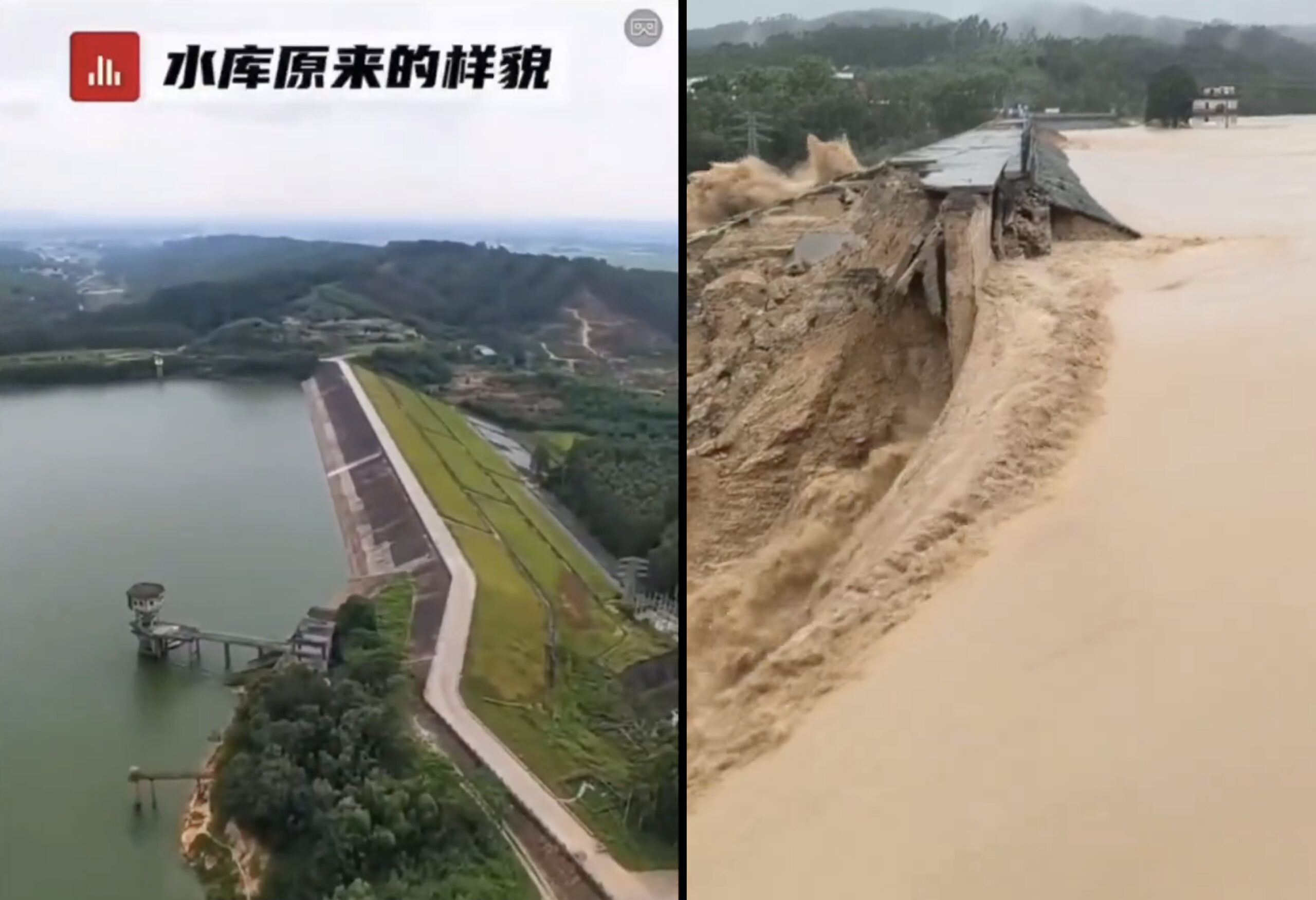
Recent Floods in Guangxi Reveal Issues with Reservoirs in China
The sudden release of water from reservoirs without prior warning has once again caused havoc in Guangxi due to flooding. From the collapse of dams in Banqiao to the collapse of the Liulan Reservoir, what are the underlying issues with China’s reservoirs? While it may seem like a technical, engineering, and profit-related problem on the surface, the core issues lie in the system and ideology, which cannot be resolved through legislation.
On July 6th, heavy rainfall in Nanning, Guangxi, led to the dam breach at the Liulan Reservoir. Prior to the breach, authorities fully opened the floodgates at 6 o’clock in the morning but only notified downstream residents to evacuate at 8 o’clock, two hours after the gates were opened.
Subsequently, the main dam collapsed, causing rapid flooding in several downstream villages, with water levels reaching as high as two stories in some areas, resulting in significant losses for local residents.
The situation in Nanning is not an isolated case. In recent years, whenever heavy rainfall triggers flooding, it is often accompanied by news of reservoirs releasing water without notification or advance warning, leading to significant loss of life and property.
In the 2024 flood in Lanxi Town, Shanghang County, Fujian, the upstream reservoir opened the floodgates without notifying downstream residents, resulting in the destruction of many houses and loss of lives. Similarly, in 2023, several reservoirs in the Haihe River Basin released water or utilized flood retention areas without proper warning, causing severe flooding in areas like Zhuozhou downstream, where many villagers were stranded.
The victims are not only in rural areas. In 2021, during the heavy rainfall in Zhengzhou, Henan, several reservoirs, including Changzhuang, released water without sufficient warning, exacerbating the flooding disaster in Zhengzhou and surrounding areas, leading to public skepticism about the transparency and warning mechanisms of reservoir management. The collapse of the Banqiao Reservoir in Henan in 1975 is considered one of the deadliest disasters caused by human technology, surpassing the Chernobyl leak.
China’s issue with flood release from reservoirs without warning has become a chronic problem. Is it a lack of attention from the authorities? Apparently not. Xi Jinping has emphasized the importance of water governance. In 2023, the Ministry of Water Resources published “In-depth Study and Implementation of Xi Jinping’s Important Discourse on Water Governance.”
However, it is possible that precisely because Xi Jinping attaches great importance to water management, the situation worsens. Just like in Chinese football, where Xi Jinping’s personal attention has not yielded satisfactory results and the team’s ranking continues to decline.
In areas personally guided by Xi Jinping, the situation tends to deteriorate as he lacks expertise but intervenes nonetheless, leaving those with the actual responsibilities or expertise powerless.
Of course, Xi Jinping is not the sole cause of China’s reservoir issues. Wang Weiluo pointed out that while China has relevant laws and regulations for flood diversion and flood control, there is a glaring absence of any legal framework for flood releases from reservoirs.
This cannot be dismissed as negligence; it appears intentional. The only plausible explanation is that the majority of large and medium-sized reservoirs are state-owned, and releasing water has consequences that authorities will be held accountable for. By enacting legislation, the focus would shift to holding central or local government officials accountable rather than the public, who have no decision-making power over flood releases and are often kept uninformed.
This originates from Mao Zedong’s approach of enacting laws that are broad rather than detailed, as any specifics would hold the party and government accountable instead of the public, who are the intended targets of the legislation.
While China has seemingly aligned with international standards post-reform and opening up, there are still intentionally overlooked areas lacking legislation, often concerning officials, such as the absence of legislation on disclosing party and government officials’ public and private assets, which has never been included in the legislative process, and even the proposal has been abandoned.
From the perspective of reservoir management or ownership, issuing notifications or warnings ahead of flood releases would make it difficult to deny responsibility afterward, as affected residents would demand compensation and hold the government accountable. However, if no warnings are issued, the authorities can simply deny releasing water with no consequences. There are no legal requirements stipulating how many hours in advance warnings must be given.
To date, no government or official has been prosecuted or convicted for failing to issue warnings before a reservoir release, nor have they faced disciplinary actions within the party for this oversight, and no concrete benefits for the party and government from issuing advance warnings and notifications for flood releases can be found.
Why do most reservoirs not release water in advance before heavy rainfall to make room for flood retention? Many reservoirs in China, including dams on rivers, claim to serve two main functions – power generation and flood retention.
In reality, these purposes contradict each other, forcing a choice between the two. To generate power, water levels must be kept high, while flood retention requires releasing water in advance to accommodate heavy rainfall.
Moreover, many reservoirs are leased for economic activities like fish farming, benefiting the owners, often local governments. Whether for power generation or development leases, there are economic interests involved.
However, planned flood releases have no economic or other benefits for authorities and related party officials. There is no reason for them to release water in advance to retain water in case of floods.
This problem extends beyond reservoir operations. There are at least two other issues that warrant discussion.
The first is the recurring occurrence of once-in-a-century floods at short intervals. In the Yangtze River basin, the phenomenon of “high water levels, moderate flow, and severe flooding” is widespread. During the catastrophic floods in the entire Yangtze River basin in 1998, the overall flow rate was lower than in 1954, yet the water levels reached historic highs. The reasons can be traced back to channel encroachment and land reclamation.
From the 1950s to the 1990s, reckless land reclamation activities took place in the middle and lower reaches of the Yangtze. The sizes of Dongting Lake and Poyang Lake, the two largest natural regulation reservoirs of the Yangtze River, shrank by more than one-third, with more than a hundred small lakes disappearing entirely.
After heavy rainfall in the upstream areas, the Yangtze River had nowhere to discharge water, leading to water congesting in the narrow main channel between the levees. As a result, water levels surged dramatically. In the lower reaches of the Yangtze River, due to urban expansion in the past few decades, many low-lying wetlands and riverbeds that traditionally served as flood discharge areas during the flood season have been filled up to construct high-rise buildings, asphalt roads, or industrial parks, preventing rainwater from permeating into the ground, causing a sudden influx into the river.
Additionally, the natural meandering bends of the river have been replaced by artificial cement embankments, eliminating the river’s capacity to store water. This leads to even a moderate rainfall event (far from historical extreme flow rates) causing water levels on both sides to skyrocket to historical alert levels within hours.
Those encroaching upon natural flood discharge areas include not only farmers and local governments but also Xi Jinping, who emphasizes “water governance.” The new Xiong’an area is situated in the Baiyangdian area, part of the Hai River basin. Due to its low-lying terrain, Baiyangdian serves as a planned flood retention area in the flood control system, historically responsible for regulating surrounding floods.
In 2023, heavy rainfall on the eastern foot of the Taihang Mountains caused a rapid increase in the water levels of rivers like the Juma River, threatening downstream areas. To ensure the safety of the millennium project Xiong’an, the Ministry of Water Resources chose to open flood diversion outlets or release water in advance in places like Zhuozhou upstream, resulting in severe flooding in these areas.
The second issue worth discussing is why the Chinese Communist Party (CCP) is keen on building reservoirs and dams. Among the nearly 100,000 registered reservoirs in China, the majority were built during the large-scale water conservancy construction period from the 1950s to the early 1980s. Before 1949, China had very few reservoirs, with only about twenty large and medium-sized reservoirs nationwide, mostly built during the Japanese invasion in the Northeast and other regions.
After the CCP came to power, a frenzy of reservoir construction began, and from 1949 to the end of the Cultural Revolution in 1976, over 80,000 reservoirs were newly constructed nationwide. Whether constructing reservoirs or building dams on rivers, these projects are essentially aimed at impeding water flow, whereas historically, China’s water management practices have prioritized water diversion.
The Dujiangyan Irrigation System is the world’s oldest and operates on the principle of “no-dam water diversion.” Besides water diversion, it serves multiple functions like flood control, sediment discharge, irrigation, and water transportation. For over two millennia, it has benefited the Chengdu Plain.
However, the CCP has taken the opposite approach due to its atheistic ideology of “man triumphs over nature,” lacking a sense of reverence for nature. Mao Zedong initiated the Sanmen Gorge Hydropower Station, Deng Xiaoping and Jiang Zemin constructed the Three Gorges Dam, and now under Xi Jinping, the largest hydropower station in the Qinghai-Tibet Plateau is being built. These projects aim for global supremacy, disregarding natural laws and scientific principles.
One of the reasons behind these projects is the lack of confidence in socialism, relying on centralized efforts to prove the superiority of the system. As the CCP changed party leaders several times since its founding, transitioning from “continuous revolution” to “white cat, black cat,” back to “self-revolution,” and economically shifting from “self-reliance” to “reform and opening up,” then reverting to “national progress and people’s retreat,” a constant thread has been the antagonistic revolutionary philosophy inherited from Marxism-Leninism, not just against people but also against nature.
Nature, however, retaliates in its own way.