
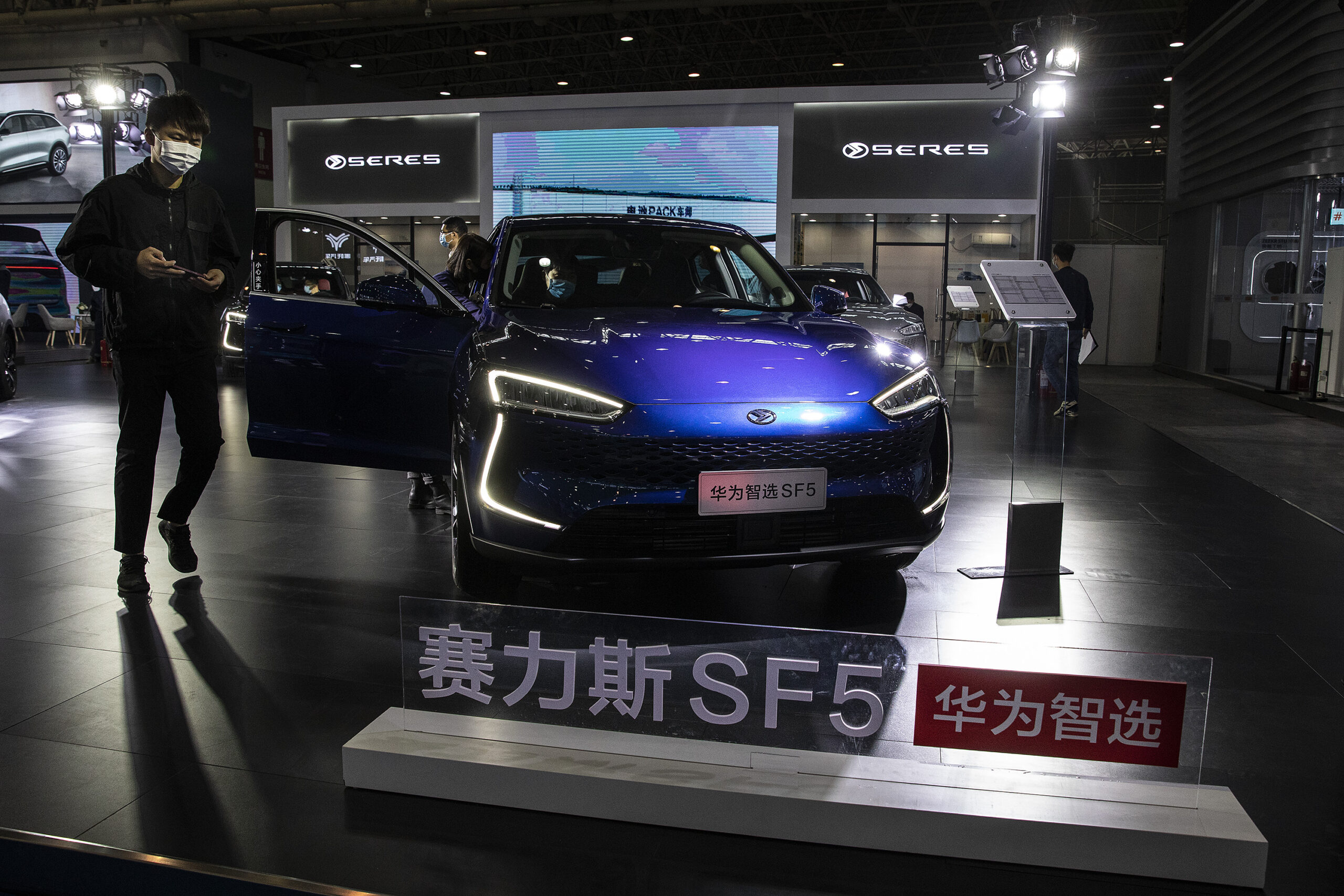
In the news reported on July 13, 2026 by Epoch Times, China’s Chongqing technology company, “Siles Group Co., Ltd.” (referred to as “Siles”), with new energy vehicles as its core business, has shifted from profit to loss. On July 12, Siles announced its performance forecast, expecting a net loss of 1.5 billion to 1.8 billion yuan (RMB) for the first half of this year, leading to a drop in Siles’ stock price.
In the A-share market on July 13, the entire automotive sector continued to weaken, with Siles hitting the limit down, reaching a low of 53.91 yuan, the lowest since February 2024. By the closing bell, the stock had fallen by 9.98% to 53.92 yuan. From October last year to now, Siles’ stock price has plummeted over 68%, with a market value remaining at around 93.9 billion yuan, breaking the trillion-yuan mark.
According to the announcement released on the evening of July 12, Siles expects a net loss of 1.5-1.8 billion yuan for the first half of 2026, compared to a net profit of 29.41 billion yuan in the same period last year. The non-GAAP net loss attributable to Siles shareholders is forecasted to be 2.2-2.5 billion yuan.
Siles further explained that due to factors such as the rise in prices of storage chips, industrial metals, and lithium carbonate, the performance of its core subsidiary, “Wenjie Motors,” fluctuated resulting in a loss, with an expected net loss of 1.9-2.15 billion yuan in the second quarter. Thus, the company anticipates a negative net profit attributable to shareholders in this period.
Compared to the same period last year, Siles’ financial report for the first half of 2025 showed a total profit of 37.25 billion yuan, with a net profit attributable to shareholders of 29.41 billion yuan and a non-GAAP net profit of 24.74 billion yuan, resulting in an earnings per share of 1.87 yuan.
The shift from profit to loss and the substantial losses incurred by Siles have garnered widespread market attention, leading to discussions trending on social media platforms like Weibo.
Finance blogger “Caibao’er” commented, “Wenjie Motors sells at such high prices, between four to five hundred thousand yuan, and yet Huawei fans are willing to spend so much money. It’s hard to imagine how Siles could shift from profit to loss: expecting a minimum loss of 1.5 billion yuan in the first half of the year, Wenjie’s projected loss exceeds 1 billion yuan, which is incredibly unbelievable. From 157 yuan to now only around 53 yuan per share, and today’s hitting the limit down, is it like getting cut at the waist, then thigh, and finally at the ankle?”
Digital blogger “Xiaolin” stated, “Previously, Yu Chengdong bluntly stated at an industry forum that all models priced under 300,000 yuan under the HarmonyOS Intelligent Driving from Wenjie and Zhijie were sold at a loss, like the M7 that focuses on sales volume, the low-end version of Zhijie R7, where for every unit sold, they had to subsidize by twenty to thirty thousand yuan. 300,000 yuan marks the breakeven for the brand, but at this stage, they are unable to produce priced around the 200,000 yuan level. Insisting on producing would only continue the losses. This statement aligns perfectly with the recently released Siles’ half-year loss announcement, instantly showcasing the root cause of the losses.”
“Many netizens only criticize car companies for ripping off customers, but looking at it from a different perspective, you can understand the core issue of the losses,” said financial blogger “Touyuwendao,” author of “Analysis of the Three Essential Elements of Huawei’s Rise and Fall.” He continued, “The standard configuration of Huawei’s high-end intelligent driving, multiple laser radar systems, and high computational chips in the electronic components are double or triple those of regular electric cars, combined with the sharp rise in lithium prices and chip costs this year, directly increasing the cost of car production by one or two thousand. Currently, the industry’s price war is intensifying, requiring discounts and benefits at the end, which directly erodes the profits of low-priced car models.
“The brand insists on not cutting hardware or reducing quality to compress costs, introducing models priced under 300,000 yuan just to expand the user base and gather intelligent driving road data. They rely on the nearly 400,000 yuan average-price high-end model M9 to make profits, filling the loss gap of low-end cars. However, with skyrocketing upstream raw material costs and asset devaluation this year, the profits from high-end models can’t support the losses of low-priced cars, leading directly to Siles’ projected loss of 15-18 billion in the first half of the year and the stock price limit down.”
Public records indicate that Siles is the first collaborative car company under Huawei’s Intelligent Selection Car model. Under this model, Huawei is involved in various aspects of the automobile industry, including product design, experience, marketing, channels, and retail.
In recent years, new energy vehicles have become one of the industries that the Chinese Communist Party is trying to use to drive economic growth. However, most new energy vehicle companies are operating under massive debts and intense competition, falling into a cycle where the more they sell, the more they lose.