
As summer comes to a close, the night skies of August are set to dazzle the residents of New York City with a celestial spectacle. Astrophysicists from the American Museum of Natural History (AMNH) have stated that August is the best month of the entire summer for stargazing.
The skies this month will be exceptionally lively, with the highly anticipated Perseids meteor shower set to offer exceptional viewing opportunities, along with a partial solar eclipse and a penumbral lunar eclipse happening within two weeks.
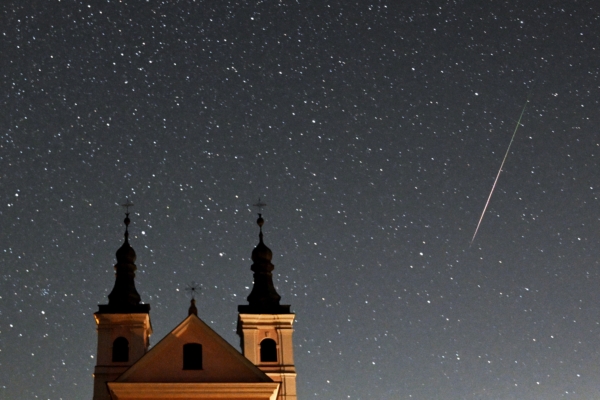
As the highlight of the August astronomical season, the Perseids meteor shower is expected to peak on the nights of August 12th to 13th.
Experts from the American Astronomical Society (AAS) have mentioned that this year’s meteor shower peak coincides with a new moon (minimal moonlight interference), making the sky exceptionally dark and providing a rare perfect viewing opportunity.
In suburban areas away from city light pollution such as the Catskill Mountains or the Adirondacks in upstate New York, observers can expect to see up to 100 shooting stars streaking across the night sky per hour. Even within New York City, people visiting locations like Floyd Bennett Field in Brooklyn or various beaches have a chance to spot nearly 50 meteors per hour with the naked eye.
The Perseids meteors travel at speeds of up to 133,000 miles per hour, appearing yellow-white or even tinged with a hint of green luminescence, often producing extremely bright fireballs.
The Amateur Astronomers Association of New York (AAA) will be hosting a free stargazing event at Brooklyn Bridge Park on the night of August 12th. Additionally, rooftops, waterfront parks, and golf courses in communities with unobstructed views are excellent spots for stargazing. Experts emphasize that this rare new moon Perseids meteor shower is not to be missed this year.
On the same day as the meteor shower peak, August 12th, the New York area will experience a partial solar eclipse with approximately 10% coverage. The peak of the eclipse will occur just before 2 pm. New Yorkers only need to wear solar viewing glasses to witness the moon taking a small “bite” out of the sun’s edge. For those seeking to experience a total solar eclipse, traveling to locations like Iceland, Spain, Portugal, or Greenland is necessary.
Two weeks later, in the late night of August 27th, the residents of New York City will witness one of the most ceremonial astronomical events of the month, a spectacular lunar eclipse with a staggering 96% coverage, almost approaching a total eclipse.
The lunar eclipse is set to begin at 10:33 pm that night and reach its maximum around midnight (entering the 28th). At that time, the moon will almost entirely enter the Earth’s shadow, displaying a eerie deep red “blood moon.” The entire eclipse is expected to conclude before 2 am.
Watching the blood moon requires no special glasses; simply gaze up at the sky with the naked eye. The only variable is the weather, so residents are advised to monitor the weather forecast in advance.